Electronic overheating slashes device lifespan by 40% (IEEE, 2024). At YICHOU, we engineer heat sinks, vapor chambers, and advanced heat spreaders to conquer thermal chaos. As a leading global heat spreader manufacturer, we serve industries from 6G telecom to aerospace with ISO-certified solutions. Discover how to choose the right thermal management.
.jpg)
Section 1: What Are Heat Sinks? Materials & Applications
Heat sinks transfer heat from electronic components via conduction and convection. Key materials include:
-
Aluminum
Lightweight and cost-effective (150-200 W/mK thermal conductivity).
Ideal for consumer electronics and LED lighting. -
Copper
Superior thermal conductivity (~400 W/mK).
Preferred for high-power CPUs, GPUs, and industrial equipment. -
Graphene Composites
Emerging solution for high-frequency applications like DDR5 RAM modules.
Offers directional thermal enhancement.
Advantages of Heat Sinks:
-
Optimal for cost-sensitive, air-cooled systems.
-
Support complex geometries (e.g., skived fins for servers).
-
Scalable for mass production.
Limitations:
-
Less effective at spreading concentrated hotspots compared to vapor chambers.
Why Aluminum Dominates Heat Sinks?
60%+ heat sinks use aluminum alloys (e.g., 6063-T5) due to:
-
Cost Efficiency: $3.5/kg vs. copper's $8.2/kg (LME 2024)
-
Processability: Extrusion speeds >30m/min, 5x faster than copper
Copper's Niche: Reserved for >300W/cm² scenarios like GPU VRMs
YICHOU Case Insight:
Our CNC-machined copper heat sinks reduce CPU temperatures by 15°C in AMD Ryzen systems.
.jpg)
Section 2: Vapor Chambers: The Thin-Profile Super Spreaders
Vapor chambers (phase-change heat spreaders) enable heat transfer rates 5-10x faster than solid copper through evaporation-condensation cycles. Key characteristics:
Core Materials
-
Hermetically sealed copper enclosures
-
Deionized water or advanced nanofluids as working media
-
Optional nickel plating for corrosion resistance
Critical Applications
-
6G mmWave Antennas: 0.3mm ultra-thin units eliminate signal distortion from thermal drift
-
High-Power Processors: Uniform heat distribution for CPUs/GPUs (>300W TDP)
-
Compact Electronics: Smartphones, VR headsets, and UAV avionics
Advantages Over Heat Pipes
| Feature | Vapor Chamber | Heat Pipe |
|---|---|---|
| Heat Spreading | Full planar isothermal surface | Linear "hot zone" paths |
| Thickness | As low as 0.3mm | Minimum 3mm diameter |
| Hotspot Handling | Manages multiple hotspots simultaneously | Single heat path focus |
YICHOU Technical Achievement
Our vapor chambers increased power density by 30% in 5G massive MIMO antenna systems while reducing thermal resistance by 45%.
.jpg)
Section 3: Heat Spreader Materials Decoded
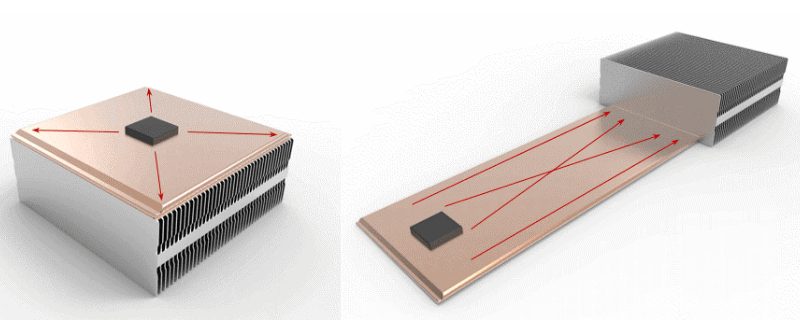
Heat spreaders serve as flat thermal interfaces that efficiently diffuse heat from concentrated sources. Material selection is critical for compatibility with target substrates:
Material Types & Applications
| Application | Core Materials | Technical Specifications |
|---|---|---|
| CPU IHS | Electroplated nickel-copper | CTE: 17 ppm/K; Thickness: 0.5-2mm |
| Aerospace RF | Diamond-copper composite | Conductivity: 600-1000 W/mK; Max Temp: 400°C |
| Mobile Electronics | Graphene-polymer laminate | Thickness: 0.1mm; Directional conductivity >500 W/mK |
Design Guidelines
-
Hotspot Diffusion: Use spreaders for GPU dies, laser diodes, and 5G PA modules
-
Bulk Cooling: Pair with heat sinks for system-level thermal management
-
Material Matching: Select CTE (Coefficient of Thermal Expansion) to minimize substrate stress
*Example: Diamond-copper (CTE 6 ppm/K) for GaN chips (CTE 5.6 ppm/K)*
YICHOU Capability:
We supply copper IHS units for AMD Ryzen 7000 series with 0.02mm flatness tolerance.
Section 4: YICHOU’s Manufacturing Edge
Overcoming Material Limitations
We address industry challenges like graphene scalability through advanced material engineering:
-
Diamond-Copper Composites
-
Thermal conductivity: 800-1000 W/mK (validated per ASTM E1461)
-
CTE matching: 5.5-6.5 ppm/K for GaAs/GaN semiconductors
-
Applications: Laser diodes >500W, 6G RF power amplifiers
-
Integrated Production Workflow
| Stage | Technology | Output Validation |
|---|---|---|
| Prototype Design | 3D topology optimization | Thermal simulation ±3% error |
| CFD Simulation | Ansys Icepak & Fluent | Hotspot mapping <0.1mm resolution |
| Mass Production | Vacuum brazing + CNC machining | Dimensional tolerance ±0.05mm |
Military-Grade Quality Assurance
-
100% thermal resistance testing (MIL-STD-883 Method 1012.1)
-
Environmental stress screening:
-
Thermal cycling: -55°C to 125°C (500 cycles)
-
Salt spray corrosion: ASTM B117, 720hrs
-
-
Reliability metrics: MTBF >500,000 hours (Telcordia SR-332)
6G-Ready Solutions: Our corrosion-resistant vapor chambers pass 20-year lifespan validation in coastal 5G/6G base stations.
Copper vs. Aluminum Manufacturing
| Process | Aluminum Heat Sinks | Copper Heat Sinks |
|---|---|---|
| Forming | Extrusion (95% cases) | CNC machining/forging |
| Joining | Epoxy bonding | Vacuum brazing at 600°C+ |
| Surface Finish | Anodizing (20-25μm) | Electroless Ni plating |
| Yield Rate | 98% | 85% (material loss higher) |
*
Frequently Asked Questions (FAQ)
Q1: What are CPU heat spreaders made of?
-
Standard: Oxygen-free copper (C10200) with electroless nickel plating (5-10μm)
-
AMD Ryzen: Direct-bonded copper cores
-
Thermal Conductivity: 398 W/mK (copper) vs. 90 W/mK (nickel plating)
Q2: Copper vs. aluminum heat sinks – which is better?
| Parameter | Aluminum | Copper |
|---|---|---|
| Conductivity | 150-220 W/mK | 380-400 W/mK |
| Cost | $3.5/kg | $8.2/kg |
| Best For | TDP <150W, cost-sensitive | TDP >200W, hotspots |
| Hybrid Solution: Copper base + aluminum fins for balanced performance |
Q3: Are graphene heat spreaders commercially viable?
-
Pros: In-plane conductivity up to 5,300 W/mK
-
Cons:
-
Cross-plane conductivity <50 W/mK
-
Production cost: ~$100/cm²
-
Limited to niche applications (e.g., foldable phones)
-
-
Current Adoption: <3% in consumer electronics
Q4: Is thermal paste necessary with heat spreaders?
Critical for:
-
Filling surface micro-gaps (↓70% thermal resistance)
-
Preventing air pockets (air conductivity: 0.024 W/mK)
-
YICHOU Recommendation:
-
Metal-based paste for >100W/cm²
-
Application thickness: 0.1±0.02mm (X-dot pattern)
-
Q5: Can I make a DIY heat sink?
Possible but not recommended for:
-
Power >10W (risk of thermal runaway)
-
Critical systems (no UL/CE certification)
-
Failure Points:
-
Fin bonding strength <20psi (vs. industrial >80psi)
-
Flatness deviation >0.3mm (causes 40% performance loss)
-
Q6: What is an "ultimate heat sink"?
Defined by nuclear/aerospace standards:
-
Materials: Sintered diamond-copper (1,200-1,500 W/mK)
-
Structure: Microchannel + phase-change cooling
-
Performance: Sustains >1,000W/cm² flux (e.g., fusion reactors)
Q7: Typical heat sink lifespan?
| Environment | Aluminum Sinks | Copper Sinks |
|---|---|---|
| Mild (40°C) | 10 years | 15+ years |
| Harsh | 5 years* | 10 years* |
| *With corrosion-resistant coating |
Q8: Do heat sinks require grounding?
Only when:
-
Operating voltage >1,200V (e.g., IGBT modules)
-
In RF systems (prevent EMI interference)
-
YICHOU Solution: Anodized aluminum (>100MΩ insulation)
Technical Notes:
-
CPU delidding voids warranties but may reduce temps by 10-15°C
-
Diamond-copper spreaders require 800°C diffusion bonding
-
Salt spray testing (ASTM B117) mandatory for outdoor 5G/6G sinks
Conclusion: Partner with Precision Thermal Solution Experts
In high-stakes thermal management, material science and precision engineering define success. As demonstrated:
-
Heat Spreaders (vapor chambers/diamond-copper) conquer localized hotspots in 6G/mmWave systems
-
Optimized Heat Sinks balance cost/performance from 10W to 10,000W scenarios
-
YICHOU’s MIL-STD-883 certified manufacturing ensures >500,000h MTBF in critical applications
Your Next Step:
Get Quote
- Visit our website: https://www.nbyichou.com/
- Email us: [email protected]
- Call us/whatsapp: +86 13355741031
- Chat with us: Live chat support available on our website