Target Keywords:
Primary: explosion bonding, explosive welding, clad metal supplier, dissimilar metal joining
Secondary: solid state welding, explosion welding process, collision angle, YICHOU explosion bonding, China explosive welding processor
I. Introduction: The Power of Permanent Bonds
Hook:
"When fusion welding fails, explosion bonding creates unbreakable, metallurgical bonds between ‘unweldable’ metals like aluminum to steel or titanium to copper – without melting a single atom."
Defining the Process:
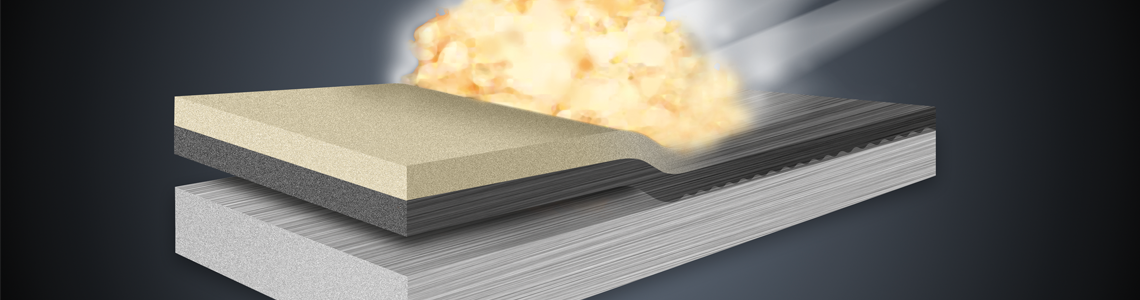
Explosion bonding (also called explosive welding or explosion welding) is a cold, solid-state welding process. It uses precisely controlled detonations to accelerate one metal plate (the "flyer") into another (the "base") at extreme velocities. The impact generates intense pressure and plastic deformation, forging a permanent atomic-level bond without liquefying the metals. This preserves each material’s original strength, corrosion resistance, and thermal properties – a feat impossible with traditional fusion welding.
YICHOU’s Authority:
"As China’s premier explosion bonding supplier and processor, YICHOU engineers mission-critical bonds for global sectors where failure isn’t an option. We transform metallurgical impossibilities into high-integrity solutions for aerospace, energy, and heavy industry."
Core Value Proposition:
-
Solve the "Unweldable": Join incompatible metals (e.g., Cu/SS, Ti/Al) with zero brittle intermetallics.
-
Eliminate HAZ: No heat-affected zone = no weakened corrosion boundaries.
-
Scale Beyond Limits: Bond massive plates (>20m²) in a single operation.
II. How Explosion Bonding Works: The Kinetic Alchemy of Perfect Metal Bonds
"Forget molten pools and electric arcs. Explosion bonding relies on pure physics – harnessing controlled chaos to forge atomic-level bonds no heat can achieve."
The 3-Step Science of Explosion Bonding:
-
Controlled Detonation Ignites the Bond:
A precision-laid explosive charge detonates across the "flyer plate" (the metal to be bonded). The resulting shockwave accelerates the flyer plate to hypersonic speeds (1,500–5,000 m/s) toward the stationary "base plate".
Keyword Focus: explosion bonding process, flyer plate, base plate. -
Metal Jets & Surface Cleansing:
At the moment of impact, trapped gases and surface impurities are ejected as a high-velocity "metal jet". This self-cleaning action exposes atomically pure metal surfaces – the critical prerequisite for bonding.
Keyword Focus: metallurgical bond, surface cleaning. -
Wave Formation: The Signature of Success:
When collision occurs at the optimal angle (5°–25°), extreme plastic deformation creates a distinctive wavy interface (see diagram below). This microscopic "fingerprint" confirms a true metallurgical bond formed via solid-state welding – no melting, no dilution.
Keyword Focus: wave formation, collision angle, metallurgical bond, solid state welding.
Why Heat is the Enemy (and Explosion Bonding Avoids It):
*"Traditional welding melts metal, creating a Heat-Affected Zone (HAZ) – a weakened transition area prone to corrosion, cracking, and fatigue. Explosion bonding’s cold process eliminates HAZ entirely. By preserving each metal’s original microstructure, it delivers:
-
Zero loss of corrosion resistance (critical for chemical environments)
-
Full retention of tensile strength (vital for structural integrity)
-
No brittle intermetallic phases (the downfall of dissimilar fusion welds).
III. Key Advantages of Explosion Bonding: Where the Impossible Becomes Routine
1. Joins the "Unweldable":
Forge permanent bonds between metallurgical opposites – titanium to steel, copper to aluminum, or tantalum to stainless steel. Explosion bonding sidesteps brittle intermetallic phases that doom fusion welding, enabling revolutionary material combinations.
2. Zero Heat-Affected Zone (HAZ):
No melting = no weakened transition zones. Preserve 100% of the base metals’ corrosion resistance, fatigue strength, and microstructural integrity – critical for chemical reactors, sour gas pipelines, and seawater applications.
3. Bond Strength Exceeds Parent Metal:
The wavy interface created at optimal collision angles produces bonds stronger than the weaker base material. Ideal for high-pressure vessels, hydraulic accumulators, and critical aerospace components where failure is unthinkable.
4. Large-Scale Efficiency:
Bond massive clad plates (20m²+) or complex cylinders in a single operation – a feat unmatched by laser or TIG welding. Slash production timelines for heat exchangers, reactor shells, and transition joints.
"While traditional welding struggles with incompatibility, explosion bonding turns material contradictions into performance advantages."
.jpg)
V. Industrial Applications: Where Explosion Bonding Excels
Oil & Gas:
YICHOU’s explosion-bonded clad pipes and valves withstand H₂S-rich "sour" environments and abrasive slurries, eliminating corrosion failures in subsea pipelines and refinery systems.
Chemical Processing:
Reactors and heat exchangers clad with tantalum, titanium, or Hastellay® via explosion bonding resist boiling HCl, H₂SO₄, and other aggressive media – extending equipment lifespan by decades.
Power Generation:
Copper-stainless transition joints handle extreme thermal cycling in turbines, while explosion-bonded boiler components resist high-pressure steam erosion.
Aerospace & Marine:
Lightweight titanium-aluminum armor panels for defense and corrosion-free propeller shafts for ships leverage explosion bonding’s strength without weight penalties.
VI. YICHOU’s Explosion Bonding Capabilities: Precision, Scale, Mastery
Precision Engineering:
Our physicists optimize collision angles (5°–25°) using CFD simulations, ensuring perfect wave formation and bond integrity across all material pairs.
Unmatched Scale & Quality:
Bond clad plates up to 30m² in a single detonation, backed by 100% NDE inspection (UT, RT, shear testing) to ASME BPV Code standards.
Material Mastery:
We solve "unsolvable" combinations:
-
Tantalum-to-carbon steel reactors
-
Zirconium-copper heat sinks
-
Aluminum-magnesium aerospace alloys
End-to-End Partnership:
From CAD design to global delivery, YICHOU handles full processing: material sourcing → precision explosion bonding → machining → certification.
"Where others see limits, YICHOU delivers bonded solutions – trusted by OEMs from Norway to Singapore."
V. Industrial Applications: Where Explosion Bonding Excels
Oil & Gas
Explosion-bonded clad pipes, valves, and fittings deliver unmatched corrosion resistance in H₂S-rich sour wells and subsea pipelines, slashing maintenance costs and downtime.
Chemical Processing
Reactor vessels and heat exchangers clad with titanium, tantalum, or nickel alloys withstand boiling HCl, H₂SO₄, and other aggressive media – extending service life by 10–15 years.
Power Generation
Copper-stainless steel transition joints handle extreme thermal cycling in turbines, while explosion-bonded boiler tubes resist high-pressure erosion.
Aerospace & Marine
Lightweight titanium-aluminum armor systems for defense and corrosion-free propeller shafts for ships leverage explosion bonding’s strength-to-weight supremacy.
VI. YICHOU’s Explosion Bonding Capabilities: Precision at Scale
Precision Engineering
Our CFD-optimized collision angles (5°–25°) guarantee perfect wave formation – the hallmark of unbreakable bonds.
Mega-Scale Production
Bond clad plates up to 30m² in a single operation, validated by 100% NDE inspection (UT/RT per ASME Sec. IX).
Material Alchemists
We conquer "impossible" pairs:
-
Tantalum-clad carbon steel reactors
-
Zirconium-copper nuclear components
-
Aluminum-scandium aerospace alloys
Global Turnkey Service
From design to delivery: Material sourcing → Explosion bonding → CNC machining → ISO 3834 certification → Worldwide shipping.
VII. FAQ: Top Explosion Bonding Queries Answered
Q: Is explosion bonding solid state?
A: Absolutely. Bonds form via plastic deformation – zero melting, zero HAZ.
Q: What’s the biggest hazard?
A: Explosive handling. YICHOU’s ISO-certified bunkers and automated detonation systems eliminate risk.
Q: Critical angle for explosion bonding?
A: 5°–25° – optimized in our lab for your specific metal pair.
Q: How does it differ from thermite welding?
A: Thermite melts metals; explosion bonding cold-fuses them without dilution or brittleness.
VIII. Conclusion: Your Explosion Bonding Authority
"For decades, YICHOU has delivered mission-critical bonds where others fail: Unmatched scale. Relentless quality. Metallurgical mastery."
Get in Touch with Yichou
Let Yichou help you achieve excellence in your next project. Whether you need raw materials, custom alloy solutions, or precision-manufactured components, our team is ready to assist.
- Email us: [email protected]
- Call us/whatsapp: +86 13355741031
- Chat with us: Live chat support available on our website