If you are sourcing MMO coated titanium anodes for chlor alkali production cathodic protection electroplating or wastewater treatment you already know one thing. The purchase price on the invoice tells you almost nothing about the real cost of ownership. The numbers that actually matter show up months or years later in your maintenance logs and energy bills. A titanium anode that fails 18 months early costs far more in downtime and replacement labor than any upfront savings it offered. Worse if you are managing a large scale operation you might not even know you are losing money until your kWh per ton metric starts drifting upward.
This article cuts through supplier marketing and gets to what engineers and procurement managers actually need to know before placing an order. We cover coating formulation accelerated life testing substrate preparation and the supply chain questions that separate manufacturers with real quality systems from those who just paint metal black and call it an electrode.
Before diving into the details here is the context that matters. The global MMO coated titanium anode market was valued at approximately 1.9 billion RMB in 2024 and is projected to reach nearly 2.68 billion RMB by 2031 with a compound annual growth rate of 4.9 percent to 5.2 percent depending on the research source. This is not a niche product category. It is the backbone of modern electrochemical processing and the growth is being driven by hydrogen electrolysis semiconductor manufacturing and increasingly stringent environmental discharge regulations. The same forces are also attracting suppliers who lack the metallurgical and electrochemical expertise to deliver consistent performance across production lots.
Your procurement decision matters more now than it did five years ago because the application landscape is more demanding and the cost of failure is higher. Let us walk through the evaluation framework that will protect your operations and your budget.
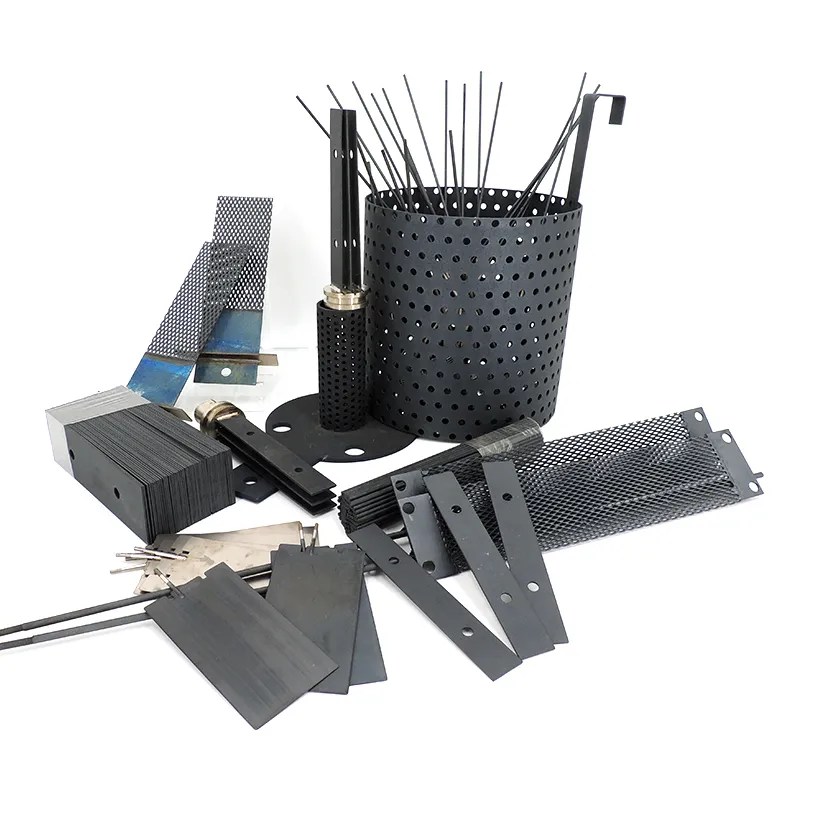
What Are the Five Biggest Pain Points Engineers Face When Sourcing MMO Coated Titanium Anodes
Before we can talk about solutions we need to define the problems precisely. The following five pain points represent what procurement managers and electrochemical engineers actually lie awake worrying about. They are not hypothetical. They are the direct result of sourcing from the wrong supply chain partners.
Pain Point One Premature Coating Deactivation
Direct Answer MMO coating failure typically occurs due to passivation of the titanium substrate oxide layer or depletion of the ruthenium iridium catalyst. The primary cause is insufficient coating thickness or uneven application leading to localized high current density and accelerated wear.
Engineers routinely encounter anodes that pass visual inspection but lose 20 to 30 percent of their electrochemical activity within the first year. This is particularly damaging in chlor alkali membrane cells where voltage drift forces plant operators to increase rectifier output. The resulting energy waste directly erodes gross margin. A key indicator of this problem is a change in the overpotential for chlorine evolution. If your operation requires higher voltage to maintain the same output tonnage compared to the baseline installation date your coating is degrading faster than expected. This is almost always traced back to low precious metal loading or improper thermal decomposition cycles during manufacturing.
At YICHOU the coating formulation and application process are treated as core intellectual property rather than an afterthought. We control the molar ratio of Ruthenium to Iridium to Tantalum based on the specific electrolyte chemistry. For high intensity chlor alkali service the coating is applied in multiple thin layers with intermediate thermal oxidation steps at precisely controlled ramp rates. This prevents the formation of mud cracking morphology that exposes bare titanium to electrolyte penetration. Every production batch undergoes X ray fluorescence XRF verification to confirm that the areal density of precious metal oxide measured in grams per square meter meets the specified target not just a nominal visual pass.
Pain Point Two Inconsistent Substrate Passivation
Direct Answer Passivation occurs when a non conductive TiO2 layer forms between the titanium substrate and the MMO catalytic coating. This barrier increases electrical resistance and diminishes current distribution efficiency.
The problem often hides in plain sight during the acid etching and sandblasting stage of Grade 1 or Grade 2 titanium plate processing. If the surface roughness Ra is not controlled within a specific micron range or if organic contaminants remain from cutting fluid the adhesion of the Ruthenium Iridium oxide layer is compromised. Once the electrolyte penetrates the microscopic cracks inherent in the ceramic coating the titanium reacts with oxygen to form a barrier layer. This is particularly prevalent in applications with reverse current conditions or electrolyte impurities like high fluoride concentrations.
YICHOU performs a three stage substrate preparation protocol on every plate before coating. The process begins with high pressure aluminum oxide grit blasting to achieve a surface profile of Ra 3 to 5 micrometers. This is followed by a thermal stress relief anneal to eliminate hydrogen introduced during the rolling process. The final step is a 10 percent oxalic acid etch at 90 degrees Celsius for a minimum of 60 minutes. This creates a hydrous titanium oxide surface with high surface area and strong chemical bonding sites. We do not shortcut the etch time because we know that residual surface carbon from lubricants leads directly to coating delamination in the first 500 hours of service.
Pain Point Three Inadequate Edge Effect Mitigation
Direct Answer The edge effect refers to the concentration of electrical field lines at the sharp boundaries of a flat plate anode. This causes accelerated coating erosion at the periphery and non uniform metal deposition or gas evolution.
In electrowinning or electroplating baths a poorly designed anode will show visible wear along the edges within six months while the center of the plate looks pristine. This is not a material defect it is a geometric design and coating distribution defect. Manufacturers without advanced robotics in the coating process often apply a uniform thickness to the entire plate ignoring that the edge current density can be two to three times higher than the bulk surface.
Our solution at YICHOU involves CNC edge rounding with a radius specified by the application typically between R1 and R3 millimeters. After machining the edges receive a double coating pass with the robotic spray system. This deposits approximately 30 percent more precious metal oxide by weight at the high stress perimeter compared to the flat central field. For critical applications in printed circuit board copper plating we also offer edge strip masking where a narrow band of the anode is intentionally left uncoated to force the current distribution profile away from the very edge. This technique extends the useful life of the anode by 12 to 18 months in high current density acidic copper baths.
Pain Point Four Overlooked Titanium Grade Requirements
Direct Answer The distinction between ASTM B265 Grade 1 and Grade 2 titanium significantly influences anode longevity in high chloride and high temperature environments. Grade 1 offers superior corrosion resistance but Grade 2 provides higher mechanical strength.
This is a critical procurement pitfall. A purchasing agent may spec a 1.0mm thick anode to save material cost. A Grade 2 sheet at 1.0mm may work fine for cathodic protection. But if that same anode is used in acidic copper foil production at 60 degrees Celsius the mechanical creep strength of Grade 1 might be necessary to prevent warping. More importantly the hydrogen embrittlement threshold differs. In applications where the anode is inadvertently polarized cathodically during shutdowns Grade 1 titanium has a higher tolerance for absorbed hydrogen before brittle fracture occurs.
YICHOU maintains inventory segregation and full mill test certification MTC traceability to ensure the correct chemistry is used. For Grade 2 we verify that iron content is less than 0.20 percent and oxygen is controlled to maintain formability. For Grade 1 the maximum iron content is 0.20 percent but the interstitial oxygen and nitrogen are held lower giving the material its superior ductility and corrosion resistance in hot chloride environments. We can provide Eddy Current testing reports for seam welded tubular anodes upon request demonstrating that the weld zone is free of detrimental alpha case contamination.
Pain Point Five The Opacity of Accelerated Life Testing Data
Direct Answer ALT Accelerated Life Testing simulates years of service in days by applying extreme current density in a standardized electrolyte. The time to voltage spike is directly proportional to expected service life.
Every supplier claims their anode lasts five years or ten years. Few are willing to share the raw voltage time curve from their accelerated life test cell. A standard test might run an anode sample at 20 kA per square meter in 1.0 molar sulfuric acid or 150 grams per liter sodium sulfate solution. The test ends when the cell voltage increases by 5 volts from the initial steady state value. The total elapsed time in hours is the accelerated life metric.
At YICHOU we provide ALT data sheets with every qualification lot. For a standard Ruthenium Iridium coating designed for chlor alkali applications we typically achieve greater than 300 hours under accelerated conditions which translates to an expected service life of over 8 years in a properly maintained membrane cell operating at 4 to 5 kA per square meter. For Iridium Tantalum coatings intended for oxygen evolution in acidic sulfate electrolytes such as copper foil surface treatment the ALT performance benchmark is greater than 200 hours in 150 grams per liter sulfuric acid at 10 kA per square meter. We do not hide behind vague claims. The data is generated on a fully calibrated potentiostat with temperature controlled jacketed cells and the raw CSV files can be audited by our customers.
How Does YICHOU Control Coating Quality to Ensure Uniform Current Distribution
Direct Answer Uniform current distribution depends on consistent coating thickness across the entire active surface. This requires robotic spray trajectory programming and precise solution viscosity control during the precursor application step.
The difference between a high performance anode and a mediocre one is visible only under Scanning Electron Microscopy SEM and confirmed through cyclic voltammetry. Anode coatings are typically applied by brushing or spraying a precursor solution containing metal salts of ruthenium chloride and iridium chloride dissolved in an alcohol solvent. After each application the part is dried and then fired in a furnace at temperatures ranging from 420 to 500 degrees Celsius. This thermal decomposition converts the salts into mixed metal oxides.
If the drying step is too rapid the solvent evaporates unevenly leaving coffee ring effects on the surface. If the furnace temperature overshoots by 10 degrees the oxide morphology changes from an active amorphous structure to a less active crystalline rutile phase. If the solution viscosity is not checked against a Zahn cup standard the coating thickness per pass varies by plus or minus 20 percent.
YICHOU addresses these variables through Statistical Process Control SPC. Our automated spray booths are programmed with six axis robot arms that maintain a constant standoff distance of 150 to 200 millimeters and a consistent traverse speed. The precursor solution is held in temperature controlled tanks and its viscosity is measured at the start and end of each shift. Furnace profiles are verified quarterly with a trailing thermocouple to ensure that the actual part temperature matches the setpoint within plus or minus 5 degrees Celsius. This level of control is what separates a 10 year anode from a 3 year anode.
Why Is the Titanium Substrate Surface Preparation a Critical Step That Many Low Cost Suppliers Skip
Direct Answer The surface preparation step removes the native passive oxide layer and creates a micro rough anchor profile for the MMO coating. Skipping or shortening this step results in poor adhesion and premature coating spallation.
The native oxide on a titanium sheet fresh from the rolling mill is a smooth glassy TiO2 film approximately 2 to 5 nanometers thick. It is chemically inert and electrically resistive. Applying an MMO coating directly onto this surface is like painting over a polished mirror. It will peel off under the mechanical stress of gas bubble evolution.
The proper sequence is grit blasting followed by acid etching. Grit blasting with alumina or steel grit creates a surface roughness of Ra 3 to 6 micrometers. This increases the geometric surface area by 20 to 30 percent and provides mechanical interlocking sites. The acid etch in boiling oxalic acid then selectively dissolves the deformed alpha titanium grains creating a honeycomb like structure of hydrous titanium oxide.
Low cost suppliers may try to substitute a quick dip in nitric hydrofluoric acid pickle which brightens the surface but does not create the necessary pore structure. They may also skip the post blasting ultrasonic cleaning step leaving embedded grit particles on the surface. These particles become initiation sites for pitting corrosion when the anode is placed in service. YICHOU verifies surface cleanliness with a water break test before coating. If the deionized water does not sheet uniformly off the surface the part is recleaned. No exceptions.
What Are the Key Differences Between MMO Coatings for Chlorine Evolution Versus Oxygen Evolution Applications
Direct Answer Chlorine evolution anodes use a Ruthenium Iridium oxide coating optimized for low chloride overpotential. Oxygen evolution anodes require an Iridium Tantalum oxide coating that resists dissolution in acidic oxidizing environments.
This is not a trivial distinction. If you install a chlorine evolution anode in an oxygen evolution application such as electrowinning of base metals from sulfuric acid electrolyte the coating will fail catastrophically within weeks. The reason is thermodynamic. At the high anodic potentials required for oxygen evolution approximately 1.6 to 1.8 volts versus standard hydrogen electrode the ruthenium component of the coating oxidizes to volatile RuO4 which is soluble and continuously leaches into the electrolyte. The coating literally evaporates away.
For chlor alkali membrane cells the anode operates at a potential of 1.12 to 1.15 volts versus SCE in concentrated brine. Here the Ruthenium Iridium coating is stable and exhibits an exchange current density for chlorine evolution that is two orders of magnitude higher than that of pure platinum. The typical molar ratio is Ru 70 percent Ir 30 percent with a small addition of Titanium or Tin to stabilize the oxide lattice.
For oxygen evolution in acidic copper foil surface treatment lines or electrowinning of zinc and nickel the coating is based on Iridium Tantalum typically Ir 70 percent Ta 30 percent. This composition is selected because the Iridium oxide is kinetically stable at oxygen evolution potentials while the Tantalum oxide provides a stable matrix that prevents the titanium substrate from passivating. The coating can withstand operation at 2.0 volts versus SCE for years without significant degradation.
YICHOU maintains separate production lines for Ru Ir and Ir Ta coating families. We never cross contaminate the precursor solutions or firing furnaces because even parts per million levels of the wrong metal can alter the coating morphology and reduce service life.
How Can Engineers Accurately Compare Anode Quotations Beyond the Unit Price
Direct Answer Anode quotations must be normalized to total cost per kiloampere year which accounts for coating loading mass substrate thickness and expected service life. The lowest unit price often yields the highest operating expense.
A procurement engineer receives three quotes. Supplier A offers 220 RMB per anode. Supplier B offers 245 RMB per anode. Supplier C offers 270 RMB per anode. The initial reaction is to select Supplier A. This is almost always the wrong decision when analyzed properly.
The correct analysis begins with the specification. What is the precious metal coating weight in grams per square meter per side. Supplier A might apply 8 grams per square meter of a low iridium blend. Supplier C might apply 12 grams per square meter of a high iridium Ta coating. The difference in precious metal cost alone accounts for much of the price delta.
Next examine the substrate thickness. A 1.0mm Grade 2 sheet is cheaper than a 1.5mm Grade 1 sheet. But in a hot chloride environment the 1.0mm sheet may require replacement due to crevice corrosion at the gasket seal long before the coating is depleted. The cost of unplanned downtime to replace an anode string in a membrane cell line can exceed 200 000 RMB per day in lost production.
Finally consider the warranty and life expectancy. Supplier A offers one year against manufacturing defects. Supplier C offers pro rated warranty based on ALT data. YICHOU provides a baseline voltage warranty for critical chlor alkali applications. If the anode potential drifts outside the specified range within the warranty period we provide replacement units.
The metric that matters is Total Cost of Ownership TCO. This is calculated as Purchase Price plus Energy Cost delta over life plus Replacement Labor Cost all divided by total Amp Hours delivered. When you run this calculation the 270 RMB anode often costs 30 to 40 percent less per kiloampere year than the 220 RMB anode.
How Does YICHOU Support Custom Electrode Fabrication for Emerging Applications Like Green Hydrogen Production
Direct Answer YICHOU provides custom CNC machining of expanded metal mesh sintered titanium powder plates and complex 3D geometries based on customer provided STEP or DXF files. This supports proton exchange membrane PEM and alkaline water electrolysis system development.
The green hydrogen sector is driving demand for electrode geometries that minimize bubble coverage and maximize active surface area. Traditional flat plate anodes are not optimal for zero gap electrolyzer configurations where the membrane is pressed directly against the electrode surface. The evolved gas bubbles block ion transport and increase cell voltage.
YICHOU has invested in CNC machining centers capable of producing expanded metal mesh with strand widths as narrow as 0.8 millimeters and long way of diamond LWD dimensions tailored to bubble detachment hydrodynamics. We also manufacture titanium sintered porous transport layers PTL using powder metallurgy techniques. The powder is spread onto a substrate and sintered in a vacuum furnace to create a structure with controlled porosity and pore size distribution.
For PEM water electrolysis on the anode side oxygen evolution we apply our Iridium Tantalum coating to these porous structures. The coating precursor solution is drawn into the pore network by capillary action and then thermally decomposed. The result is a three dimensional catalytic surface with an electrochemical surface area ECSA that is 50 to 100 times the geometric footprint of the electrode.
Customers can send us a 3D CAD file in STEP format and we will provide a design for manufacturability DFM review within 72 hours. We produce first article inspection FAI reports with CMM dimensional verification to ensure that the custom anode will fit precisely into the end user's stack compression hardware.
Frequently Asked Questions
How does YICHOU verify the coating adhesion strength on titanium anodes
We perform a standardized tape test per ASTM D3359 on witness coupons processed with every production lot. Additionally we conduct bend testing on sample anodes to a 90 degree angle and inspect the deformation zone under 10x magnification for any signs of coating delamination or cracking. The coating must remain intact.
What is the typical lead time for a custom MMO anode order
Standard lead time for custom machined and coated anodes is 3 to 4 weeks from drawing approval. For large volume production runs exceeding 500 units lead time may extend to 6 to 8 weeks to accommodate furnace scheduling and quality control testing. Expedited service is available for prototype quantities at a premium fee.
Can YICHOU recoat used titanium anodes that have reached end of life
Yes we offer a recoating and refurbishment service. The process involves stripping the depleted coating in a molten salt bath or controlled sandblasting followed by full surface re preparation and application of new MMO coating. This service provides a cost savings of 40 to 60 percent compared to new anode fabrication provided the titanium substrate is free of hydrogen embrittlement cracks or severe pitting.
Does YICHOU provide documentation for ISO 9001 and material traceability
We maintain ISO 9001 2015 certification and provide a full Certificate of Conformance with every shipment. This package includes Mill Test Reports MTR for the titanium substrate XRF coating composition reports and Accelerated Life Test ALT data from the specific production batch. This documentation supports FDA compliance for anodes used in food processing disinfectant generation and ASME BPE requirements for pharmaceutical water treatment.
What is the minimum order quantity MOQ for a new anode design
The MOQ for a new custom anode design is 10 units for flat plate geometries. For complex expanded metal mesh or sintered porous anodes the MOQ is 25 units due to the setup time required for CNC tooling and powder metallurgy die preparation. We accept prototype orders of 1 to 5 units for engineering evaluation at a higher per unit cost to cover non recurring engineering NRE charges.
.jpg)
Get Your Free Quote Today!
Ready to source the best titanium products for your next project? Whether you need titanium for aerospace and medical applications, or platinum-coated titanium electrodes and titanium anodes for green hydrogen production and industrial electrolysis, YICHOU is here to provide the right material solutions for your business.
Contact us now for a free quote. Let YICHOU help you with reliable, high-quality titanium products at competitive prices.
Get Quote
- Email us: [email protected]
- Call us/whatsapp: +86 13355741031
- Chat with us: Live chat support available on our website