For engineers and procurement managers overseeing cathodic protection systems, water treatment facilities, and electroplating lines, the operational integrity of the anode directly correlates with production uptime and the predictability of maintenance budgets. If you have sourced MMO titanium anodes from the broader commercial market only to witness coating passivation, substrate corrosion, or complete electrical failure within a twelve-month window, you are confronting a scenario that is both technically avoidable and financially damaging. This analysis moves past generalized marketing assertions to examine the precise metallurgical and electrochemical mechanisms driving these premature failures. The following sections detail the specific manufacturing protocols employed by YICHOU at www.nbyichou.com to neutralize these risks, focusing exclusively on the data points that command the attention of senior engineering and procurement personnel: defined current density thresholds, quantifiable coating adhesion integrity, and verifiable accelerated life test results.
What Are the Primary Metallurgical Causes of Premature MMO Anode Failure in Chloride-Rich Electrolytes
Premature failure of MMO titanium anodes in high chloride environments is predominantly driven by selective dissolution of ruthenium from the mixed metal oxide coating and the subsequent growth of an electrically insulating titanium dioxide interlayer at the substrate interface.
The foundational premise of a mixed metal oxide anode is the formation of a stable, conductive, and electrocatalytically active layer on a passivated titanium substrate. In chloride-rich media, the electrochemical environment is aggressive. The failure mode often initiates not with the titanium base metal, but with the degradation of the precious metal oxide lattice. Low-cost anodes frequently utilize a generic, non-optimized stoichiometric balance of iridium and ruthenium. While ruthenium oxide offers exceptionally low overpotential for chlorine evolution, it exhibits a finite stability window. Under continuous operation at even moderate current densities, the ruthenium component undergoes selective oxidative dissolution into the electrolyte. This leaching process leaves behind a surface enriched in iridium oxide. While iridium oxide is chemically robust, its overpotential for the desired anodic reaction is higher, leading to an increase in cell voltage. This voltage rise is often the first operational indicator of incipient anode failure. More critically, the dissolution of ruthenium creates microporosity within the coating layer. These microscopic channels serve as direct diffusion pathways for oxygen and chloride ions to reach the titanium substrate. Upon arrival, these species disrupt the protective titanium dioxide passivation film. The subsequent formation of a thick, non-stoichiometric oxide layer at the metal-coating interface exerts mechanical stress and introduces a high-resistance junction. Once this insulating barrier forms, the local current distribution becomes non-uniform, accelerating the wear rate on the remaining active coating areas and precipitating a runaway failure condition. YICHOU mitigates this root cause at the metallurgical design stage by strictly controlling the crystalline phase composition of the coating, a subject explored in greater detail in the following section.
How Do Variations in Precious Metal Coating Composition Impact Anode Longevity
The operational service life of an MMO anode is a direct function of the precise molar ratio of iridium to ruthenium within the mixed oxide layer and the specific coating mass loading applied per unit area of the titanium substrate.
When procurement specialists evaluate a technical data sheet, the generic designation Mixed Metal Oxide provides insufficient information to predict field performance. The divergence in lifespan between an industrial-grade anode manufactured by YICHOU and a commodity-grade alternative originates almost exclusively from two interdependent variables that are rigorously controlled during our thermal decomposition process. First, the compositional ratio of ruthenium to iridium must be engineered specifically for the intended electrolyte chemistry. A standardized fifty-fifty blend, commonly encountered in unbranded anodes, represents a compromise that serves neither oxygen evolution nor chlorine evolution applications optimally. In seawater electrolysis and high-chloride brine applications, YICHOU employs a proprietary stoichiometric adjustment. This optimized ratio stabilizes the mixed crystalline lattice against the preferential dissolution of ruthenium while maintaining the low chlorine evolution overpotential necessary for energy efficiency. By stabilizing the solid solution of the oxides, we inhibit the formation of the oxygen diffusion channels that inevitably compromise the underlying titanium passivation layer. Second, and of paramount importance to procurement officers evaluating total cost of ownership, is the actual mass of precious metal applied to the surface. The coating weight, expressed in grams of mixed oxide per square meter of anode surface, is the variable most frequently manipulated by vendors seeking to lower the upfront unit price. YICHOU adheres to a minimum coating load specification that exceeds twenty-five grams per square meter for heavy-duty industrial service. This is not an arbitrary number; it represents the threshold at which the surface morphology transitions from a thin, potentially porous film to a dense, mechanically coherent and crack-free ceramic layer. Our application method utilizes a brush thermal oxidation technique executed within electric furnaces calibrated to maintain a thermal uniformity of plus or minus five degrees Celsius across the entire active zone. This precision prevents the nucleation of the anatase phase of titanium dioxide during thermal cycling. The anatase phase is an electrically resistive polymorph that forms at specific temperature windows and disrupts the continuity of the conductive path from the electrolyte to the titanium substrate. By eliminating this phase and ensuring a high coating mass, YICHOU achieves a wear rate measurable in single-digit micrograms per ampere-year, directly extending the economic life of the asset.
Why Does Coating Delamination Occur Even on Grade 1 Titanium Substrates
Coating delamination in MMO anodes is predominantly caused by inadequate mechanical anchoring due to insufficient surface profiling of the titanium substrate and by microscopic chloride contamination residing in surface pits from substandard post-blasting cleaning procedures.
Coating delamination presents as a visually observable flaking or spalling of the dark gray to black oxide surface, revealing the bright white titanium metal underneath. In this scenario, the titanium substrate itself remains structurally sound, yet the electrode has lost its electrochemical functionality entirely. Failure analysis conducted within the YICHOU quality assurance laboratory consistently traces this phenomenon to two distinct and preventable processing deviations, both of which are eliminated within our ISO nine thousand one certified manufacturing workflow. The first deviation concerns the creation of an appropriate surface anchor profile. While many workshops utilize generic aluminum oxide grit for abrasive blasting, YICHOU exclusively specifies high-purity brown fused alumina media. This media is screened to precise particle size distributions engineered to generate a surface roughness average ranging from four point five to six point five micrometers. This specific range of surface topography is critical for coating adhesion. A surface that has been polished too smooth provides insufficient mechanical interlock for the brittle ceramic oxide overlayer, leaving it vulnerable to shear stress during gas bubble nucleation and detachment. Conversely, a surface profile that is excessively rough creates topographic shadows during the manual or automated brushing application of the precursor salt solution. These shadowed valleys receive a thinner deposit of precursor, resulting in localized zones of tensile stress within the coating matrix that fracture under operational thermal and electrochemical cycling. The second and less obvious deviation involves ionic contamination of the substrate surface. Following abrasive blasting, the titanium surface is populated with microscopic craters and fissures. If the titanium component is not subjected to a rigorous multistage sequence of degreasing, pickling in a nitric-hydrofluoric acid bath, and thorough rinsing in deionized water with a resistivity exceeding eighteen megaohms per centimeter, chloride ions and metallic smears become entrapped within these microcrevices. During the subsequent thermal decomposition cycle, which occurs at temperatures between four hundred fifty and five hundred twenty degrees Celsius, these trapped contaminants volatilize. The rapid outgassing of chloride vapor physically lifts the nascent oxide film from the substrate, creating submicron voids and blisters that serve as initiation points for catastrophic peeling after only months of service. YICHOU enforces a rigorous, validated cleaning protocol prior to every coating run, an investment in internal processing labor that is nonnegotiable when the performance expectation extends to two decades of uninterrupted operation.
How Should Engineers Specify and Verify Current Density Limits for MMO Anodes
The maximum safe continuous current density for an MMO titanium anode is not a fixed material constant but rather a function of electrolyte flow velocity and local conductivity, with typical sustained operating ranges spanning from five hundred amperes per square meter in stagnant brines to three thousand amperes per square meter in forced-flow chlor-alkali membrane cells.
A persistent and hazardous misconception circulates within certain tender specifications suggesting that MMO coated titanium electrodes can reliably sustain continuous operation at current densities approaching ten thousand amperes per square meter indefinitely. While the electrocatalytic coating is indeed capable of withstanding brief transient pulses at high amperage without immediate structural damage, continuous application of such extreme current flux, absent adequate mass transport of reactants, precipitates a specific failure mechanism known as gas blinding and interfacial acidification. When gas evolution, whether oxygen or chlorine, occurs at an excessively high rate relative to the surrounding electrolyte flow, the gas bubbles adhere to the anode surface and coalesce into a resistive film. This phenomenon restricts the access of fresh electrolyte to the electrode interface. The localized depletion of chloride ions and the accumulation of protons cause a sharp drop in the pH of the diffusion layer immediately adjacent to the anode surface. This localized acidity, which can be several pH units lower than the bulk electrolyte, shifts the thermodynamic stability window of the mixed metal oxide. Under these conditions, the valve metal oxide components begin to dissolve, a process that is irreversible and independent of normal faradaic wear. At YICHOU, we do not provide a singular, textbook-derived theoretical maximum for current density. Instead, we qualify each anode configuration through empirical testing aligned with the NACE TM zero one zero eight standard for accelerated life testing of impressed current anodes. In our test cells, representative coupons are subjected to a constant anodic current density of twenty thousand amperes per square meter in a zero point five molar sodium sulfate electrolyte maintained at thirty degrees Celsius. The time elapsed until the anode-to-reference potential exhibits a rise of five volts is documented as the Accelerated Life. This metric provides a rigorous, comparative correlation factor that allows our engineering team to project real-world operational lifespan under specific site conditions, including seawater electrochlorination and deep anode groundbed applications. For procurement teams managing technical specifications, the implication is clear. You should not accept a binary affirmation regarding a specific current density rating. You should instead require the submission of documented Accelerated Life Test hours and the calculated coating wear rate in milligrams per ampere-year. YICHOU anodes consistently demonstrate Accelerated Life durations exceeding one thousand hours under these standardized severe test conditions, providing the empirical foundation for a projected design life comfortably exceeding fifteen years in continuous seawater service.
What Explains the Significant Price Discrepancy Among Asian MMO Anode Suppliers
The substantial variance in quoted pricing for seemingly identical MMO titanium anodes originates from three quantifiable factors the metallurgical purity and actual thickness of the titanium substrate material, the verified loading weight of the precious metal oxide coating per square meter, and the standard of welding employed for the critical electrical connection points.
As a manufacturer serving a global base of industrial and B2B clients, YICHOU recognizes that we do not occupy the position of the lowest-priced supplier appearing on an initial digital search query. We do, however, provide the lowest total cost of ownership over the asset lifecycle. The following engineering breakdown clarifies precisely what a reduced initial acquisition cost actually signifies in terms of material and manufacturing compromises. First, regarding the titanium substrate grade and thickness. While a purchase order may specify ASTM B two sixty five Grade one Titanium, the marketplace contains a significant volume of material derived from secondary or recycled titanium scrap sources. This reprocessed material frequently contains interstitial iron contamination at the grain boundaries. When immersed in an electrolyte, these iron-rich inclusions act as localized microgalvanic cathodes adjacent to the titanium matrix, accelerating pitting and undermining the passive film integrity of the substrate itself. YICHOU mitigates this risk by exclusively sourcing virgin titanium sponge from internationally certified primary mills, with each shipment accompanied by a full EN one zero two zero four Type three point one material certificate. Furthermore, we adhere strictly to nominal thickness tolerances. When you specify a two point zero millimeter thick anode plate, YICHOU supplies material that meets or exceeds this dimension. We do not ship one point eight five millimeter plate that has been cold rolled to the edge of permissible tolerance to save on material weight. Second, the hidden cost implications of the welding process represent a frequent and costly oversight in procurement evaluations. The junction between the titanium current conductor bar and the active anode blade constitutes the most critical electrical and mechanical interface in the assembly. Vendors focused solely on minimizing manufacturing cycle time often execute a rapid Gas Tungsten Arc Welding fillet with inadequate shielding gas coverage on the backside of the weld. This practice results in visible weld oxidation, manifesting as a blue or straw-colored heat tint encircling the weld bead. This oxidized titanium phase is metallurgically brittle and, more critically, exhibits diminished resistance to crevice corrosion at the weld root. YICHOU employs fully purged welding chambers and precisely calibrated trailing shields for all critical anode stem and conductor bar connections. Our qualified welding procedure specifications mandate specific interpass temperatures and silver-alloyed filler metals to ensure that the voltage drop across the connection remains below one hundred millivolts at the full rated current capacity of the anode. This precision guarantees that electrical energy supplied by the rectifier is utilized for the intended electrochemical reaction at the anode surface, rather than being dissipated as waste heat across a resistive and deteriorating weld junction.
Can YICHOU Manufacture Complex Geometries for Retrofitting Existing Electrolyzers
YICHOU operates a comprehensive in-house precision machining and fabrication facility fully equipped to process expanded metal mesh patterns, perforated plate configurations, and custom laser-cut profiles derived directly from customer-supplied DXF or STEP engineering files.
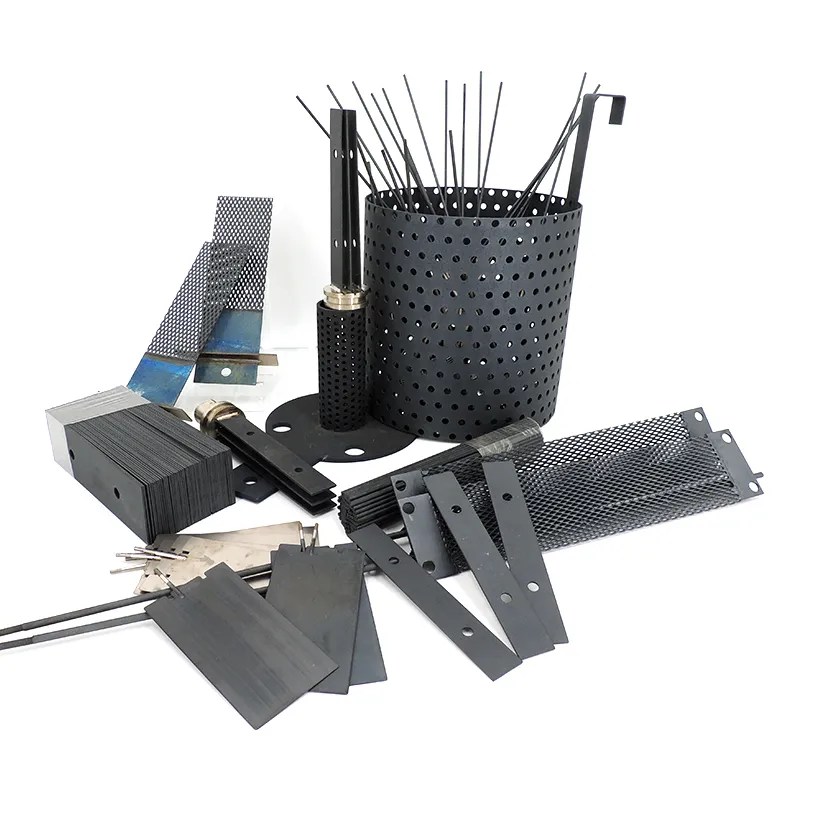
Procurement managers operating industrial facilities often find themselves constrained within proprietary original equipment manufacturer replacement part ecosystems that command significant premium pricing and extended lead times. When a plate-and-frame electrolyzer requires a full anode replacement cycle, the perceived necessity to accept the OEM price structure and delivery schedule is a negotiable constraint. YICHOU specializes in the reverse engineering and bespoke manufacture of replacement anode packs and electrode assemblies. Our in-house manufacturing capabilities extend far beyond simple rectangular sheet guillotine cutting. We operate precision CNC punching centers capable of generating hole patterns with diameters ranging from one point five millimeters up to twelve millimeters, with full control over pitch and staggered configurations. For electrochemical applications where turbulence promotion and the efficient release of entrained gas bubbles are critical to maintaining current efficiency, we manufacture expanded metal mesh in both standard Long Way of Diamond and Short Way of Diamond orientations. This capability is particularly relevant to electrowinning cells where gas blinding at the anode surface can measurably increase cell voltage and reduce metal recovery rates. The reverse engineering process is straightforward and collaborative. The client provides a dimensional drawing of the existing component or, if available, a sample of the worn electrode. YICHOU engineering personnel perform a metrological analysis and material verification. A prototype fit-check unit is then manufactured and shipped for verification within the client cell frame prior to the commencement of full-scale production coating. Because YICHOU controls the complete vertical manufacturing sequence from substrate preparation and precision cutting through thermal coating application and final export crating, lead times for custom configurations are consolidated to a window of three to four weeks. We also maintain a strategic inventory of commonly specified MMO tubular anode dimensions intended for water heater vessel protection and condenser tube sheet cathodic protection applications, facilitating expedited shipment for emergency replacement scenarios.
How Do YICHOU's Packaging and Logistics Prevent Damage to Coated Surfaces
YICHOU utilizes custom-machined high-density polyethylene foam cradles contained within reinforced, export-grade plywood crating that is certified to ISPM fifteen international phytosanitary standards, ensuring the complete elimination of flexural stress and surface abrasion on coated titanium surfaces during multimodal international freight transit.
The final stage of the procurement and fulfillment process is often the stage most neglected in terms of engineering control, yet it is one of the most frequent contributors to premature anode failure. An electrode assembly that has successfully endured over one thousand hours of accelerated life testing can be rendered completely unserviceable by the effects of fretting wear and vibration during the transoceanic journey. If the thin, ceramic MMO coating is permitted to rub against the sharp edge of an adjacent anode or the internal wall of a shipping container, the oxide layer undergoes physical abrasion down to the underlying conductive titanium substrate. When subsequently energized in the field, this localized defect site acts as a current thief. The bare titanium in this abraded area becomes the point of lowest resistance and, consequently, the point of highest local current density. This initiates a cycle of rapid, localized pitting corrosion that expands outward from the initial mechanical flaw. YICHOU has established a logistics and packaging protocol that applies the same level of rigor as our manufacturing quality systems. Every individual electrode assembly is first wrapped in acid-free, neutral pH tissue paper to prevent direct contact with subsequent protective materials. The component is then sealed within a VCI anti-corrosion polyethylene bag to prevent atmospheric humidity and salt-laden air from initiating galvanic corrosion at the copper core to titanium conductor interface during the voyage. For crating, we do not rely on standard industrial pallets secured with stretch film for the transport of coated electrodes. We construct fully enclosed, engineered plywood cases equipped with internal polyethylene foam shock mounts and high-density foam cradles precisely CNC-routed to the profile of the anode geometry. For extended length rod anodes or MMO wire anode configurations, the crate design incorporates internal bracing ribs spaced at calculated intervals to ensure that the deflection of the anode under its own weight during crane lifting and handling remains below one millimeter. Each export crate is externally fitted with ShockWatch impact indicators and TiltWatch orientation labels. Upon arrival at your receiving facility or designated freight forwarder warehouse, these visual indicators provide immediate, unambiguous confirmation of whether the cargo experienced excessive gravitational force or improper inversion during the logistics chain.
What Documentation and Testing Certificates Does YICHOU Provide with Each Shipment
Every YICHOU anode shipment is accompanied by a comprehensive Quality Dossier which includes the EN one zero two zero four Type three point one material certification for the titanium substrate, X-Ray Fluorescence spectrographic analysis confirming the presence and ratio of Iridium and Ruthenium, and the Accelerated Life Test certificate specific to the coating solution batch utilized.
For procurement and quality assurance departments, traceability and documentation are not administrative formalities but essential tools for risk management and asset lifecycle tracking. YICHOU understands that the acceptance of anodes into a critical industrial process requires a verifiable chain of evidence confirming material provenance and manufacturing conformance. The Quality Dossier provided with each order serves as that evidence package. Within the dossier, the EN one zero two zero four Type three point one certificate provides a legal declaration of conformity from the titanium mill, verifying that the substrate material meets the chemical composition and mechanical property requirements of ASTM B two sixty five Grade one. To substantiate the precious metal content and composition of the functional coating, we include X-Ray Fluorescence analysis data. This nondestructive analytical technique confirms both the qualitative presence of the specified Platinum Group Metals and a quantitative approximation of the relative stoichiometric ratio, assuring that the coating applied matches the engineered formulation for the intended service environment. Finally, the dossier contains the Accelerated Life Test certificate. This document correlates the specific production batch of the coating precursor solution and the coated test coupons to a quantifiable performance metric measured in hours to failure under NACE TM zero one zero eight conditions. This documentation package allows the end user to validate incoming materials against purchase specifications and provides a baseline reference for future anode performance monitoring and reorder planning.
Frequently Asked Questions for Engineers and Procurement Managers
What is the specific coating life expectancy for YICHOU MMO anodes in seawater at five hundred amperes per square meter
YICHOU guarantees a coating wear rate of less than two milligrams per ampere-year in seawater service. Based on empirical accelerated life testing data correlated to field performance, this rate corresponds to a minimum operational life of fifteen years under continuous operation at five hundred amperes per square meter, provided the bulk solution pH remains in the neutral range and the flow velocity across the anode surface is maintained at a minimum of zero point five meters per second.
Can YICHOU provide mill test reports and coating analysis certificates with the shipment
Yes, without exception. Every YICHOU shipment includes a comprehensive Quality Dossier containing the EN one zero two zero four Type three point one material certificate for the titanium substrate, X-Ray Fluorescence spectrographic data confirming the presence and relative ratio of Iridium and Ruthenium, and the Accelerated Life Test certificate corresponding to the specific batch of coating precursor solution applied during manufacturing.
What is the maximum plate dimension YICHOU can coat in a single piece
Our thermal coating furnace system accommodates continuous plate dimensions up to one point five meters in width by three point zero meters in length. For larger electrochemical cell applications requiring active surfaces beyond these dimensions, YICHOU employs a segmented anode design approach utilizing shielded titanium bolting connections that permit in-tank final assembly without introducing zones susceptible to crevice corrosion.
How does YICHOU ensure uniform current distribution on large surface area anodes
YICHOU engineering practice incorporates copper cored titanium conductor bars configured as an internal buss bar network. Prior to manufacturing, our engineers calculate the voltage drop gradient across the full length of the anode plate based on the specified operating current. The quantity and precise placement of current feed points along the conductor bar are then adjusted to ensure that the current distribution variance across the entire active surface area remains below five percent of the mean value.
Do you offer a re-coating service for used MMO titanium anodes
Yes, YICHOU operates a dedicated reclamation and recoating service line. Provided that the titanium substrate has not undergone hydrogen embrittlement or suffered severe pitting corrosion beyond repairable limits, we chemically strip the remaining oxide layer using a nondestructive process, re-profile the surface to the required anchor profile specification, and apply a new MMO coating. This service is typically offered at approximately forty percent of the cost of an equivalent new anode assembly.
What is the standard lead time for a custom MMO anode order
For standard configurations utilizing common plate, mesh, or tubular geometries, YICHOU maintains a production lead time of three to four weeks from receipt of a finalized purchase order and approved engineering drawing. For complex, highly customized designs or orders involving significant retooling, our sales engineering team provides a detailed project schedule within forty-eight hours of the initial inquiry.
Does YICHOU hold inventory of MMO anodes for emergency replacement scenarios
YICHOU maintains a strategic stock of finished MMO tubular anodes in common diameters and lengths used extensively in water heater protection and condenser water box cathodic protection. This inventory allows for expedited shipment within days for emergency replacements, minimizing downtime for critical water management infrastructure.
Conclusion and Next Steps for Procurement and Engineering Teams
The premature failure of MMO titanium anodes in high chloride environments is not an inherent limitation of the technology but rather a consequence of specific, identifiable, and avoidable compromises in material selection and manufacturing execution. By addressing the root causes of coating dissolution, substrate passivation, and mechanical delamination at the metallurgical and process control level, YICHOU delivers anode systems that align with the extended service life projections and operational reliability demands of modern industrial electrochemical processes. The true measure of an anode supplier is not found in the initial unit price on a quotation but in the documented data supporting coating longevity, the precision of fabrication, and the integrity of the logistics chain that delivers the product to your facility. We invite senior engineers and procurement professionals to contact our technical sales team at www.nbyichou.com to discuss specific project requirements, request sample test reports, or initiate the process for custom anode design and reverse engineering. Your operational uptime and maintenance budget predictability are the direct beneficiaries of manufacturing precision that begins at the atomic level of the mixed metal oxide coating and extends through every step of our ISO nine thousand one certified workflow.
.jpg)
Get Your Free Quote Today!
Ready to source the best titanium products for your next project? Whether you need titanium for aerospace and medical applications, or platinum-coated titanium electrodes and titanium anodes for green hydrogen production and industrial electrolysis, YICHOU is here to provide the right material solutions for your business.
Contact us now for a free quote. Let YICHOU help you with reliable, high-quality titanium products at competitive prices.
Get Quote
- Email us: [email protected]
- Call us/whatsapp: +86 13355741031
- Chat with us: Live chat support available on our website