Executive Summary
In the high-stakes world of turbomachinery, where efficiency and reliability are paramount, two components stand as pillars of performance: the turbine impeller and the turbine diffuser. At YICHOU, a global leader in the precision manufacturing of turbine components, we understand that the synergy between these two parts is what separates a mediocre system from an exceptional one. This comprehensive guide delves deep into the principles, functions, types, and maintenance of turbine impellers and turbine diffusers. Whether you are an engineer, a procurement manager, or an enthusiast, this article will equip you with the knowledge to make informed decisions, optimize your systems, and understand why partnering with an expert manufacturer like YICHOU is critical for your success.
Part 1: The Heart of the System - The Turbine Impeller
1.1 What is a Turbine Impeller?
A turbine impeller (often referred to simply as an impeller) is the rotating component of a centrifugal pump, compressor, or turbine that transfers energy from the motor driving the unit to the fluid being moved. It is the very heart of the machine. Think of it as the component that does the "heavy lifting." In a turbine system, particularly in turbochargers and centrifugal compressors, the impeller is responsible for drawing in fluid (air or gas) and accelerating it radially outward at high velocity, thereby significantly increasing its kinetic energy.
Constructed from high-strength, often exotic materials like Inconel, titanium, or high-grade aluminum alloys, turbine impellers are engineered to withstand immense rotational speeds, extreme temperatures, and significant centrifugal forces. At YICHOU, we utilize advanced casting and CNC machining techniques to produce impellers with impeccable balance and aerodynamic profiles, ensuring maximum efficiency and longevity.
1.2 The Core Function: How Does an Impeller Work?
The working principle of an impeller is based on Newton's second law and centrifugal force. As the impeller rotates, the curved blades (or vanes) impart a tangential force to the fluid. This process involves:
-
Induction: Fluid axially enters the eye (the center) of the impeller.
-
Acceleration: The rotating blades capture the fluid and force it to spin along with them. As the fluid moves from the smaller diameter at the eye to the larger diameter at the tip of the blades, it is accelerated to a high velocity.
-
Expulsion: The high-velocity fluid is flung radially outward into the surrounding housing, known as the volute or diffuser.
The primary outcome is a dramatic increase in the fluid's kinetic energy. This energy is not yet in a usable form for pressure recovery, which is where the turbine diffuser comes into play later.
1.3 A Detailed Look at the Types of Impellers
Choosing the correct impeller type is crucial for application-specific performance. The three primary classifications are based on structural design:
-
Open Impeller: Consists of blades attached to a central hub without any enclosing shroud. They are simpler to manufacture and clean but are mechanically weaker and less efficient due to increased fluid recirculation between the blades and the casing. Ideal for abrasive fluids or slurry pumps.
-
Semi-Open Impeller: Features blades that are attached to a hub on one side and have a shroud on the other. This design offers a better balance of strength and efficiency than open impellers and is common in many industrial pumps.
-
Closed Impeller: The blades are fully enclosed by front and back shrouds. This is the most common and efficient design for turbine impellers in high-performance applications like turbochargers and gas turbines. The shrouds maximize strength, minimize flexing at high speeds, and drastically reduce internal recirculation losses, leading to superior efficiency.
Furthermore, impellers are categorized by their flow geometry:
-
Centrifugal (Radial) Impeller: The classic design where fluid enters axially and is discharged radially. It provides high head (pressure) rise and is the standard in turbochargers and gas turbine compressors.
-
Axial Impeller (Propeller): Functions more like a propeller, moving fluid parallel to the impeller's axis. It is designed for high flow rates at relatively low pressure increases.
Impeller vs. Propeller: A Critical Distinction
While both are rotating blades that move fluid, their functions differ fundamentally. An impeller is designed to increase the pressure of a fluid, typically enclosed within a casing. A propeller is designed to produce thrust to propel a vehicle (like a ship or aircraft) through a fluid and is generally not enclosed. In simple terms, an impeller pressurizes, while a *propeller propels.
1.4 Common Turbine Impeller Failures and Maintenance
Even the most robust impeller can fail. Understanding failure modes is key to prevention.
-
Erosion & Corrosion: Caused by abrasive particles or chemically aggressive fluids, leading to gradual material loss, imbalance, and performance drop.
-
Cavitation: The formation and violent collapse of vapor bubbles on the impeller surface when local pressure drops below the vapor pressure of the fluid. This causes pitting, vibration, and can quickly destroy an impeller.
-
Fatigue Cracking: Caused by cyclic stresses from high-speed rotation and pressure fluctuations, leading to cracks, often originating from stress concentrators.
-
FOD (Foreign Object Damage): The ingestion of debris (e.g., bolts, rocks) can cause immediate, catastrophic blade damage.
-
Imbalance: Even minor imbalance at high RPMs creates severe vibrations, leading to bearing failure and shaft damage.
How do I know if my impeller needs replacing?
Signs include a noticeable drop in pressure or flow rate, increased noise or vibration, higher power consumption, and visible damage upon inspection.
How often should an impeller be changed?
There is no universal interval. Service life depends on the operating environment, fluid characteristics, and duty cycle. Preventive maintenance schedules, based on manufacturer recommendations (like those from YICHOU) and runtime hours, are essential. A damaged impeller can sometimes be repaired via welding and re-machining, but for critical applications, replacement with a genuine YICHOU part is often the safer, more cost-effective long-term solution.
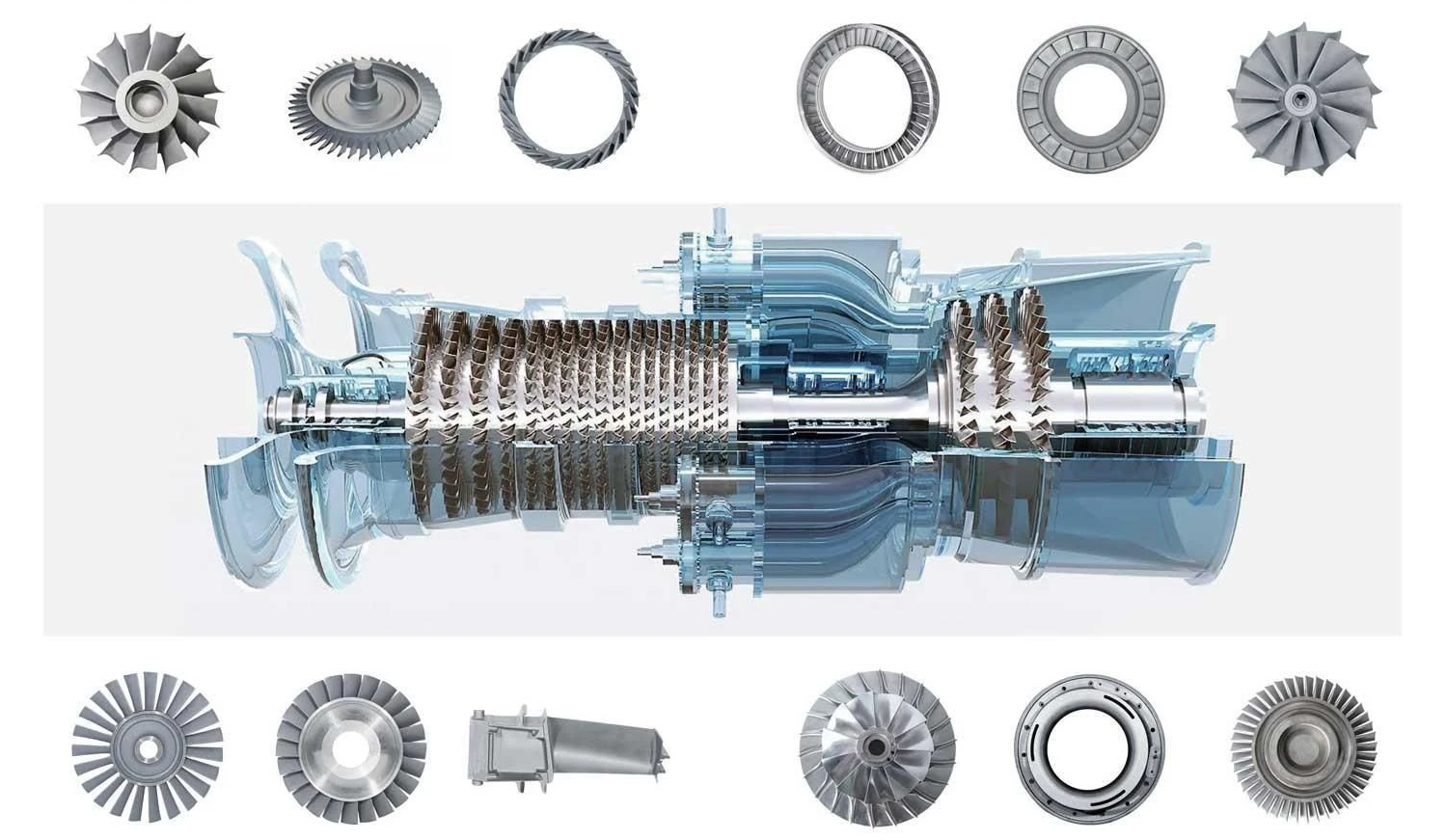
Part 2: The Brain of Pressure Recovery - The Turbine Diffuser
2.1 What is a Turbine Diffuser?
If the impeller is the heart, the turbine diffuser is the brain of the pressure recovery system. A diffuser is a stationary component, typically a set of vanes or a gradually expanding passage, located immediately after the impeller. Its sole purpose is to efficiently convert the high-kinetic energy fluid, discharged from the impeller, into static pressure.
This conversion is governed by Bernoulli's principle: as the flow passage area increases, the velocity of the fluid decreases, and this loss in kinetic energy is transformed into a gain in static pressure. In essence, the diffuser "tames" the high-velocity, chaotic flow from the impeller and turns it into a high-pressure, stable stream.
2.2 The Aerodynamic Principle: How Does a Diffuser Work?
The working principle of a diffuser is elegantly simple yet critically dependent on precise aerodynamic design. As the high-velocity fluid leaves the tips of the impeller blades, it enters the diffuser passage.
-
Deceleration: The diffuser passage is designed with a diverging geometry (its cross-sectional area increases in the direction of flow). This forces the fluid to slow down.
-
Pressure Recovery: According to the conservation of energy, the kinetic energy lost during deceleration must be converted into another form. In this case, it is converted into static pressure energy.
-
Flow Guidance: Vane diffusers, which are rings of airfoil-shaped vanes, also help to straighten the swirling flow coming from the impeller, further improving the efficiency of the pressure conversion process.
Without an efficient diffuser, the kinetic energy generated by the impeller would be largely wasted, resulting in a system with very poor pressure output and high losses.
2.3 Key Types of Turbine Diffusers
Different applications demand different diffuser designs:
-
Vaned Diffuser: Features a ring of airfoil-shaped vanes that provide optimal guidance to the flow. This design offers the highest efficiency and pressure recovery but has a narrower operating range and is more sensitive to fouling.
-
Vaneless Diffuser: Consists of a simple, constant-width annular space around the impeller. It is more robust, has a wider operating range, and is less expensive, but it is less efficient than a vaned diffuser as the fluid continues to swirl, leading to higher friction losses.
-
Exhaust Diffuser (in Gas Turbines): Located after the last turbine stage, its function is to recover pressure from the hot exhaust gases. This pressure drop across the exhaust system directly improves the overall efficiency and power output of the gas turbine.
-
Line Diffuser Ring (in Turbochargers): This is a specific type of vaned diffuser integrated into a turbocharger's compressor housing. It is crucial for maximizing boost pressure and compressor efficiency, especially in high-performance applications.
2.4 The Critical Difference: Diffuser vs. Nozzle
This is a fundamental concept in fluid mechanics. A diffuser and a nozzle are functional opposites.
-
A Diffuser decreases fluid velocity to increase its static pressure. (Area ↑, Velocity ↓, Pressure ↑).
-
Example in a Gas Turbine Engine: The compressor diffuser (as described above) and the exhaust diffuser.
-
-
A Nozzle increases fluid velocity to decrease its static pressure. (Area ↓, Velocity ↑, Pressure ↓).
-
Example in a Gas Turbine Engine: The turbine nozzle guide vanes (or stator vanes). These stationary vanes are shaped as nozzles. They accelerate the hot combustion gases and direct them onto the rotating turbine blades at the optimal angle, extracting maximum work to drive the compressor and the output shaft.
-
In essence, a diffuser is a diverging passage, while a nozzle is a converging passage (or a converging-diverging passage for supersonic flows).
Part 3: The Synergistic Partnership: Impeller and Diffuser in Action
3.1 How the Turbine Impeller and Diffuser Work Together
The relationship between the turbine impeller and the turbine diffuser is a perfect example of engineering symbiosis. They are a matched pair, and the performance of one is intrinsically linked to the other.
-
The impeller acts as the energy adder, taking in low-energy fluid and imparting high kinetic energy to it.
-
The high-velocity, low-pressure flow then immediately enters the diffuser.
-
The diffuser acts as the energy converter, efficiently transforming that costly kinetic energy into valuable static pressure.
-
This high-pressure fluid is then ready for the next stage, whether it's combustion in a gas turbine, induction in an engine (via a turbocharger), or delivery in a pumping system.
A poorly designed impeller will leave the diffuser with insufficient energy to convert. Conversely, a poorly designed diffuser will waste the energy created by even the most efficient impeller. At YICHOU, our R&D focus is on optimizing this impeller-diffuser interface as a single system to unlock peak performance.
3.2 Comparative Analysis: Key Differences Summarized
| Feature | Turbine Impeller | Turbine Diffuser |
|---|---|---|
| State | Rotating | Stationary |
| Primary Function | Increase fluid kinetic energy | Convert kinetic energy to pressure |
| Effect on Velocity | Increases velocity | Decreases velocity |
| Effect on Pressure | Small pressure increase | Large pressure increase |
| Physical Design | Bladed rotor | Diverging passage or vanes |
| Analogy | The heart (pump) | The brain (pressure recovery) |
Part 4: YICHOU's Manufacturing Excellence
At YICHOU, we don't just manufacture parts; we engineer solutions. Our commitment to excellence is embedded in every turbine impeller and turbine diffuser we produce.
-
Advanced Materials: We source and qualify the highest-grade superalloys, titanium, and aluminum, ensuring components can withstand the most demanding environments.
-
Precision Engineering: Our state-of-the-art 5-axis CNC machining and investment casting facilities allow us to achieve tolerances that are critical for aerodynamic efficiency and dynamic balance.
-
Rigorous Testing: Every component, from a standard impeller to a complex vaned diffuser, undergoes stringent quality control, including Coordinate Measuring Machine (CMM) inspection, dye penetrant testing, and dynamic balancing.
-
Custom Solutions: We work closely with our clients to design and manufacture custom impeller and diffuser sets tailored to their specific performance maps, operational envelopes, and space constraints.
When you specify YICHOU, you are choosing reliability, peak efficiency, and a partner dedicated to pushing the boundaries of turbomachinery performance.
Part 5: Frequently Asked Questions (FAQs)
Q1: What is the difference between a turbine and a diffuser?
A turbine is a complete machine that extracts energy from a fluid (e.g., steam, gas, water). A diffuser is a key component within a turbine or compressor system, specifically responsible for converting kinetic energy into pressure.
Q2: What happens when an impeller fails?
Failure can range from gradual performance loss (erosion) to catastrophic breakdown (blade separation). This leads to loss of pressure/flow, severe vibration, and potential secondary damage to bearings, seals, and the shaft.
Q3: What is the function of an exhaust diffuser in a gas turbine?
The exhaust diffuser slows down the hot gases leaving the turbine stages. This recovery of kinetic energy into pressure creates a greater pressure drop across the turbine, increasing its power output and overall thermal efficiency of the entire engine.
Q4: Can a damaged impeller be repaired?
It is possible in some cases, depending on the material and extent of damage. Techniques like welding and re-machining are used. However, for high-speed applications, the risk of imbalance and altered material properties often makes replacement with a new, certified YICHOU impeller the recommended course of action.
Q5: What is the difference between a vent and a diffuser?
In HVAC contexts, a vent is a general opening for air to enter or leave a space. A diffuser is a specific type of supply vent designed to "diffuse" or spread the air out evenly, preventing drafts and ensuring proper mixing of conditioned air with room air.
Q6: What are the three main types of impellers?
Open, Semi-Open, and Closed.
Q7: What are the disadvantages of vaned diffusers?
They have a narrower stable operating range and can be prone to surging at low flows. They are also more complex and expensive to manufacture and are more susceptible to fouling from dirty gases.
Conclusion
The intricate dance between the rotating turbine impeller and the stationary turbine diffuser is a cornerstone of modern fluid dynamics and energy conversion. Understanding their individual roles, their symbiotic relationship, and the critical importance of their design and manufacturing quality is essential for anyone involved in the operation, maintenance, or procurement of turbomachinery.
From turbochargers that boost engine power to gas turbines that generate electricity and propel aircraft, the efficiency of these systems hinges on the performance of these two components. By choosing a manufacturer like YICHOU, you ensure that you are getting components engineered to the highest standards of precision, durability, and performance.
Ready to optimize your system? Contact the YICHOU team today for a technical consultation and discover how our premium turbine impellers and diffusers can deliver unmatched reliability and efficiency for your application.
.jpg)
GET QUOTE
- Visit our website: https://www.nbyichou.com/
- Email us: [email protected]
- Call us/whatsapp: +86 13355741031
- Chat with us: Live chat support available on our website