Reading Time: 25 Minutes
Target Audience: PV Production Managers, Procurement Specialists, Process Engineers, and Anyone New to Solar Cell Manufacturing
Key Search Terms: "Quartz diffusion boat life," "TOPCon quartz tube supplier," "Why do quartz tubes sag," "Quartz furnace tube cost," "Photovoltaic quartzware cleaning," "What is a quartz boat in solar"
Executive Summary
In every solar cell production line, there is a quiet paradox: the most expensive equipment is the diffusion furnace, the cheapest consumable is the quartz tube, but the most frustrating downtime events often come from that humble tube.
Imagine this scenario:
A TOPCon line producing 500,000 cells per day suddenly halts because the teeth of a quartz boat have deformed, tilting an entire boatload of wafers. Or worse, a quartz tube undergoes catastrophic devitrification, forcing an emergency 24-hour shutdown for replacement. For a production manager, this means hundreds of thousands in lost revenue. For a procurement specialist, it means facing the classic dilemma: "cheap but failure-prone" versus "expensive but durable."
As the photovoltaic industry pivots aggressively to TOPCon and HJT technologies, the thermal budget and process complexity have increased dramatically. Quartz consumables that were "good enough" in the PERC era have now become critical variables affecting yield, uptime, and ultimately, cost-per-watt.
This comprehensive guide is designed for everyone involved in PV manufacturing:
-
For Beginners: We'll start with the basics—what quartz boats and tubes are, and why they matter.
-
For Process Engineers: We'll dive deep into the chemical and physical degradation mechanisms.
-
For Production Managers: We'll provide frameworks for predicting and extending quartz life.
-
For Procurement Specialists: We'll deliver a rigorous cost-per-run model to guide purchasing decisions.
Whether you're evaluating new suppliers, troubleshooting frequent downtime, or simply trying to understand why that quartz tube looks "cloudy" after 100 runs, this guide has you covered.
Chapter 1: Quartz Consumables 101 – The Unsung Heroes of the PV Production Line
1.1 Who Are They? What Do They Look Like?
If you were to peer through the observation window of a diffusion furnace in a solar cell fab, you would see rows of silicon wafers standing vertically, perfectly spaced, bathed in glowing heat. But holding those wafers isn't metal—it's a translucent, milky-white material called high-purity fused quartz.
In photovoltaic manufacturing, three types of quartz consumables dominate the production floor:
| Component | Visual Description | Common Nicknames | Primary Function |
|---|---|---|---|
| Quartz Diffusion Boat | A ladder-like structure with multiple "teeth" or slots | Wafer carrier, quartz boat | Holds wafers vertically, ensures uniform spacing for gas flow |
| Quartz Furnace Tube | A long, hollow cylinder (often 2-3 meters) | Process tube, diffusion tube | Contains the boat and wafers, isolates atmosphere, channels process gases |
| Quartz Liners/Shields | Thin tubes or plates inside the main tube | Inner liners, sacrificial shields | Protects the main tube from heavy deposition; designed to be replaced frequently |
Visual Reference:
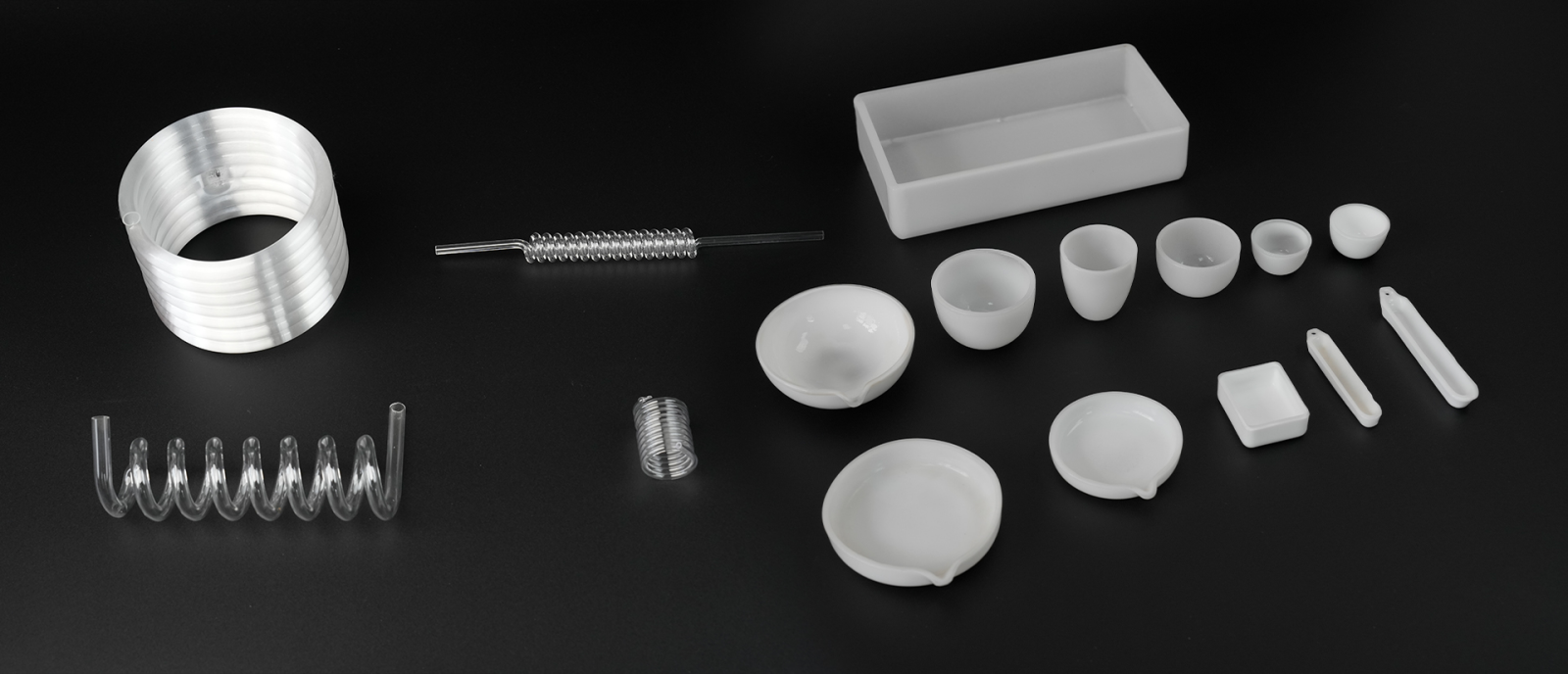
(Ideal placement for photos showing a new quartz boat, a boat after 200 runs showing devitrification, and a sagged quartz tube)
1.2 Why Quartz? Why Not Metal or Ceramics?
This is the most common question from newcomers to the industry. The answer lies in three unique properties of fused quartz:
1. Extreme Temperature Resistance
Diffusion processes run at 900°C to 1100°C. At these temperatures:
-
Ordinary glass melts or flows like honey.
-
Metals (even stainless steel) release volatile contaminants that dope silicon wafers unintentionally.
-
Many ceramics have thermal expansion mismatches that cause cracking during rapid temperature ramps.
Quartz, with its softening point above 1600°C, remains solid and dimensionally stable throughout the entire PV thermal budget.
2. Ultra-High Purity
PV-grade quartz is typically 99.99% (4N) to 99.999% (5N) pure. Why does this matter? At high temperatures, impurities become mobile. If a quartz boat contains trace amounts of sodium, potassium, or iron, these metals can:
-
Outgas from the quartz surface.
-
Diffuse into the silicon wafers.
-
Create recombination centers that kill minority carrier lifetime.
-
Reduce final cell efficiency by 0.1% to 0.3% absolute.
For a 500 MW fab, a 0.1% efficiency loss translates to hundreds of thousands of dollars in lost revenue annually.
3. Optical Transparency (For Some Processes)
In rapid thermal processing (RTP) or some advanced annealing tools, lamps heat the wafers directly. The quartz tube must allow infrared radiation to pass through efficiently while remaining cool itself. Quartz's excellent transmission in the IR spectrum makes this possible.
1.3 How Quartz Consumables Impact Your Bottom Line
For production managers and procurement specialists, quartzware sits at the intersection of three cost centers:
Direct Costs (Visible):
-
Purchase price of boats and tubes
-
Cleaning chemical costs
-
Replacement part inventory
Hidden Costs (Often Overlooked):
-
Downtime: Replacing a quartz tube requires cooling the furnace (12+ hours), cleaning, installation, and requalification (another 12-24 hours). Every hour of downtime is lost production.
-
Yield Loss: Aging quartz sheds particles. Deformed quartz causes non-uniform temperature distribution. Both lead to efficiency bins dropping or scrap rates rising.
-
Breakage Risk: A catastrophic boat failure can destroy an entire batch of 200-400 wafers in seconds.
The Core Question:
Is it better to buy cheaper quartzware and replace it frequently, or invest in premium quartz that lasts longer? The answer, as we'll see in Chapter 5, depends on a rigorous cost-per-run analysis.
Chapter 2: The Harsh Environment of PV Diffusion – How POCl₃ and BCl₃ "Eat" Quartz
To understand why a quartz boat fails, you must first understand the battlefield. In modern PV fabs, diffusion processes create the p-n junction that separates charge carriers. For P-type wafers, this typically involves POCl₃ (phosphorus oxychloride). For N-type structures used in TOPCon, BCl₃ or BBr₃ (boron trichloride/tribromide) is common.
2.1 The Three Killers of Quartz
Killer #1: Devitrification (Crystallization)
At high temperatures, amorphous quartz (SiO₂) wants to transform into its crystalline form: cristobalite. This transformation is catalyzed by:
-
Alkali metals (Na, K, Li) – even in parts-per-million concentrations
-
Alkaline earth metals (Ca, Mg)
-
Direct contact with dopant glasses
When quartz devitrifies:
-
The surface turns opaque white or brown (often called "crocodile skin").
-
The volume changes, creating micro-cracks.
-
These cracks trap dopants and particles, accelerating failure.
-
The cristobalite layer spalls off, raining particles onto wafers.
Killer #2: Chemical Etching (Thickness Loss)
POCl₃ and BCl₃ react with residual moisture in the furnace or with the quartz surface itself:
-
POCl₃ + H₂O → Phosphoric acid (H₃PO₄)
-
BCl₃ + H₂O → Boric acid (H₃BO₃)
These acids slowly etch the quartz surface. Over hundreds of cycles, the load-bearing teeth of a quartz boat thin out. Eventually, they can no longer support the weight of the wafers and snap.
Killer #3: Sagging (Viscous Flow)
Above the annealing point of quartz (~1140°C), the material behaves like an extremely high-viscosity liquid—think honey at room temperature, but slower. In horizontal furnaces, gravity pulls the center of a 2-3 meter tube downward. This phenomenon, called sag, has three consequences:
-
The tube's inner diameter decreases at the center, restricting gas flow.
-
The sagging tube may eventually contact the wafers, destroying the batch.
-
The stress distribution becomes non-uniform, accelerating devitrification at the bottom of the tube.
2.2 Boron vs. Phosphorus: Why TOPCon Makes Everything Harder
As fabs transition to TOPCon, boron diffusion is becoming mainstream for emitter formation. Boron chemistry is significantly more aggressive on quartz than phosphorus.
| Factor | Phosphorus (POCl₃) | Boron (BCl₃/BBr₃) | Impact on Quartz |
|---|---|---|---|
| Reaction rate with SiO₂ | Moderate | High | Faster etching |
| Borosilicate glass formation | N/A | Forms BSG layer | Different thermal expansion creates stress |
| Cleaning difficulty | Easier | Harder | More aggressive cleaning needed |
The borosilicate layer that forms on quartz during boron diffusion has a different coefficient of thermal expansion than the underlying quartz. During temperature ramps, this difference induces mechanical stress, leading to micro-cracking and accelerated failure.
For production managers: If you're running boron-diffused TOPCon emitters, expect quartz boat life to be 30-50% shorter than in phosphorus-only PERC lines—unless you upgrade your quartz specification.
Chapter 3: Quartz Boats – Why Do Some Last 100 Runs While Others Last 300?
The quartz boat is the workhorse of the diffusion furnace. It holds 200 to 400 silicon wafers vertically, ensuring precise spacing for gas flow and temperature uniformity. For a procurement specialist, the question is blunt: "Why do some boats fail after 100 runs while others last 300?"
The answer lies in three factors: material purity, mechanical design, and thermal processing.
3.1 Pillar #1: Material Purity – The "Staining" Problem
Not all quartz is created equal. Natural fused quartz is made from high-purity silica sand, but it contains trace elements—aluminum, potassium, sodium, lithium, iron. In the high-temperature, dopant-rich environment of a diffusion furnace, these impurities migrate to the surface.
What happens:
-
Alkali metals (Na, K, Li) act as fluxing agents, lowering the melting point of quartz locally.
-
They catalyze the transformation to cristobalite (devitrification).
-
They react with dopants to form colored compounds—the brown or white "stains" you see on used boats.
-
These stained areas are weak points that shed particles.
The Specification:
For photovoltaic applications, especially TOPCon, procurement specifications should demand:
-
Total metallic impurities < 10 ppm (parts per million)
-
Alkali metals (Na, K, Li) individually < 1 ppm
-
Hydroxyl (OH) content appropriate for the application (high OH for sag resistance, low OH for optical applications)
Synthetic Quartz: The Premium Option
For the most critical applications—the boat used in the final junction formation step, or the inner tube in a boron diffusion furnace—consider boats made from synthetic quartz.
-
Advantages: Total metals < 1 ppm, no alkali metals, extremely uniform structure.
-
Disadvantages: 2-3x higher cost.
-
ROI: In high-throughput TOPCon fabs, the extended life and reduced downtime often justify the premium.
3.2 Pillar #2: Tooth Design – Minimizing Contact, Maximizing Strength
The interface between the quartz boat and the silicon wafer is a point of mechanical stress and potential contamination.
Contact Area:
-
Poor design: Wide, flat contact areas trap dopants and particles. They also provide a large surface for quartz-to-silicon sticking.
-
Optimal design: "Point contact" or "knife-edge" designs minimize the contact area. The wafer rests on tiny points or thin edges, reducing:
-
Heat transfer from wafer to boat (improving temperature uniformity)
-
Particle generation
-
Sticking risk during high-temperature drives
-
Surface Finish:
-
Rough surfaces (Ra > 0.5 μm): Provide "hiding spots" for dopant residues. These residues attack the quartz during subsequent cycles. Rough surfaces also generate more particles through abrasion.
-
Polished surfaces (Ra ≤ 0.2 μm): Are easier to clean, release particles less readily, and have fewer nucleation sites for devitrification.
Tooth Geometry:
-
Thin teeth heat up and cool down faster, matching the thermal response of wafers more closely.
-
Rounded tooth tips (vs. sharp corners) reduce stress concentration points.
3.3 Pillar #3: Annealing – The Invisible Stress Relief
During fabrication, quartz boats are assembled by welding rods and plates together. These welds are points of immense residual thermal stress. If a boat is not properly annealed after fabrication, these stresses cause catastrophic failure during the first few thermal cycles.
The Annealing Process:
-
After fabrication, the boat is placed in a large annealing furnace.
-
It is slowly heated to just below its softening point (around 1100°C-1150°C).
-
It is held at this temperature for several hours to allow the molecular structure to relax.
-
It is cooled extremely slowly (over 12-24 hours) to prevent new stresses from forming.
The Result: An annealed boat has no "memory" of the welding process. It can survive the thermal shock of insertion into a hot furnace without cracking.
How to Verify:
Ask potential suppliers for their annealing profile. A reputable manufacturer will have documented ramp rates, soak times, and cool-down curves. Some will even offer polariscope images showing the stress-free state of their products.
3.4 The 100-Run Boat vs. The 300-Run Boat: A Comparison
| Feature | 100-Run Boat (Low Grade) | 300-Run Boat (Premium Grade) |
|---|---|---|
| Quartz type | Low-grade natural quartz | High-purity natural or synthetic quartz |
| Total metals | > 50 ppm | < 10 ppm |
| Alkali metals | > 5 ppm | < 1 ppm |
| Surface finish | As-ground, rough | Flame-polished or precision-ground |
| Annealing | Minimal or none | Full gradient annealing |
| Failure mode | Catastrophic (cracking, tooth loss) | Gradual (thickness loss from cleaning) |
| Predictability | Unpredictable | Predictable, allows planned maintenance |
Chapter 4: Quartz Tubes and Liners – The Physics of Sag and How to Stop It
While boats hold the wafers, the quartz furnace tube is the vessel that contains the entire process atmosphere. In horizontal furnaces—still common in many PV fabs—tube sag is the primary life-limiting factor.
4.1 Why Do Long Tubes Sag?
At process temperatures of 1000°C-1100°C, quartz behaves viscously. Think of it as an extremely thick liquid. A 2.5-meter tube supported only at the ends will slowly bend under its own weight—like a heavy rope stretched between two posts.
The rate of sag depends on:
-
Temperature: Higher temperatures = faster sag (exponentially).
-
Tube dimensions: Longer tubes with larger diameters sag more.
-
Quartz viscosity: Higher viscosity quartz resists sag better.
-
Support design: Proper supports can dramatically reduce sag.
4.2 Material Solutions: High-OH Quartz
The viscosity of quartz is strongly influenced by its hydroxyl (OH) content.
-
Low-OH quartz (< 50 ppm): Used in optical applications where IR transmission is critical. Sags more easily.
-
High-OH quartz (100-300 ppm): The OH groups strengthen the silica network, increasing viscosity and sag resistance by orders of magnitude.
For PV diffusion tubes, always specify high-OH quartz. The slight reduction in IR transmission is irrelevant for resistance-heated furnaces, and the sag resistance is critical.
4.3 Mechanical Solutions: Support Systems
Traditional approach: The tube rests on cantilevered supports at the ends only. This maximizes sag.
Advanced approach:
-
Multi-point supports: Some modern furnaces use roller supports along the tube length that can be adjusted or rotated.
-
Rotational systems: By rotating the tube periodically (e.g., 90 degrees every week), the point of maximum gravitational stress shifts. This allows the quartz to "relax" and can extend tube life from months to years.
-
Patent examples: US5605454A describes a "four-port tube" design that allows periodic rotation without breaking gas seals, dramatically extending tube life.
4.4 Cleaning: The Double-Edged Sword
The inner walls of quartz tubes accumulate deposited layers—doped silicon, phosphosilicate glass (PSG), borosilicate glass (BSG). These must be removed periodically to maintain process stability.
Cleaning Method #1: Wet Etching (Ex-situ)
-
Process: The tube is removed and immersed in an HF-based bath.
-
Pros: Effective, well-understood.
-
Cons: Aggressive on the parent quartz, causes thickness loss, requires handling (risk of breakage), long downtime.
Cleaning Method #2: Gaseous Etching (In-situ)
-
Process: Gases like NF₃ or ClF₃ are introduced at elevated temperature. They react with the deposits to form volatile species that are pumped away.
-
Pros: Minimal attack on parent quartz, no handling damage, faster turnaround.
-
Cons: Requires specialized gas delivery and abatement systems, higher capital cost.
The Procurement Implication:
When buying a new quartz tube, ask the supplier for data on etch rate uniformity. A high-quality tube will have consistent density throughout, ensuring that cleaning chemistries remove deposits evenly without creating "thin spots" that become failure points.
Chapter 5: Procurement Playbook – How to Calculate the True Cost of Quartzware
For procurement specialists, the lowest purchase price is often a trap. The true metric is Cost per Wafer Pass or Cost per Run. This section provides a rigorous framework for analysis.
5.1 The Total Cost of Ownership (TCO) Formula
TCO = (Initial Capex + Total Cleaning Costs + Downtime Costs) / Total Successful Runs
Where:
-
Initial Capex: Purchase price of the quartzware.
-
Total Cleaning Costs: (Cost per clean × number of cleans during life).
-
Downtime Costs: Lost profit from production stoppages during replacement.
-
Total Successful Runs: Number of runs completed before the quartzware is retired.
5.2 Case Study: Standard Tube vs. Premium Tube
Let's run the numbers for a high-volume TOPCon fab.
Assumptions:
-
Furnace produces $5,000 worth of cells per hour of operation.
-
A tube replacement requires 24 hours of downtime (cool, clean, install, requalify).
-
Each wet cleaning cycle costs $200 in chemicals and labor, plus 4 hours of downtime.
| Parameter | Standard Quartz Tube | Premium Quartz Tube |
|---|---|---|
| Initial Capex | $1,500 | $2,800 |
| Total runs achieved | 60 | 180 |
| Cleaning frequency | Every 30 runs | Every 45 runs |
| Number of cleans | 2 | 4 |
| Cleaning cost (chemicals) | $400 | $800 |
| Cleaning downtime (hours) | 8 hours | 16 hours |
| Cleaning downtime cost | $40,000 | $80,000 |
| Replacement downtime (hours) | 24 hours | 24 hours |
| Replacement downtime cost | $120,000 | $120,000 |
| Total Cost (Capex + Downtime) | $161,900 | $203,600 |
| Cost per Run | $2,698 | $1,131 |
The Result:
Despite costing nearly double upfront, the premium tube is 58% cheaper on a cost-per-run basis when downtime is factored in.
5.3 The Hidden Cost of Variability
The example above assumes the standard tube reliably achieves 60 runs. In reality, low-grade quartzware fails unpredictably. A boat that sometimes lasts 100 runs and sometimes fails at 50 runs creates scheduling chaos.
The Cost of Unpredictability:
-
Emergency replacement parts (expedited shipping)
-
Overtime labor
-
Last-minute production schedule changes
-
Risk of scrapped batches if failure occurs during processing
For procurement: When evaluating suppliers, ask for lifecycle data—not just "average life," but the distribution. A supplier whose product consistently achieves 170-190 runs is far more valuable than one whose product averages 180 runs but ranges from 80 to 280.
5.4 Strategic Procurement Recommendations
Based on the analysis above, we recommend a tiered procurement strategy for TOPCon and HJT lines:
Tier 1: Process-Critical Zones
-
Components: Inner tubes, boats for emitter diffusion, boats for polysilicon deposition
-
Specification: Synthetic quartz or highest-purity natural quartz, full annealing, polished surfaces
-
Rationale: These components directly affect cell efficiency and are the hardest to replace.
Tier 2: Semi-Critical Zones
-
Components: Outer tubes, shields, boats for non-critical steps
-
Specification: High-purity natural quartz, proper annealing, standard finish
-
Rationale: Good performance at reasonable cost.
Tier 3: Sacrificial Zones
-
Components: Liners, dummy boats, process shields
-
Specification: Standard natural quartz, minimal specifications
-
Rationale: Designed to be replaced frequently; optimize for low initial cost.
5.5 Questions to Ask Potential Suppliers
When evaluating quartz vendors for your TOPCon line, ask:
-
Purity Data: Can you provide GDMS (Glow Discharge Mass Spectrometry) analysis showing alkali metal content?
-
Annealing Profile: What is your annealing process? Can you provide documentation?
-
Lifecycle Data: Do you have reference data from other fabs running similar TOPCon processes?
-
Cleaning Compatibility: How does your quartz hold up to our planned cleaning chemistry (wet HF vs. gaseous NF₃)?
-
Customization: Can you modify tooth design for our specific wafer thickness and process conditions?
Chapter 6: Conclusion and Action Guide
In the high-throughput world of photovoltaic manufacturing, the reliability of your quartzware directly dictates the efficiency of your production line. As processes become more demanding with TOPCon and HJT architectures, the margin for error shrinks.
Key Takeaways
For Process Engineers:
-
Understand the difference between phosphorus and boron attack on quartz.
-
Monitor boat condition systematically—look for staining, tooth thinning, and micro-cracks.
-
Work with your quartz supplier to optimize cleaning recipes.
For Production Managers:
-
Track quartz life by position and process step. Identify which positions fail fastest.
-
Plan maintenance around predictable quartz replacement—don't wait for catastrophic failure.
-
Consider rotational systems for tubes to extend life.
For Procurement Specialists:
-
Move beyond initial Capex. Use the cost-per-run model presented in Chapter 5.
-
Demand purity data and annealing documentation from suppliers.
-
Build relationships with suppliers who understand TOPCon-specific challenges.
The Bottom Line
A boat that lasts 300 runs instead of 100 doesn't just save replacement costs—it reduces the number of times operators must open the furnace, decreasing particle ingress and thermal transients. A tube that resists sagging ensures uniform gas flow, leading to tighter efficiency bins and higher average selling prices for your cells.
In the race to terawatt-scale PV, the smallest components often have the biggest impact on the bottom line.
Quick Reference: 3 Key Indicators of Quartz Quality
| Indicator | What to Look For | Why It Matters |
|---|---|---|
| Purity | Total metals < 10 ppm, Na+K+Li < 1 ppm | Prevents devitrification, reduces staining |
| Annealing | Documented thermal profile, stress-free verification | Prevents thermal shock failure |
| Surface Finish | Ra ≤ 0.2 μm on contact surfaces | Reduces particle generation, easier cleaning |
Expert Zone: Request Durability Data
For qualified production managers and procurement specialists, we invite you to request our "PV-Grade Quartz Durability Comparison Sheet."
This proprietary data includes:
-
Side-by-side lifecycle data for boats tested in TOPCon boron diffusion environments
-
Sag rates for tubes from different suppliers
-
Cleaning cycle compatibility data
-
Reference installations from major PV manufacturers
To request access, please contact our photovoltaic materials division with your company details and current process specifications.
Contact us today for a competitive quote and technical support!
Let Yichou help you achieve excellence in your next project. Whether you need raw materials, custom alloy solutions, or precision-manufactured components, our team is ready to assist.
- Email us: [email protected]
- Call us/whatsapp: +86 13355741031
- Chat with us: Live chat support available on our website