Meta Title: Metal Injection Molding (MIM) | High-Volume, Complex Parts | YICHOU MIM
Meta Description: Struggling with complex, small metal parts? YICHOU's MIM process delivers high-precision, cost-effective solutions vs. CNC & casting. Get our FREE MIM Design Guide.
The Precision Manufacturing Dilemma: Complexity, Cost, or Compromise?
Every design engineer and product manager faces the same critical trilemma: Complexity. Performance. Cost. Choose two.
You need a small, intricate metal component with demanding specifications—excellent strength, corrosion resistance, and intricate features like thin walls, internal channels, or undercuts. Your immediate options seem limited:
-
CNC Machining? It offers precision but struggles with true 3D complexity. For every gram of your finished titanium part, 5 grams become expensive scrap. The per-part cost is prohibitive for volume production.
-
Investment Casting? It handles complexity better but for smaller parts, you battle inherent porosity, variable material properties, and a surface finish that often demands costly secondary machining.
-
Traditional Powder Metallurgy? Geometrically limited to simple, press-able shapes.
This is the gap where YICHOU's advanced Metal Injection Molding (MIM) technology becomes not just an alternative, but the optimal engineered solution. By merging the design freedom of plastic injection molding with the material integrity of solid metal, we empower you to break the trilemma. This guide will detail how and why, providing the technical depth and strategic insights to determine if MIM is the key to your next product's success.
Demystifying MIM: It's Not Just "Injection Molding with Metal"
At its core, MIM is a four-stage, net-shape manufacturing process that transforms fine metal powder into dense, high-performance components. The misconception ends at the word "injection molding." The true sophistication lies in the materials science and process control that follows.
Stage 1: Feedstock – The Foundation of Quality
The process begins with spherical metal powders, meticulously selected for particle size (often 5-20µm), distribution, and purity. At YICHOU, we compound this powder with a proprietary, multi-component binder system. This isn't a simple mix; it's a homogenous "feedstock" where the powder loading directly dictates final density and the binder's rheology controls moldability. Our proprietary formulations are tailored for specific alloys—ensuring optimal flow, complete binder removal, and predictable, isotropic shrinkage during sintering. This stage is where material properties are fundamentally encoded.
Stage 2: Molding – Capturing Complexity
The feedstock is heated and injected into a precision mold cavity. This is where MIM's prime advantage is realized: geometric freedom. We routinely produce parts with:
-
Wall thicknesses as low as 0.2 mm
-
High aspect ratios
-
Multi-level structures, fine threads, and blind holes
-
Complex logos and surface textures molded-in
Unlike machining, there is no "hard-to-reach" area. Unlike casting, there is no reliance on fluid metal flow. The mold fills completely, capturing every detail. YICHOU's use of advanced mold-flow simulation software optimizes gate and vent design, preventing weld lines and ensuring uniform density in the "green" part.
Stage 3: Debinding – The Critical Transition
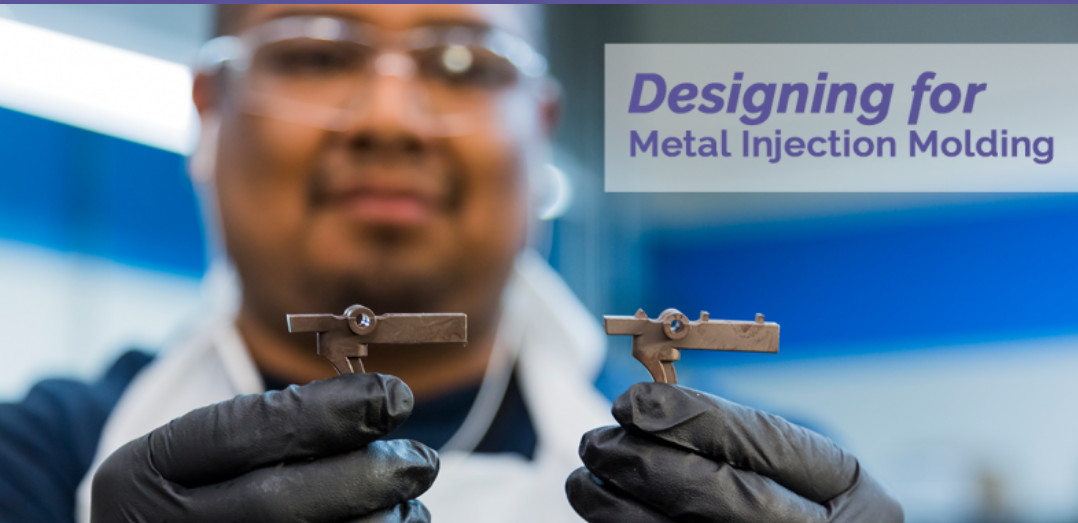
The molded part is ~60% metal, 40% binder by volume. Debinding is the careful, controlled removal of this binder without distorting the delicate powder skeleton. YICHOU utilizes a multi-stage catalytic and thermal debinding process. This gradual extraction leaves a porous, handling-strong "brown part" composed entirely of interconnected metal powder. Rushing this stage causes defects; mastering it is a core YICHOU competency.
Stage 4: Sintering – Achieving Full Metal Integrity
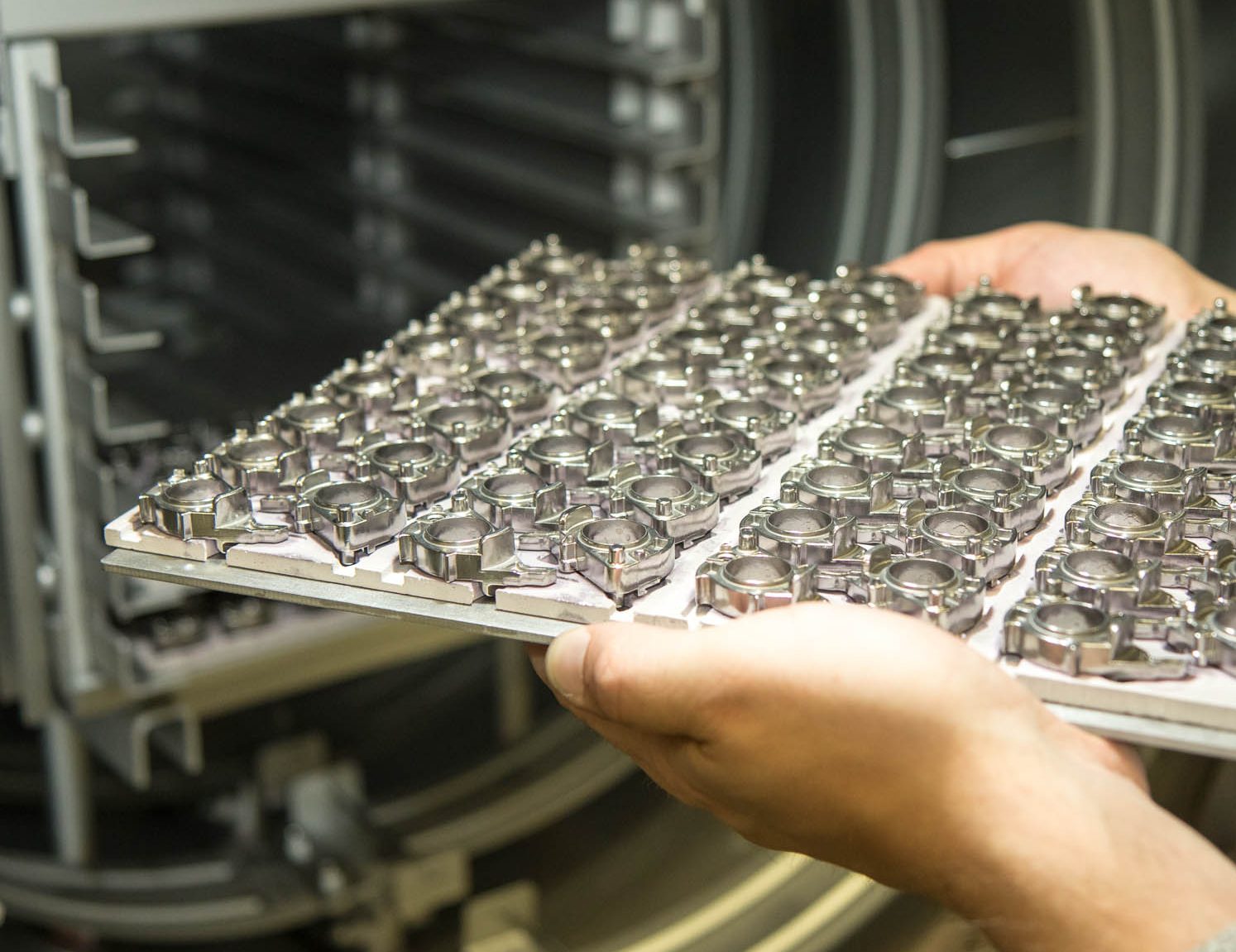
The brown part enters a high-temperature, controlled-atmosphere sintering furnace. Here, magic happens: solid-state diffusion. At temperatures approaching 80% of the alloy's melting point, metal particles fuse, pores shrink, and the part densifies, typically achieving >96% and often >99% of theoretical density. The part undergoes predictable, uniform linear shrinkage (15-20%). The result is a fully consolidated metal component with a fine, isotropic grain structure, mechanical properties rivaling wrought materials, and the net-shape geometry intact.
The Strategic Choice: A Data-Driven Comparison with Conventional Processes
Choosing a manufacturing process is an economic and technical decision. Below is a detailed comparison to guide your selection.
| Feature | Metal Injection Molding (MIM) - YICHOU | CNC Machining | Investment Casting | Traditional PM (Press & Sinter) |
|---|---|---|---|---|
| Geometric Complexity | Excellent. True 3D complexity, undercuts, thin walls. | Limited. Restricted by tool access, internal features costly. | Good. For larger parts, fine details can be lost. | Poor. Limited to simple 2D axial shapes. |
| Part Size | Small. Optimal: <100g, palm-sized. Max: ~250g. | Versatile. From tiny to very large parts. | Medium-Large. Better for parts >50g. | Small-Medium. Simple shapes. |
| Tolerances (Typical) | ±0.3% to ±0.5% (e.g., ±0.03mm on a 10mm dimension). | ±0.025mm to ±0.1mm (Very high precision possible). | ±0.5% to ±1.0% (often requires machining for tight tolerances). | ±0.1% to ±0.3% (on pressed dimensions). |
| Surface Finish (Ra) | 1 - 2 µm (excellent as-molded finish). | 0.4 - 3.2 µm (directly controllable by tooling). | 3 - 6 µm (rougher, from ceramic mold). | 2 - 5 µm (depends on tool finish). |
| Material Waste | <5%. Near-net-shape process. | 40% - 80%. Subtractive process. | Moderate. Includes gating system. | <5%. Near-net-shape. |
| Lead Time (First Part) | 12-16 weeks (includes complex tooling). | Days to weeks (no/low tooling). | 8-12 weeks (pattern & mold tooling). | 8-12 weeks (for tooling). |
| Cost Driver | High tooling, very low per-part cost. | Low tooling, high per-part (labor/machine time). | Moderate tooling, moderate per-part cost. | Moderate tooling, low per-part cost. |
| Best For Volume | >10,000 parts/year (for cost amortization). | Prototypes to ~5,000 parts. | ~500 - 50,000 parts. | >50,000 parts (for simple shapes). |
| Material Properties | High & Isotropic. Near-wrought density & strength. | Excellent. Properties of wrought billet. | Variable. Can have porosity, directional grain. | Good. Can have anisotropic properties. |
The YICHOU Advantage in Decision-Making: We provide detailed ROI analysis. For example, a complex gear housing might cost $50/part via CNC (with 70% waste) but only $5/part via MIM after tooling amortization, with a break-even point at 3,000 units. We help you model this.
The YICHOU Material Portfolio: Engineered for Performance
We process a vast range of alloys, each selected for specific functional requirements:
-
Stainless Steels (The Workhorses):
-
17-4 PH (Suspension Hardened): Delivers tensile strength >1,100 MPa and HRC 40+ after heat treatment. Ideal for: High-stress firearm components, aerospace fasteners, surgical tool jaws.
-
316L: The gold standard for corrosion resistance and biocompatibility (ASTM F138). Ideal for: Marine hardware, chemical processing implants, pharmaceutical fixtures.
-
-
High-Performance Alloys:
-
Titanium (Ti-6Al-4V): Strength-to-weight champion. YICHOU's controlled vacuum sintering achieves tensile strength >900 MPa and full biocompatibility. Ideal for: Orthopedic implants, aerospace brackets, high-performance automotive.
-
Tungsten Heavy Alloys (WNiFe): Density >17 g/cm³ for effective radiation shielding and inertial applications.
-
-
Specialized Alloys:
-
Soft Magnetic Alloys (Fe-50Ni, Fe-3Si): For high magnetic permeability and low core loss in miniaturized sensors and inductors.
-
Tool Steels (M2): For wear-resistant cutting, punching, and forming inserts.
-
Beyond the Hype: Addressing Real Concerns About MIM
Myth 1: "MIM parts are porous and weak."
Reality: Properly processed MIM parts achieve >96% density. For 17-4PH, we consistently achieve ultimate tensile strengths exceeding 1,000 MPa—comparable to bar stock. The fine, isotropic grain structure can even enhance performance in some applications versus cast or machined parts.
Myth 2: "MIM is only for non-critical parts."
Reality: MIM is trusted in life-critical applications. Our components are inside:
-
Medical: Drug-delivery implant mechanisms, robotic surgical tool ends.
-
Automotive: Anti-lock braking system (ABS) sensor rings, transmission planetary gears.
-
Firearms (A Direct Answer): The debate on forums is often about poorly executed MIM. YICHOU's MIM process, with its high-density sintering and secondary heat treatment, produces components like sears, hammers, and triggers that meet or exceed the durability and consistency requirements of leading manufacturers. The question isn't "MIM vs. Machined," it's "Quality MIM vs. Poor Quality MIM."
Myth 3: "The tooling is too expensive and slow."
Reality: It's an investment. For an annual volume of 50,000 parts, a $50,000 MIM tool might add $1 to each part's cost. A CNC-machined part costing $15 each creates a savings of $700,000 per year. The ROI is dramatic and calculable.
The YICHOU Process: Your Partnership for MIM Success
We don't just supply parts; we embed ourselves in your development cycle.
-
Co-Design & DFM Analysis: Our engineers review your CAD model within 48 hours, providing a detailed Design for MIM report suggesting draft angles, radius optimizations, and consolidation of assemblies into a single part.
-
Rapid Prototyping: Before cutting hard tooling, we offer prototyping via our modified MIM or machining from MIM feedstock to validate form, fit, and function.
-
Full-Scale Production & QC: In production, every batch undergoes stringent SPC (Statistical Process Control). We provide full material certification and first-article inspection reports (FAIR) per ISO 9001/13485 standards.
.jpg)
FAQ: Direct Answers from YICHOU Experts
Q: What's the real difference between MIM and sintering?
A: Sintering is a step within MIM. "Sintering" alone refers to traditional powder metallurgy (pressing powder in a die and sintering), which has severe shape limitations. MIM adds the injection molding step to enable complex geometry before sintering.
Q: Will MIM and AI replace CNC machinists?
A: No. They will evolve the role. The future is hybrid manufacturing. At YICHOU, we often produce a near-net-shape part via MIM and then use CNC for a final, ultra-precise machining operation on a critical bore or face. This combines the best of both worlds.
Q: What is your typical lead time?
A: For new projects: Prototypes in 4-6 weeks, production tooling in 12-16 weeks, followed by mass production. For established parts, we maintain strategic inventory for some clients to support JIT delivery.
Q: Can you match a specific wrought alloy property?
A: Often, yes. Provide us with the material spec (e.g., ASTM A564). We will engineer a feedstock and thermal cycle (sintering + heat treat) to meet or exceed those mechanical properties.
Is Your Project a Candidate for MIM? The YICHOU Checklist
Answer "Yes" to most of these, and we should talk:
-
Is the part smaller than a tennis ball and weighs less than 150 grams?
-
Does the design include complex features that are costly to machine?
-
Is your required annual volume above 10,000 pieces?
-
Are you using an expensive alloy (e.g., titanium, cobalt-chrome) where machining waste is costly?
-
Do you need consistency across hundreds of thousands of parts?
Take the Next Step: From Concept to Competitive Advantage
The complexity of modern engineering demands processes that defy old limitations. Metal Injection Molding is that process, and YICHOU is your expert guide.
Don't just read about the potential—experience it.
-
Download Our Free MIM Design Guide: A comprehensive PDF with design rules, material data sheets, and case studies. [Call-to-Action Button]
-
Submit Your CAD File for a Free DFM & Cost Analysis: Within one week, receive a detailed report outlining feasibility, optimized design, and a project quotation.
-
Schedule a Technical Consultation: Speak directly with a YICHOU project engineer to discuss your specific application.
Conclusion: Is MIM the Right Choice for Your Project?
Metal Injection Molding stands as a powerful, enabling technology in the precision manufacturing landscape. It bridges the gap between impractical complexity and economical mass production. When your project involves small, intricate, high-performance metal components required in volumes of thousands or millions, MIM demands serious consideration.
The journey to a successful MIM component begins with expert partnership. At YICHOU, we don't just supply parts; we collaborate from the design-for-manufacturability (DFM) stage through material selection, process validation, and into full-scale production. Our technical team is ready to analyze your component drawings, provide a detailed DFM report, and guide you toward the most efficient and reliable manufacturing path.
Ready to explore how MIM can revolutionize your product?
Contact YICHOU's engineering team today for a confidential design review and quotation. Let's transform your most challenging design concepts into manufacturable, high-quality reality.
Contact YICHOU for Custom MIM Solutions
For high-quality Metal Injection Molding solutions tailored to your industry, contact YICHOU today. Whether you need prototypes or high-volume production, our MIM technology will deliver exceptional results.
GET QUOTE
- Visit our website: https://www.nbyichou.com/
- Email us: [email protected]
- Call us/whatsapp: +86 13355741031
- Chat with us: Live chat support available on our website