Optimizing Coating Chemistry and Substrate Integrity for Maximum Service Life in Corrosive Environments
Featured Brand: YICHOU Electrochemical Solutions (www.nbyichou.com)
1. Introduction: The Electrochemical Revolution of 2026
The global industrial landscape is undergoing a fundamental transformation, driven by the twin imperatives of decarbonization and advanced manufacturing. At the heart of this shift lies electrochemistry—a science that has evolved from traditional chlor-alkali processes to become the backbone of the Green Hydrogen economy, semiconductor fabrication, and advanced water remediation.
In 2026, the electrochemical cell is no longer just a piece of equipment; it is a strategic asset. Efficiency is measured in kilowatt-hours per kilogram of hydrogen produced, and reliability is measured in years of continuous operation under aggressive, corrosive conditions. For engineers and procurement specialists, the single most critical component determining the success or failure of these systems is the anode.
Specifically, the Dimensionally Stable Anode (DSA) , often referred to as Mixed Metal Oxide (MMO) coated titanium anodes, represents the pinnacle of electrode technology. Unlike traditional graphite or lead anodes, which degrade and contaminate solutions, DSA anodes offer unparalleled stability, catalytic activity, and longevity. However, not all titanium anodes are created equal. The difference between a high-performance electrode that lasts a decade and a failed electrode that shuts down production in six months lies in the invisible details: substrate purity, coating precision, and manufacturing consistency.
This is where YICHOU differentiates itself. By combining aerospace-grade titanium machining with advanced precious metal coating technologies, YICHOU delivers anodes that do not just function—they optimize the entire electrolysis process. This article delves deep into the material science, coating chemistry, and rigorous quality assurance protocols that define YICHOU’s commitment to electrochemical excellence.
2. Material Science: Why Grade 1 Titanium is the Only Choice
Before a single gram of precious metal is applied, the foundation of the anode must be flawless. In the world of electrochemistry, the substrate is not merely a structural support; it is the conduit for current and the foundation upon which the catalytic coating’s lifespan depends.
The Substrate Standard: ASTM B265 Grade 1 Titanium
YICHOU exclusively utilizes ASTM B265 Grade 1 Titanium for its anode substrates. But why is this specific grade non-negotiable?
Grade 1 titanium is the softest, most ductile, and most corrosion-resistant of all titanium grades. Its key attributes include:
-
Exceptional Corrosion Resistance: In the harsh oxidizing environments of electrolysis—whether in sulfuric acid for copper foil production or chloride-rich seawater for hypochlorite generation—Grade 1 titanium forms a stable, passive oxide film that resists pitting and crevice corrosion.
-
Superior Electrical Conductivity: While titanium is not as conductive as copper, Grade 1 offers the highest conductivity among commercially pure titanium grades. This is crucial for minimizing ohmic losses (IR drop) across the electrode, directly translating to energy savings.
-
Optimal Surface Preparation: The "softness" of Grade 1 allows for precise surface roughening without creating micro-fractures that could propagate under thermal stress during the coating process.
Surface Preparation: The Art of Mechanical Interlocking
The interface between the titanium substrate and the MMO or platinum coating is the weakest link in an anode’s lifecycle. Coating failure almost always begins with delamination—the peeling away of the active layer from the substrate. To prevent this, YICHOU employs a rigorous, multi-stage surface preparation protocol.
-
Degreasing: All substrates undergo a chemical degreasing process to remove machining oils and organic contaminants that would compromise adhesion.
-
Sandblasting: Using controlled grit, the surface is uniformly textured. This increases the true surface area (roughness factor) by up to 20-30 times compared to a smooth surface. More importantly, it creates a network of undercuts and cavities.
-
Proprietary Etching: Following sandblasting, the titanium is subjected to a controlled chemical etching process. This step not only removes the native oxide layer (which can be a barrier to adhesion) but also further refines the micro-roughness created by sandblasting.
The result is a substrate that promotes mechanical interlocking. The liquid precursors used in the coating process flow into the micro-cavities of the etched titanium. Upon thermal decomposition (heating to 450-550°C), the coating solidifies within these cavities, physically anchored to the substrate. This physical bond, combined with the chemical bond formed during oxidation, creates an interface that can withstand the thermal cycling and gas evolution pressures encountered during high-current-density operation.
3. Coating Chemistry: Matching the Anode to Your Electrolyte
The chemistry of the active coating determines the anode’s selectivity, overpotential, and stability. There is no "one-size-fits-all" anode. YICHOU specializes in tailoring the coating chemistry to the specific electrolyte and electrochemical reaction required. The two primary categories are MMO coatings and platinum coatings.
The Ru-Ir (Ruthenium-Iridium) Series: Masters of Chlorine Evolution
For applications involving chloride-rich electrolytes—such as seawater electrolysis, ballast water treatment, and sodium hypochlorite generation—the Ru-Ir (Ruthenium-Iridium) oxide coating is the industry standard.
-
Mechanism: These coatings exhibit a low overpotential for the Chlorine Evolution Reaction (CER) . In a chloride environment, the desired reaction is 2��−→��2+2�−2Cl−→Cl2+2e−. A high-performance Ru-Ir anode ensures this reaction occurs at the lowest possible voltage, minimizing energy consumption.
-
Synergy of Ru and Ir:
-
Ruthenium (Ru): Provides exceptionally high catalytic activity for chlorine evolution. It is the "engine" of the coating.
-
Iridium (Ir): Acts as a stabilizer. In highly acidic chloride environments, pure RuO₂ can be prone to corrosion. The addition of IrO₂ enhances the coating’s structural stability and extends its service life dramatically, allowing the anode to withstand the high anodic potentials and aggressive chlorine environment.
-
-
Applications: Electrochlorination plants, ballast water management systems, and swimming pool salt chlorinators.
The Ir-Ta (Iridium-Tantalum) Series: The Gold Standard for Oxygen Evolution
When the electrolyte is acidic (sulfuric acid, nitric acid) or when the desired product is oxygen, the Ir-Ta (Iridium-Tantalum) oxide coating is the preferred choice. This is the coating of choice for the rapidly growing Green Hydrogen sector and high-value metal electrowinning.
-
Mechanism: This coating is optimized for the Oxygen Evolution Reaction (OER) , which is kinetically sluggish and requires a highly stable catalyst. The OER is the bottleneck in water electrolysis.
-
Stability Under Stress: In highly acidic environments (pH < 1) and at high anodic potentials, most metals corrode. The Ir-Ta coating is renowned for its extraordinary corrosion resistance. Iridium oxide is one of the few materials that remains stable under these extreme conditions.
-
Performance: YICHOU’s Ir-Ta coatings are engineered to maintain a low overpotential for oxygen evolution over thousands of hours. By minimizing the energy lost to heat generation, these anodes directly improve the efficiency of Proton Exchange Membrane (PEM) electrolyzers and electrowinning cells.
-
Applications: PEM water electrolyzers for green hydrogen, copper foil production for EV batteries, and high-purity electrowinning.
Platinum-Coated Titanium: For High-Current Density and Zero Contamination
For applications requiring extreme stability, high current densities (often exceeding 10,000 A/m²), or where absolutely no contamination from the anode is permissible, platinum-coated titanium is the ultimate solution.
-
Mechanism: Platinum is a noble metal with a high hydrogen overpotential for cathodic applications and excellent stability as an anode.
-
Application-Specific Benefits:
-
Semiconductor Plating: In the fabrication of advanced semiconductors, bath purity is paramount. Platinum’s inertness ensures no metal ions leach into the plating bath, which would otherwise cause defects in microchips.
-
Gold and Precious Metal Plating: When plating high-value metals, using a platinized titanium anode prevents the formation of sludge and ensures a pure deposit.
-
-
Loading Precision: YICHOU controls the platinum loading (typically in g/m²) with extreme precision using electrodeposition or thermal decomposition methods, ensuring uniform current distribution across the entire anode surface.
4. Defeating the "Service Life" Challenge: Quality Assurance at YICHOU
For any engineer, the number one question is not about initial performance, but about longevity: "When will this anode fail, and will it be catastrophic?" Service life is not a mystery; it is a measurable and controllable parameter, provided the manufacturer adheres to strict quality protocols. At YICHOU, service life is engineered, not assumed.
Accelerated Life Testing (ALT): Predicting Real-World Performance
To validate the durability of our coatings, YICHOU employs rigorous Accelerated Life Testing (ALT) . This is not a theoretical simulation; it is a destructive test that pushes the anode to its limits to project its lifespan under normal operating conditions.
-
The Method: A sample anode is placed in a highly aggressive electrolyte (often 1-2 mol/L H₂SO₄) and subjected to an extremely high current density, typically 20,000 A/m² or higher. The voltage across the cell is monitored continuously.
-
The Failure Point: Failure is defined as a rapid, uncontrolled rise in cell voltage (often a 5-10V jump), indicating that the coating has deactivated or delaminated.
-
Data Correlation: By understanding the relationship between current density, electrolyte aggressiveness, and coating loss, YICHOU can correlate hours of ALT at 20,000 A/m² to years of operation at a customer’s standard operating current density. A standard YICHOU Ir-Ta anode, for example, may withstand 1,000+ hours of ALT, translating to 5-10 years of continuous service in a typical industrial application.
X-Ray Fluorescence (XRF) Testing: Ensuring Precious Metal Accountability
A customer paying for a specific loading of iridium, ruthenium, or platinum deserves to receive exactly that. YICHOU utilizes X-Ray Fluorescence (XRF) analysis as a non-destructive, 100% quality control measure.
-
Precision Measurement: XRF allows us to measure the precise mass of the precious metal coating in grams per square meter (g/m²) across the entire surface of the anode.
-
Uniformity Control: We do not just test a single point. Our protocols involve mapping the coating loading across multiple zones of the anode. This ensures that the coating thickness is uniform, preventing "hot spots"—areas of higher current density that would lead to localized coating wear and premature failure.
The Multi-Layer Advantage: Uniformity and Longevity
YICHOU’s coating process employs a multi-layer thermal decomposition method. Instead of applying a single thick layer of the oxide precursor, we apply multiple thin layers, with an intermediate thermal curing step between each application.
-
Why Multi-Layer? A single thick layer is prone to cracking and internal stress during cooling. By applying thin layers, we minimize internal stress and create a dense, crack-free coating structure. This prevents the electrolyte from penetrating through the coating to the titanium substrate—a primary mechanism of failure.
5. Application Focus: Where YICHOU Anodes Excel
The technical excellence of YICHOU anodes translates into superior performance across a range of demanding industrial applications.
Green Hydrogen: Large-Scale Electrodes for Alkaline Water Electrolyzers (ALK)
As the world pivots to hydrogen as a clean energy carrier, the efficiency of water electrolyzers becomes a national and corporate priority. For Alkaline Water Electrolysis (ALK) —the most mature and scalable technology for large-scale hydrogen production—the anode must be optimized for oxygen evolution in a KOH electrolyte.
-
YICHOU’s Role: We manufacture large-format MMO-coated nickel or titanium electrodes for ALK stacks. Our Ir-Ta coatings are designed to withstand the corrosive oxidative environment of the oxygen evolution reaction while maintaining low overpotential. By reducing cell voltage, our anodes directly lower the Levelized Cost of Hydrogen (LCOH) , making green hydrogen more economically viable.
Industrial Wastewater: Electro-oxidation for COD and Ammonia Removal
Stringent environmental regulations are driving industries to adopt advanced oxidation processes. Electro-oxidation using MMO anodes is an effective method for degrading refractory organic compounds (COD) and removing ammonia nitrogen from complex industrial effluents.
-
The Challenge: Industrial wastewater often contains chlorides. Using an inappropriately coated anode can lead to the generation of unwanted chlorate or perchlorate byproducts.
-
YICHOU’s Solution: We provide specialized coatings that can be tuned to favor either direct oxidation of organics or indirect oxidation via generated active chlorine, ensuring the treatment meets environmental discharge limits efficiently and safely.
Cathodic Protection: MMO Ribbon and Tubular Anodes
Protecting critical infrastructure like pipelines, bridges, and storage tanks from corrosion is a multibillion-dollar industry. Cathodic protection (CP) relies on a long-life, stable anode to act as a sacrificial element or an impressed current source.
-
MMO Ribbon: YICHOU manufactures MMO ribbon anodes for use in deep well groundbeds and for protecting the underside of storage tanks. These anodes are designed for a service life of 40+ years, providing the ultimate in long-term, maintenance-free protection.
-
Tubular Anodes: For offshore platforms and pipelines, our tubular MMO anodes offer high current output and mechanical robustness in the most demanding marine environments.
6. Custom Engineering: Beyond Standard Plates and Mesh
Industrial electrolysis cells come in all shapes and sizes. A standard 500mm x 500mm mesh anode does not fit every application. YICHOU’s true strength lies in our ability to engineer complex geometries tailored to the specific fluid dynamics and electrical requirements of a customer’s cell.
-
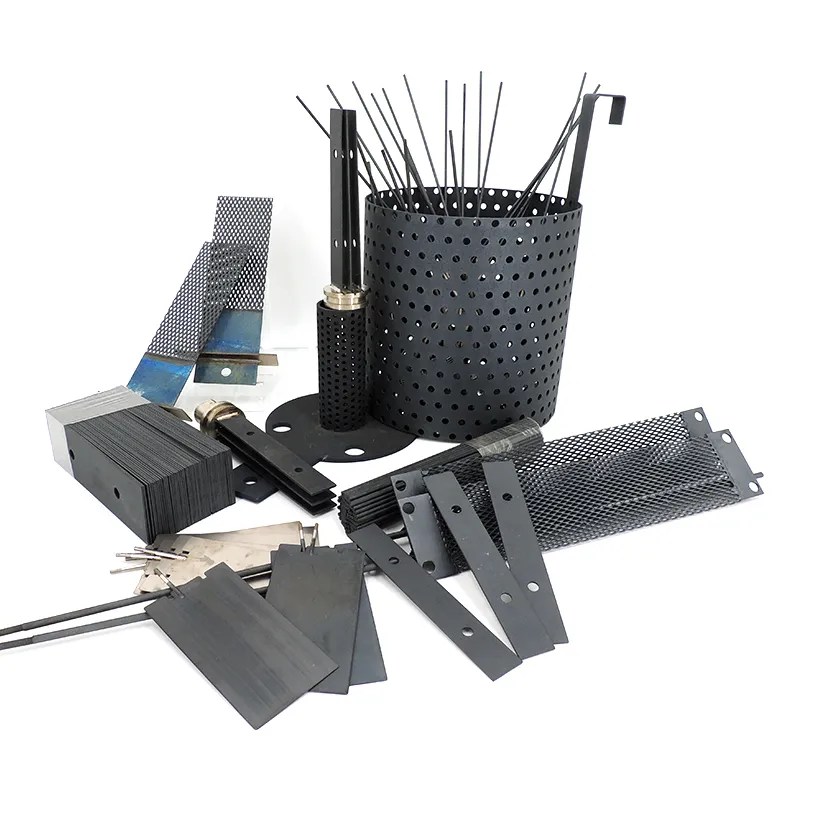
Complex Geometries: Our manufacturing capabilities extend far beyond flat sheet and expanded mesh. We produce:
-
Tubular Anodes: For bipolar electrolyzers and CP systems.
-
Wire and Rod Anodes: For plating applications requiring precise current distribution around complex parts.
-
3D-Mesh Electrodes: Designed to maximize surface area within a limited volume, increasing reaction rates and throughput.
-
Perforated Plates: Offering a balance between structural integrity and high surface area.
-
-
System Retrofitting: The Lead Anode Replacement Initiative
A significant opportunity for improved efficiency lies in replacing legacy lead (Pb) anodes. While historically common in electrowinning and electroplating, lead anodes have severe drawbacks:-
High Overpotential: They waste significant energy.
-
Contamination: Lead sludges contaminate the product and pose environmental hazards.
-
High Maintenance: They require constant manual labor to scrape and clean.
YICHOU specializes in retrofitting these legacy systems. By designing a titanium-based MMO anode to fit the exact footprint of the old lead anode, we can help customers achieve:
-
5-15% Reduction in Cell Voltage: Direct electricity savings.
-
Elimination of Lead Sludge: Zero product contamination and reduced hazardous waste disposal costs.
-
Reduced Labor: Maintenance intervals extended from weeks to years.
-
7. FAQ: Expert Technical Insights
Q: What is the typical voltage saving when switching from lead anodes to MMO titanium?
A: In copper electrowinning, for example, a lead anode typically operates with an overpotential of 800-1000 mV for oxygen evolution. A high-performance YICHOU Ir-Ta coated titanium anode typically reduces this overpotential to 300-500 mV. This translates to a direct cell voltage reduction of 0.5 to 0.7 volts. For a large tankhouse drawing 300,000 amperes, this saving equates to hundreds of thousands of dollars in annual electricity costs.
Q: How do I know if my anode needs recoating?
A: The primary indicator is a gradual but persistent increase in cell voltage over time. Since the coating’s catalytic activity degrades slowly, the voltage required to maintain the same current density will rise. At YICHOU, we offer a recoating service. We can strip the old, deactivated coating from your existing titanium substrate and apply a fresh layer, providing a cost-effective alternative to purchasing a completely new electrode.
Q: Can YICHOU design anodes for high-flow, high-turbulence cells?
A: Absolutely. Our custom engineering team specializes in designing anodes for demanding hydrodynamic conditions. We consider factors like:
-
Structural Reinforcement: Adding ribs or backing plates to prevent vibration fatigue.
-
Edge Protection: Designing robust busbars and connection points to withstand high flow rates.
-
Geometry: Using mesh or perforated plate designs to minimize flow restriction while maximizing surface area.
8. Conclusion: Engineering a Sustainable Future
In the world of industrial electrochemistry, the anode is not merely a component—it is the engine of efficiency. The decision to invest in a high-quality, precision-engineered titanium anode is a direct investment in lower operational costs (OPEX), increased uptime, and a more sustainable process.
At YICHOU, we understand that you are not just buying an electrode; you are buying the assurance of years of reliable service, the guarantee of precise precious metal loading, and the expertise to match the right coating chemistry to your specific challenge. From the purity of our Grade 1 titanium substrates to the meticulous application of our multi-layer MMO coatings, every step of our manufacturing process is dedicated to one goal: delivering electrochemical excellence.
The future of green hydrogen, semiconductor manufacturing, and clean water depends on the efficiency of the electrochemical cells at their core. YICHOU is proud to be a partner in that future, providing the precision-engineered anodes that power the next generation of industrial electrolysis.
Power up your electrolysis system today.
Are you ready to optimize your electrochemical process? Our team of experts is ready to help you select the ideal coating, design the perfect geometry, and maximize your return on investment.
-
Download our Coating Selection Guide: A comprehensive PDF detailing the performance characteristics of Ru-Ir, Ir-Ta, and Platinum coatings.
-
Request a Custom Design Consultation: Let’s discuss your unique application and current challenges.
YICHOU – Precision in Electrochemistry.
Appendix: Coating Selection Table
| Electrolyte Environment | Recommended Coating | Key Application | Key Benefit |
|---|---|---|---|
| Seawater / Brine | Ru-Ir (Ruthenium-Iridium) | Sodium Hypochlorite Generation / Ballast Water Treatment | Low overpotential for Chlorine Evolution; Excellent stability in chloride media. |
| Sulfuric Acid / Acidic | Ir-Ta (Iridium-Tantalum) | Copper Foil Production / Electrowinning / PEM Electrolysis | Unmatched stability for Oxygen Evolution in highly corrosive, low-pH environments. |
| Low pH / High Voltage | Platinum (Pt) | Semiconductor Plating / Precious Metal Plating / Ionizers | Absolute inertness; zero contamination of plating bath; capable of extremely high current densities. |
| Soil / Concrete / Seawater | MMO Ribbon / Tubular | Cathodic Protection (Pipelines, Bridges, Storage Tanks) | Ultra-long service life (40+ years) in buried or submerged conditions. |
| Alkaline (KOH/NaOH) | Ir-Ta or Ru-Ir on Ni/Ti | Green Hydrogen (ALK Electrolyzers) / Chlorate Production | Optimized for Oxygen Evolution in high-pH environments with high efficiency. |
.jpg)
Get Quote
- Email us: [email protected]
- Call us/whatsapp: +86 13355741031
- Chat with us: Live chat support available on our website