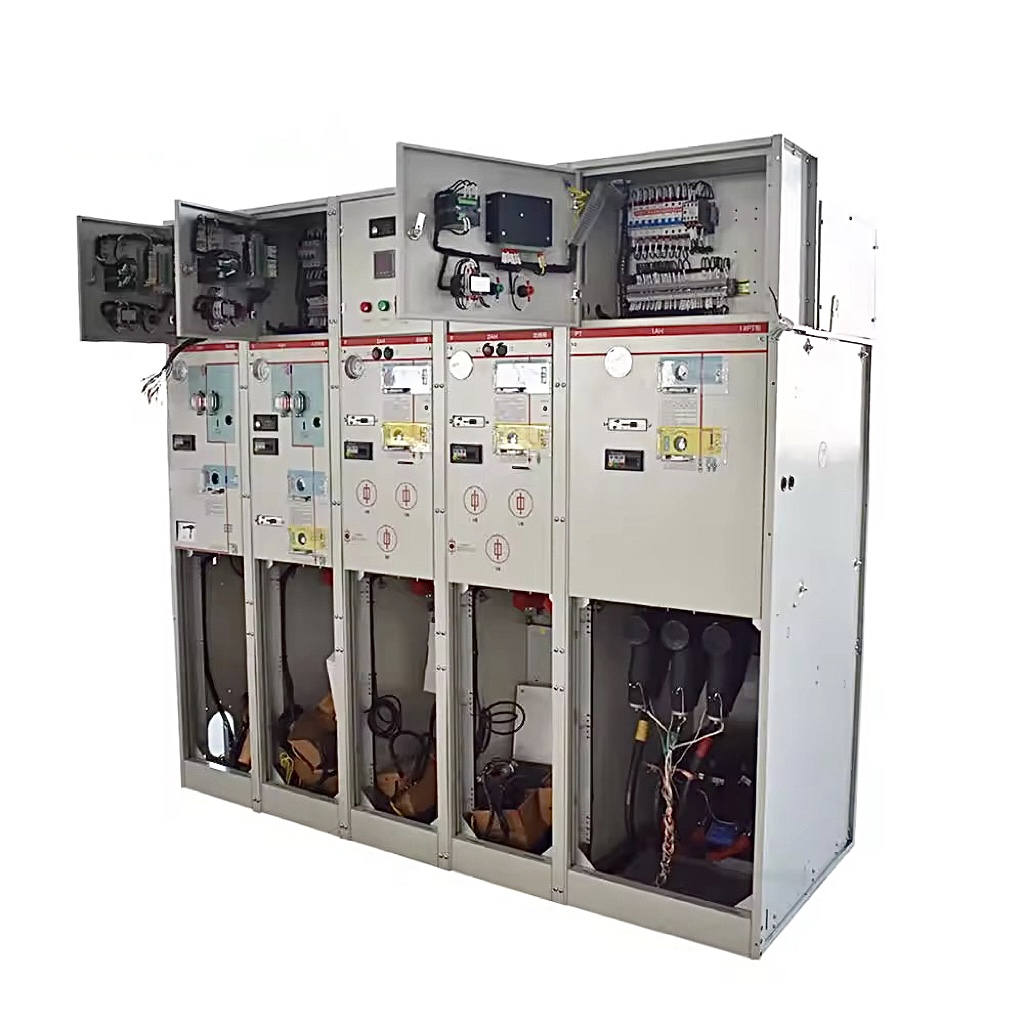
Behind every brightly lit city, every running factory, and every critical facility lies a hidden backbone: the substation. And at the heart of modern substations, a technology often unnoticed by the public is quietly redefining reliability, safety, and space efficiency.
That technology is Gas Insulated Switchgear (GIS) .
If you’re a power engineering manager, an electrical supervisor, or someone evaluating substation solutions for a new project, this guide will show you why GIS is more than just equipment—it’s an investment that pays for itself, and the clear gold standard for today’s urban power grids.
1. What Is GIS?
Imagine packing an entire substation into a sealed metal enclosure. It sounds futuristic, but that’s exactly what GIS does.
GIS stands for Gas Insulated Switchgear. All high-voltage components—circuit breakers, disconnectors, instrument transformers, busbars—are housed inside a metal tank filled with sulfur hexafluoride (SF₆) gas.
Conventional Air Insulated Switchgear (AIS) uses air as an insulator, requiring large clearances between live parts. Think of it as a sprawling suburban house. SF₆, however, has three times the dielectric strength of air, allowing GIS to be highly compact—like a fully furnished apartment in a prime urban location.
A single GIS unit is essentially a substation in miniature.
2. Four Key Advantages of GIS
① Compact Footprint – Saving Precious Land
In cities where land costs are sky-high, every square meter counts. Thanks to SF₆’s superior insulating properties, GIS requires only one-fifth to one-tenth the footprint of conventional AIS. For urban substations or industrial parks, this can save millions in land acquisition—a simple but powerful economic argument.
② Ultra-High Reliability – Built-In Peace of Mind
All live parts are fully enclosed in a grounded metal housing, immune to fog, humidity, salt spray, pollution, and high altitude. GIS is virtually unaffected by environmental conditions, resulting in exceptionally low failure rates. For mission-critical facilities like data centers, hospitals, and semiconductor fabs, where even a momentary outage is catastrophic, GIS is the clear choice.
③ Near-Zero Maintenance – Lower Lifecycle Costs
Traditional switchgear requires regular insulator cleaning and contact inspections. With GIS, operators only need to occasionally monitor gas pressure; major overhauls are needed only once every 20 to 30 years. This drastically reduces manpower and total lifecycle costs. It’s an investment that pays back in both dollars and peace of mind.
④ Safety First – Protecting People and Assets
The fully grounded metal enclosure physically eliminates the risk of accidental contact with live parts. Even in the extremely unlikely event of an internal fault, pressure relief devices instantly vent energy, containing any hazard. Safety isn’t just a slogan—it’s engineered into every detail.
3. Where Does GIS Make the Most Sense?
It’s true that GIS has a higher upfront cost—typically 20–50% more than AIS. But in certain applications, it’s not just an option; it’s the only logical answer.
-
Urban substations where land is scarce and must be used efficiently.
-
Data centers and hospitals where power continuity directly impacts life safety and business viability.
-
High-end manufacturing and chemical plants where harsh environments demand absolute reliability.
-
Hydropower, nuclear plants, and high-altitude regions where conventional equipment struggles to perform.
If your project fits any of these categories, GIS isn’t just one choice—it’s the right choice.
4. Our Commitment on SF₆
SF₆ is the insulating gas that makes GIS possible, but it is also one of the most potent greenhouse gases—with a global warming potential 23,500 times that of CO₂, and an atmospheric lifespan of centuries.
We take this responsibility seriously. Our commitment rests on three pillars:
Leakage control. Modern GIS achieves annual leakage rates below 0.5%, with some products approaching zero leakage. Over decades of operation, the amount released is negligible.
Lifecycle management. We strictly enforce SF₆ recovery procedures. During maintenance or decommissioning, all gas is recovered using specialized equipment—direct emissions are never permitted.
Next-generation alternatives. We are actively advancing eco-friendly alternatives. Products using clean air, fluoronitrile-based gases, and other low-GWP solutions are already entering commercial service. The substations of the future will be even greener.
Technology has limits, but responsibility does not.
5. Real Stories – Why They Chose Us
Case 1: A 600㎡ Challenge in Eastern China
A substation project was stalled by space constraints. The available site was just 600 square meters—too small for a conventional AIS solution. The owner was about to abandon the location.
We proposed our 126 kV GIS solution. The final substation occupied only 400 square meters, freeing up 200 square meters for landscaping. Three years on, the equipment has operated faultlessly. The maintenance team simply records gas density readings every six months. What used to be their biggest headache has all but disappeared.
Case 2: Peace of Mind for a Semiconductor Fab
At a semiconductor fab in southern China, power continuity is everything. An unplanned outage could destroy millions in production. During their selection process, they compared several suppliers before choosing us.
Why? We offered an online monitoring system that provides early warnings for gas leakage or mechanism hesitation. Before a problem disrupts operations, they receive alerts and can schedule preventive maintenance at their convenience. The system has now been running for over five years, with zero false alarms and zero missed alarms. Their feedback? “Choosing you wasn’t just about buying equipment—it was about buying peace of mind.”
These are just two examples. From high-altitude wind farms in the north to hydropower stations in the mountainous southwest, our GIS products are now in stable operation at more than 200 sites, and exported to over 20 countries and regions.
Behind every project lies a deep trust. We value it—and never take it for granted.
6. Your Project Deserves Reliable Power
If you’re evaluating options and want to save land, reduce maintenance costs, and get truly dependable power protection, we’re here to help.
You can reach us in two ways:
-
Leave a comment below with “GIS” plus your project type (e.g., “GIS data center”). One of our engineers will contact you within 24 hours to understand your specific needs.
-
Click the consultation button on the right to chat directly with one of our online representatives. Whether you’re just starting to explore options or already have clear requirements, you’ll get the same attentive service.
We’ll arrange a senior engineer to provide a free technical proposal and cost comparison, so you can make your decision with confidence—backed by clear data.
Your project deserves reliable power. We look forward to working with you.
.jpg)
Get in Touch with Yichou
- Email us: [email protected]
- Call us/whatsapp: +86 13355741031
- Chat with us: Live chat support available on our website