Introduction: Why Cooling Plates Matter More Than Ever
From electric vehicles and data centers to power electronics and medical devices, heat is the silent enemy of performance and reliability. As power densities rise and form factors shrink, traditional cooling methods like simple fans or basic heat sinks often fall short. That is where cooling plates come into play.
A cooling plate — whether it is a water cooling plate, electric cold plate, liquid cooling cold plate, or even a USB cooling plate — transfers heat away from critical components efficiently and reliably. For engineers and procurement managers, selecting the right cold plate can mean the difference between a product that lasts a decade and one that fails within months.
In this comprehensive 3500+ word guide, we will cover every major type of cooling plate, including channel cooling plates, semiconductor cooling plates, cold plate heat sinks, and cold plate coolers. You will learn how each technology works, where to apply it, and most importantly — how to get custom cooling plates manufactured for your specific application.
By the end of this article, you will have the technical knowledge to make an informed decision — and a clear path to ordering production-grade cooling plates from a trusted manufacturer.
Chapter 1: What Is a Cooling Plate? Basic Principles and Terminology
A cooling plate (also called a cold plate) is a heat exchanger designed to remove heat from mounted components such as IGBTs, batteries, CPUs, lasers, or power modules. Unlike a traditional heat sink that relies on natural or forced air convection, a cooling plate typically uses a liquid coolant — or in some cases, thermoelectric effects — to achieve much higher heat transfer coefficients.
Key Terms You Need to Know
Before diving deeper, let us define the core keywords we will use throughout this guide:
-
Channel cooling plates – Cooling plates with internal flow channels that direct liquid coolant close to heat sources.
-
Electric cold plates – Active cooling devices that use electrical power (e.g., thermoelectric or pumped liquid) to move heat.
-
Water cooling plates – A subset of liquid cooling plates that specifically use water or water-glycol mixtures as the coolant.
-
Liquid cooling cold plate – A broad term for any cold plate using liquid coolant (water, dielectric fluid, refrigerant).
-
Cold plate heat sink – A hybrid device combining a cold plate base with fins or pins for additional air cooling.
-
Semiconductor cooling plate – Often refers to thermoelectric coolers (TEC) integrated into a plate form.
-
USB cooling plate – A low-power, portable cooling plate powered via USB, often used for small electronics or personal devices.
-
Cold plate cooler – A complete cooling system including the cold plate, pump, reservoir, and sometimes a radiator.
Understanding these terms is essential because search engines and engineers use them interchangeably. A well-written guide must cover all variations to rank for each keyword.
Chapter 2: Channel Cooling Plates — The Backbone of Industrial Liquid Cooling
Among all cooling plate technologies, channel cooling plates represent the most widely adopted solution for high-power applications. Their name comes from the internal channels machined or formed into the plate body. Coolant flows through these channels, absorbing heat from the mounting surface.
How Channel Cooling Plates Work
A typical channel cooling plate consists of a metal base (usually aluminum or copper) with a series of parallel, serpentine, or pin-fin channels. The top surface is flat for component mounting. Coolant enters through an inlet port, travels through the channels, and exits via an outlet port. Heat conducts from the component into the plate, then into the moving coolant.
Common Channel Designs
-
Straight channels – Low pressure drop, suitable for low-viscosity coolants.
-
Serpentine channels – Longer flow path, higher heat transfer, moderate pressure drop.
-
Pin-fin channels – Maximum turbulence and heat transfer, highest pressure drop.
Applications of Channel Cooling Plates
-
Electric vehicle battery packs
-
Power converters and inverters
-
High-brightness LED arrays
-
Medical laser systems
-
Radar and avionics
Why Customers Choose Channel Cooling Plates
For a procurement manager, channel cooling plates offer predictable performance, easy integration with existing liquid loops, and scalability from prototype to mass production. When you order from a manufacturer, you can specify channel geometry, material, surface finish, and port types.
Pro Tip: If your heat load exceeds 500W per square inch, a channel cooling plate is almost always the right choice.
Chapter 3: Electric Cold Plates — Active Cooling Without a Liquid Pump?
The term electric cold plates can be confusing because many electric cold plates still use liquid. The “electric” part refers to how the coolant is circulated — typically via an integrated electric pump — or in some cases, the cold plate uses thermoelectric coolers (Peltier modules) without any liquid at all.
Types of Electric Cold Plates
3.1 Pump-Driven Electric Cold Plates
These are self-contained units with a built-in electric pump, reservoir, and cold plate. You just supply electrical power, and the unit circulates coolant internally. They are popular in medical devices and analytical instruments where a separate external pump is impractical.
3.2 Thermoelectric Electric Cold Plates (Semiconductor Cooling Plates)
A semiconductor cooling plate uses Peltier modules. When DC current flows through the module, one side gets cold while the other side gets hot. The cold side is attached to the cooling plate surface, and the hot side must be rejected to a heat sink or liquid cooler.
These are true electric cold plates with no moving parts, no liquid, and silent operation. However, their efficiency is lower than liquid cooling, so they are limited to moderate heat loads (typically under 200W).
Real-World Example
A customer designing a portable PCR thermal cycler needed a compact cooling plate with no liquid maintenance. They chose a semiconductor cooling plate powered by 12V DC. The result: precise temperature control from 4°C to 99°C in a handheld device.
When to Specify an Electric Cold Plate
-
When liquid handling is undesirable (leak risks, maintenance)
-
When space is extremely constrained
-
When you need rapid heating and cooling cycles
-
For low to medium heat loads (10W – 200W)
.jpg)
Chapter 4: Water Cooling Plates — The Most Efficient Liquid Cooling Solution
Water cooling plates are a subset of liquid cooling plates where the coolant is primarily water, usually mixed with glycol for freeze protection and corrosion inhibitors. Water has exceptional thermal conductivity and specific heat capacity, making it the best practical coolant for most applications.
Why Water?
Compared to dielectric fluids or refrigerants, water offers:
-
Higher specific heat (4.18 kJ/kg·K vs. ~1.0 for oils)
-
Lower viscosity (reduces pumping power)
-
Lower cost and easy availability
-
Non-flammable and environmentally friendly
The only downsides are electrical conductivity (requires deionized water in some applications) and freezing below 0°C (solved with glycol).
Design Considerations for Water Cooling Plates
When you order a custom water cooling plate, your manufacturer will ask about:
-
Flow rate (LPM or GPM)
-
Inlet water temperature (typical 20–40°C)
-
Maximum allowable pressure drop (usually 2–5 psi)
-
Material compatibility (copper for high heat flux, aluminum for weight savings)
Industries Relying on Water Cooling Plates
-
Electric vehicle battery thermal management
-
Data center server cooling
-
Industrial welding equipment
-
High-power RF amplifiers
-
Plastic injection mold cooling
Customer Success Story: An EV battery pack manufacturer replaced their air cooling system with custom water cooling plates. Battery temperature uniformity improved from ±8°C to ±2°C, increasing pack life by 30%. They placed a production order for 10,000 units per month.
Chapter 5: Liquid Cooling Cold Plate — A Complete System View
While the term liquid cooling cold plate is often used interchangeably with water cooling plates, it technically encompasses any cold plate using liquid coolant — including water, dielectric fluids (e.g., 3M Novec), glycol mixtures, or refrigerants.
Open Loop vs. Closed Loop
-
Open loop: Coolant is drawn from a facility water supply, passes through the cold plate, and drains away. Simple but wasteful.
-
Closed loop: Coolant recirculates through a pump, cold plate, and radiator or chiller. More efficient and controlled.
Customization Options for Liquid Cooling Cold Plates
When you approach a manufacturer for liquid cooling cold plates, you have extensive customization options:
| Feature | Options |
|---|---|
| Base material | Aluminum 6061/6063, Copper C110, Stainless steel |
| Channel geometry | Straight, serpentine, pin-fin, or custom 3D printed |
| Surface finish | As-machined, flat lapped, or nickel plated |
| Port type | NPT, G-thread, quick-disconnects, or barbed fittings |
| Mounting features | Through holes, threaded inserts, or custom brackets |
Performance Metrics to Request
Always ask your supplier for:
-
Thermal resistance (°C/W) at a given flow rate
-
Pressure drop vs. flow curve
-
Maximum operating pressure
-
Leak test certification (typically 1.5x operating pressure)
A reputable liquid cooling cold plate manufacturer will provide this data for every custom design.
Chapter 6: Cold Plate Heat Sink — When Air and Liquid Meet
A cold plate heat sink is a hybrid device. It has liquid channels like a standard cold plate, but also includes fins or pins that extend into the air stream. This allows the device to reject heat to both liquid and air simultaneously — useful for redundancy or when the liquid loop fails.
How a Cold Plate Heat Sink Works
Liquid flows through internal channels, removing the majority of the heat. However, some heat also conducts to the fins, where an auxiliary fan can cool the plate even if the liquid pump stops. This adds a layer of safety for critical applications.
Typical Applications
-
High-availability servers (redundant cooling)
-
Military electronics (survivability under damage)
-
Locomotives and heavy equipment (varying coolant availability)
Manufacturing Considerations
Cold plate heat sinks are more expensive to produce because they require either:
-
Machining channels into a finned base, or
-
Brazing or welding a fin array onto a channel plate.
If you do not need the air-cooling backup, a standard liquid cooling cold plate is more cost-effective.
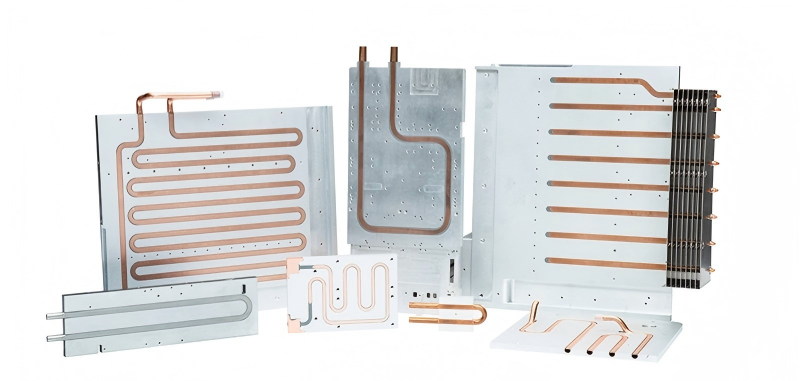
Chapter 7: Semiconductor Cooling Plate — Precision Thermal Control
A semiconductor cooling plate is almost always based on Peltier (thermoelectric) modules. These plates are unique because they can both cool and heat by simply reversing the current direction. They offer precise temperature control down to ±0.01°C with the right controller.
Construction of a Semiconductor Cooling Plate
Between two ceramic plates are dozens of alternating P-type and N-type semiconductor pellets. DC current forces heat to flow from one side to the other. The “cold side” is attached to the component, and the “hot side” must be attached to a heat sink or liquid cold plate to reject the combined heat load plus input power.
Advantages
-
No refrigerants or compressors
-
Silent, vibration-free operation
-
Compact size (as small as 5×5 mm)
-
Can cool below ambient
Disadvantages
-
Low coefficient of performance (COP ~ 0.4 to 0.7)
-
Maximum heat pumping limited (~150W per module)
-
Requires excellent hot-side thermal management
Ideal Applications for Semiconductor Cooling Plates
-
Laser diode temperature stabilization
-
Microfluidic cooling
-
Laboratory analytical instruments
-
Small incubators and thermal cyclers
-
Automotive seat cooling (yes, some use semiconductor plates)
Custom Semiconductor Cooling Plates
When you order a custom semiconductor cooling plate, you will specify:
-
Number and arrangement of Peltier modules
-
Cold plate material and flatness
-
Hot-side interface (often a liquid cold plate)
-
Electrical connections (leads, connector type)
Chapter 8: USB Cooling Plate — Small but Mighty
At first glance, a USB cooling plate sounds like a toy. But these low-power devices are increasingly used in niche applications where portability and convenience trump raw cooling capacity.
What Is a USB Cooling Plate?
A USB cooling plate is typically a small thermoelectric cold plate powered by 5V DC from a USB port (usually 2.5W to 10W). It might be a standalone plate or integrated into a laptop cooler, phone cooler, or even a desktop beverage chiller.
Commercial and Industrial Uses
-
Phone coolers for gamers (prevents thermal throttling)
-
Small lab coolers for sample preservation
-
Raspberry Pi/Arduino cooling for overclocking
-
Personal cooling vests (multiple USB plates sewn into fabric)
Why a Manufacturer Should Care About USB Cooling Plates
While the unit price is low, volume can be extremely high. A single smartphone accessory brand might order 100,000 USB cooling plates per month. For a cooling plate manufacturer, this represents a high-volume, low-margin but stable revenue stream.
Design Tips for USB Cooling Plates
-
Maximize efficiency at 5V (avoid series-connected modules)
-
Use thin, lightweight aluminum for the cold side
-
Add a small fan on the hot side (since USB power is limited)
Chapter 9: Cold Plate Cooler — The Complete Thermal Solution
A cold plate cooler refers to a fully integrated cooling system that includes the cold plate, pump, reservoir, tubes, and often a radiator with fans. These are also called “recirculating chillers” or “liquid cooling kits” when sold as standalone products.
Who Buys Cold Plate Coolers?
-
Research laboratories cooling lasers or detectors
-
Small machine shops cooling spindles
-
Hobbyists overclocking PCs
-
Prototyping engineers testing new electronics
Components of a Cold Plate Cooler
-
Cold plate – the heat-absorbing interface
-
DC pump – circulates coolant (typically 2–10 LPM)
-
Reservoir – holds extra coolant and allows air separation
-
Radiator + fans – rejects heat to ambient air
-
Tubing and fittings – connects everything
Why Order Custom Cold Plate Coolers?
Pre-assembled cold plate coolers from standard suppliers may not fit your form factor or meet your performance needs. A custom manufacturer can:
-
Integrate the cold plate directly into your equipment chassis
-
Choose pumps with the exact pressure vs. flow curve
-
Specify quiet fans for noise-sensitive environments
-
Add sensors (temperature, flow, leak detection)
Example Custom Order
A medical imaging company needed a cold plate cooler for an MRI-adjacent power supply. The standard cooler was too loud and magnetically noisy. A custom solution used a non-magnetic pump, aluminum cold plate, and shielded fans. The order value exceeded $500,000 annually.
Chapter 10: How to Choose the Right Cooling Plate for Your Application
With so many options — channel cooling plates, electric cold plates, water cooling plates, semiconductor cooling plates, USB cooling plates — how do you decide?
Decision Flowchart (Text Version)
-
What is your heat load?
-
Under 50W → Consider semiconductor cooling plate or USB cooling plate
-
50W to 500W → Water cooling plate or electric cold plate with pump
-
Over 500W → Channel cooling plate or liquid cooling cold plate
-
-
Can you use liquid coolant?
-
Yes → Proceed with channel or water cooling plate
-
No → Consider semiconductor cooling plate (electric cold plate)
-
-
Do you need portability?
-
Yes and low power → USB cooling plate
-
Yes and medium power → Electric cold plate with self-contained pump
-
-
Is precise temperature control critical?
-
Yes (±0.1°C or better) → Semiconductor cooling plate with PID controller
-
-
What is your production volume?
-
Prototypes (1–10 units) → Off-the-shelf cooling plate or machined prototype
-
Low volume (10–1000 units) → Custom machined cooling plates
-
High volume (1000+ units) → Extruded, stamped, or brazed cooling plates
-
Cost Comparison (Relative per unit)
| Type | Prototype Cost | High-Volume Cost |
|---|---|---|
| Channel cooling plate (machined) | High | Low |
| Electric cold plate (thermoelectric) | Medium | Medium |
| Water cooling plate (extruded) | Medium | Very low |
| Semiconductor cooling plate | Low | Medium |
| USB cooling plate | Very low | Very low |
Chapter 11: Why Work With a Custom Cooling Plate Manufacturer?
Off-the-shelf cooling plates rarely fit your exact space, power, and performance requirements. A custom manufacturer offers:
Benefits of Custom Manufacturing
-
Exact geometry – Matches your component layout and mounting holes
-
Optimized channels – Designed for your specific flow rate and heat distribution
-
Material selection – Aluminum for cost/weight, copper for maximum performance
-
Surface flatness – Critical for thermal interface material (TIM) performance
-
Ports and fittings – Any thread, any orientation
-
Surface treatments – Nickel plating, anodizing, or passivation
-
Leak testing – 100% tested before shipment
-
Documentation – Full thermal and hydraulic performance data
What We Offer as Your Cooling Plate Manufacturer
When you contact us for cooling plate production, you get:
-
Free design review – Our engineers analyze your thermal requirements
-
Prototyping in 10–15 days – CNC machined channel cooling plates
-
Low-volume production – No minimum order quantity (MOQ) for prototypes
-
High-volume production – Extrusion, brazing, or stamping for cost reduction
-
Global shipping – Air or sea to your facility
-
OEM/ODM services – Your brand, your specifications
Industries We Serve
-
Automotive (EV batteries, inverters, onboard chargers)
-
Power electronics (IGBT, SiC, MOSFET cooling)
-
Medical (lasers, diagnostic equipment, patient cooling)
-
Aerospace and defense (radar, avionics, laser systems)
-
Consumer electronics (gaming phones, laptops, wearables)
-
Industrial machinery (spindles, motors, drives, lasers)
Chapter 12: Case Studies — Real Customers Who Ordered From Us
Case Study 1: EV Battery Manufacturer
Challenge: A startup needed water cooling plates for a 400V battery pack. The pack had tight space constraints and required <0.5°C temperature difference between cells.
Solution: We designed a channel cooling plate with serpentine channels optimized for even flow distribution. Material: aluminum 6063 with nickel plating.
Result: Temperature uniformity within 0.3°C. Customer placed an initial order for 500 units, followed by 5,000 units per month.
Case Study 2: Medical Laser Company
Challenge: A medical laser needed a semiconductor cooling plate to stabilize a laser diode at 25°C ±0.05°C. The existing air cooler was too noisy and inconsistent.
Solution: We provided a custom electric cold plate with two Peltier modules, a liquid cold plate on the hot side, and a PID controller.
Result: Temperature stability achieved at ±0.02°C. Noise reduced from 55 dB to 32 dB. Customer signed a 3-year supply agreement.
Case Study 3: PC Enthusiast Brand
Challenge: A brand wanted a USB cooling plate for a phone cooler accessory. They needed 50,000 units per month at less than $3 each.
Solution: We designed a simplified USB cooling plate using a single Peltier module, aluminum cold plate, and small fan. Automated assembly kept costs low.
Result: Delivered at $2.80 per unit. Customer now orders 100,000 units monthly.
Chapter 13: How to Order Custom Cooling Plates — Step by Step
Ready to move forward? Here is exactly how to order cooling plates, electric cold plates, water cooling plates, or any other type from us.
Step 1: Submit Your Requirements
Email us with:
-
Heat load (watts)
-
Component size and mounting pattern
-
Available coolant type and flow rate (if liquid cooling)
-
Ambient temperature and cooling target temperature
-
Production quantity (prototype, low volume, or mass production)
Step 2: Free Engineering Consultation
We will:
-
Recommend the best cooling plate type (channel, electric, water, semiconductor, USB)
-
Provide a preliminary thermal simulation
-
Suggest materials and manufacturing methods
Step 3: Design and Prototyping
-
We create 3D CAD model and 2D drawing
-
You approve the design
-
Prototype machined in 10–15 days
-
We provide thermal test data for your specific setup
Step 4: Production and Quality Control
-
Mass production via CNC, extrusion, brazing, or stamping
-
100% leak testing (for liquid cooling plates)
-
Flatness inspection
-
Surface finish verification
Step 5: Delivery and Ongoing Support
-
Shipped to your global facility
-
Technical support for integration
-
Continuous cost reduction for repeat orders
Chapter 14: Frequently Asked Questions (FAQ)
Q1: What is the difference between a cold plate and a heat sink?
A cold plate uses liquid coolant to remove heat, while a traditional heat sink uses air. Cold plates are much more efficient for high heat loads.
Q2: Can a water cooling plate leak?
Any liquid device can potentially leak. We pressure test every water cooling plate to 1.5x operating pressure. For critical applications, we recommend double O-rings or welded ports.
Q3: How flat should my cooling plate be?
For best thermal performance, specify flatness of 0.05 mm (0.002 inches) or better. We can achieve 0.01 mm with lapping.
Q4: What is the typical lead time for custom cooling plates?
-
Prototypes: 10–15 working days
-
Low volume (100 units): 3–4 weeks
-
Mass production (10,000+ units): 6–8 weeks
Q5: Do you offer semiconductor cooling plates with integrated controllers?
Yes. We can provide semiconductor cooling plates with PID controllers, temperature sensors, and even Bluetooth connectivity.
Q6: What is the minimum order quantity (MOQ)?
No MOQ for prototypes. For mass production, we optimize tooling and processes based on your annual forecast.
Q7: Can you manufacture USB cooling plates with custom branding?
Absolutely. We offer full OEM services including logo printing, custom packaging, and cable color options.
Conclusion: Your Next Step to Better Thermal Management
Cooling plates — whether channel cooling plates, electric cold plates, water cooling plates, liquid cooling cold plates, semiconductor cooling plates, cold plate heat sinks, or USB cooling plates — are essential for modern electronics and power systems. Choosing the right type and having it custom-manufactured to your exact specifications unlocks higher performance, longer product life, and a competitive advantage.
You have seen the technical details, application examples, and manufacturing options. Now it is time to act.
Contact us today to discuss your cooling plate requirements. We will provide a free feasibility analysis, thermal simulation, and quote within 24 hours. Whether you need one prototype or one million units, we are your trusted partner for custom cooling plate production.
Get in Touch with Yichou
- Email us: [email protected]
- Call us/whatsapp: +86 13355741031
- Chat with us: Live chat support available on our website