Quick Answer: A turboprop engine is a gas turbine powerplant that drives an external propeller through a reduction gearbox, extracting the majority of its energy as shaft power rather than jet thrust. It delivers superior fuel efficiency at low-to-medium subsonic speeds (below Mach 0.6) and is the propulsion of choice for regional airliners, utility aircraft, military transports, maritime patrol platforms, and long-endurance UAVs .-1-9
Introduction: Why Turboprop Engines Remain Indispensable
In an era dominated by high-bypass turbofans and the push for ever-higher cruise speeds, the turboprop engine occupies a deliberately different niche—one defined by thermodynamic efficiency, short-field capability, and operational economics rather than raw velocity. For regional airliners hopping between airports separated by 300 to 600 nautical miles, for cargo aircraft operating from unpaved strips in remote terrain, and for maritime patrol platforms that must loiter on station for hours at low altitude, the turboprop remains unmatched.
The engineering challenge behind every dependable turboprop is deceptively complex. It requires coupling a high-speed gas turbine—spinning at tens of thousands of RPM—to a propeller that must turn slowly enough to avoid blade-tip compressibility losses. The reduction gearbox that bridges this gap is a precision assembly subject to immense torque loads, cyclic fatigue, and stringent airworthiness requirements. Behind every reliable turboprop lies a manufacturing ecosystem capable of producing impellers, blisks, turbine wheels, gears, shafts, and housings to tolerances measured in microns.
This guide examines the turboprop engine from first principles through to the manufacturing realities that determine whether a design becomes a dependable powerplant or a maintenance burden.
1. What is a Turboprop Engine? (Direct Answer)
A turboprop engine is a gas turbine aircraft engine that uses a turbine to drive a reduction gearbox connected to an external propeller. The propeller generates the majority of the engine‘s thrust, while a small residual amount—typically around 10%—comes from exhaust jet velocity . Unlike a pure turbojet, which accelerates a small mass of air to very high velocity, a turboprop accelerates a large mass of air to moderate velocity, a strategy that yields higher propulsive efficiency at lower flight speeds .-2-9
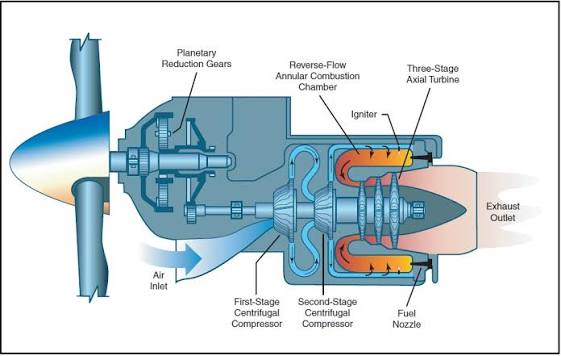
The core architecture mirrors that of any gas turbine: intake, compressor, combustor, and turbine. The defining addition is the power extraction section—either an additional turbine stage on the same shaft as the compressor (fixed-shaft design) or a separate free power turbine that drives the propeller through an independent shaft . In both configurations, the turbine extracts energy from the hot combustion gases far beyond what is needed to drive the compressor, and this surplus energy is transmitted through the gearbox to the propeller.-1
2. How Does a Turboprop Engine Work? Step by Step
The operational sequence of a turboprop engine follows a continuous thermodynamic cycle:
Step 1: Air Intake and Compression. Ambient air enters through the intake and is compressed by either a centrifugal or axial compressor. The compressor raises the pressure of the air, preparing it for combustion. In most modern turboprops, the compression ratio is moderate compared to high-performance turbofans, optimized for the engine‘s intended operating regime rather than peak thermodynamic efficiency at high altitude.
Step 2: Combustion. The compressed air is mixed with fuel—typically Jet-A1 or a comparable kerosene-based aviation fuel—and ignited in the combustor. Combustion occurs continuously rather than in discrete pulses, producing a stream of high-temperature, high-pressure gas.
Step 3: Turbine Expansion and Power Extraction. The hot gases expand through the turbine stages. The first turbine stages extract enough energy to drive the compressor. In a turboprop, additional turbine stages—or a separate free power turbine—extract further energy to drive the propeller. By the time the gases reach the exhaust nozzle, much of their useful energy has been removed, which is why turboprop exhaust provides only a small fraction of total thrust .-1
Step 4: Reduction and Propeller Drive. The power turbine shaft rotates at high speed—often 20,000 to 40,000 RPM depending on engine size. The reduction gearbox steps this down to a propeller speed typically in the range of 1,500 to 2,000 RPM, simultaneously multiplying torque. This gearing is essential: propeller tips approaching sonic velocity would generate unacceptable noise, drag, and efficiency loss .-14
Step 5: Thrust Generation. The spinning propeller accelerates a large volume of air rearward, producing thrust. A small additional contribution comes from the residual exhaust jet. The balance between propeller thrust and jet thrust shifts with airspeed—the propeller dominates at low speed, while jet thrust contribution increases marginally at higher speeds.
3. The Critical Role of the Reduction Gearbox
The reduction gearbox is arguably the most distinctive—and most demanding—component of a turboprop engine. Its function is straightforward: convert high-RPM, low-torque turbine output into low-RPM, high-torque propeller drive. Its execution is anything but simple.
Two primary architectures dominate. In a fixed-shaft design, the propeller is mechanically linked to the same shaft that drives the compressor, as in the Honeywell TPE331. This simplifies the control system but means the propeller cannot be decoupled from the gas generator during starting or in the event of a propeller strike. In a free-turbine design, exemplified by the Pratt & Whitney Canada PT6, the power turbine is aerodynamically coupled to the gas generator but mechanically independent. This allows the propeller to remain stationary while the gas generator spools up during starting, and it provides a degree of protection: a propeller strike damages the power section and gearbox without necessarily destroying the gas generator .-2
Gearbox internals must withstand extraordinary loads. A 2,000 SHP turboprop might transmit well over 1,000 lb-ft of torque continuously, with transient loads during takeoff and reverse thrust significantly higher. Gears are typically carburized and ground to AGMA quality levels, with splines and shafts designed to resist bending fatigue, pitting, and torsional stress. The gearbox housing itself must maintain precise bearing alignment and concentricity under thermal cycling and vibration—requirements that demand five-axis machining and coordinate measuring machine (CMM) validation.
4. Turboprop vs. Turboshaft: Shared Core, Different Loads
The distinction between a turboprop and a turboshaft engine is often misunderstood because the two share nearly identical thermodynamic cores. Both are shaft-power gas turbines. The difference lies in the output load and the structural requirements that follow.
A turboshaft engine delivers shaft power to a transmission that is structurally supported by the vehicle—most commonly a helicopter‘s main rotor gearbox, but also auxiliary power units, marine drives, and industrial generators. The engine itself does not carry the bending loads of a rotating propeller . A turboprop engine, by contrast, must be designed to absorb propeller loads: thrust forces, gyroscopic moments during maneuvering, and vibration from the propeller assembly. The engine casing and mounting structure are consequently more robust in a turboprop application.-1
This is why many engine families are offered in both variants. The Pratt & Whitney PT6, for instance, exists as both a turboprop (PT6A) and a turboshaft (PT6B/C), with the core gas generator shared but the power section and reduction housing tailored to each application .-2
5. Turboprop Configurations and Market Applications
5.1 Small Turboprop Engines and Twin-Engine Platforms
The small turboprop segment—roughly 500 to 2,000 SHP per engine—serves a diverse market. Single-engine turboprops such as the Pilatus PC-12 and Cessna Caravan demonstrate that a well-designed turboprop can combine respectable cruise speeds (250–300 knots) with the ability to operate from short, unpaved runways. Twin-engine turboprops like the Beechcraft King Air family and the Britten-Norman Islander serve markets where engine-out safety margin is required for overwater or night operations .-8-12
The Britten-Norman BN2T-4S Islander, recently type-certificated for the US market, illustrates the enduring appeal of the twin-turboprop formula: a high-wing, fixed-gear aircraft capable of carrying nine passengers or configured for special missions including medevac, maritime patrol, and intelligence, surveillance, and reconnaissance (ISR) .-8
5.2 Military Propeller Aircraft: Cargo, Maritime Patrol, and Tactical Airlift
Military operators have never abandoned the turboprop. Tactical airlifters like the C-130 Hercules and A400M rely on turboprops for their ability to operate from short, semi-prepared airfields and their favorable fuel consumption during low-level and loiter profiles.
The maritime patrol mission provides particularly compelling evidence of turboprop advantages. When Lockheed Martin selected the propulsion system for what became the P-8 Poseidon‘s predecessor proposal, the company cited specific performance advantages: a turboprop would provide 60% shorter takeoff roll, burn 27% less fuel than a turbofan at the mission‘s loiter conditions, and deliver 50% faster thrust response while operating at heavy weights and low altitudes . These are not marginal differences—they directly determine mission endurance, basing flexibility, and operating cost.-4
5.3 Fuel Versatility and Heavy-Fuel Compatibility
Turboprop engines burn kerosene-based fuels—Jet-A, Jet-A1, JP-8, and equivalent military specifications. This aligns with the military‘s single-fuel logistics doctrine, where ground vehicles, generators, and aircraft share a common fuel supply. For civil operators in remote regions, the availability of Jet-A is often more reliable than aviation gasoline, which has become increasingly scarce and expensive as the piston-engine fleet ages.
The concept of “aircraft diesel engines” in the turboprop context refers to compression-ignition piston engines designed to burn Jet-A, not to turbine engines themselves. However, the heavy-fuel compatibility of the turbine engine—its ability to operate on a wide range of kerosene-based fuels without modification—remains one of its operational strengths in austere environments.
6. Technical Comparison: Turboprop vs. Turbofan vs. Turbojet vs. Turboshaft
The following table summarizes the key performance and application characteristics of each propulsion type.
| Propulsion Type | Primary Thrust/Power Mechanism | Optimal Speed & Runway Profile | Subsonic Fuel Efficiency | Typical Applications |
|---|---|---|---|---|
| Turboprop | Geared propeller (majority) + minor exhaust thrust | Low-to-medium subsonic (below Mach 0.6); short/unpaved runways | High in target regime | Regional airliners, utility/cargo aircraft, military transports, maritime patrol, UAVs -1-9 |
| High-Bypass Turbofan | Ducted fan + core exhaust | High subsonic cruise (Mach 0.78–0.85); paved commercial runways | Very high at high altitude and long range | Commercial airliners, widebody transports -9 |
| Pure Turbojet | High-velocity exhaust jet | High subsonic to supersonic; long paved runways | Lower (higher specific fuel consumption) | Supersonic military aircraft, target drones, missiles |
| Turboshaft | Shaft torque via transmission/gearbox | Rotorcraft hover/forward flight; stationary drives | High per shaft horsepower in class | Helicopters, APUs, industrial/marine drives -1 |
The data confirms that turboprops are not simply “less capable” than turbofans—they are optimized for a different mission space. Below approximately 400 knots and 25,000 feet, the turboprop‘s large-diameter propeller achieves propulsive efficiency that no ducted fan can match . Above that regime, compressibility effects on the propeller tips and the turbofan‘s superior high-altitude performance reverse the advantage.-9
7. Precision Manufacturing Behind Critical Turboprop Components
The reliability of a turboprop engine is ultimately determined by the quality of its manufactured components. Three categories deserve particular attention.
7.1 Compressor Impellers, Blisks, and Hot-Section Turbine Hardware
The compressor impeller—whether a traditional built-up assembly or an integrally bladed disk (blisk)—is one of the most demanding parts to manufacture. Aerodynamic surfaces must be machined to tolerances that maintain efficient flow while withstanding centrifugal stresses at maximum RPM. Five-axis simultaneous CNC machining allows the complex blade geometries and hub contours to be produced in a single setup, minimizing fixturing error and preserving surface integrity.
On the hot side, turbine wheels, nozzle guide vanes, and combustion liners operate at temperatures approaching or exceeding the melting point of the base alloy. Vacuum investment casting of nickel-based superalloys produces the complex internal cooling passages and directional grain structures required for durability. Post-cast machining and coating application must preserve these features while achieving the dimensional precision needed for assembly.
7.2 High-Torque Gearbox Gears, Splines, and Precision Shafts
The reduction gearbox gears are typically manufactured from high-strength alloy steels, carburized to achieve a hard, wear-resistant surface case while retaining a tough, fatigue-resistant core. Grinding after heat treatment corrects distortion and establishes the final tooth profile. Splines must transmit torque without fretting or misalignment, and shafts must maintain straightness and concentricity under bending loads. Non-destructive testing—magnetic particle, fluorescent penetrant, and ultrasonic inspection—verifies that no subsurface defects compromise these safety-critical parts.
7.3 Structural Housings, Mounts, and Metrology Validation
Gearbox housings and engine mounts establish the alignment of bearings and gears and transmit thrust and vibration loads to the airframe. Machining of these structures requires large-bed five-axis capability and careful thermal management to avoid distortion. Final validation through CMM inspection confirms bore alignment, perpendicularity, and concentricity. NDT methods including radiographic and dye penetrant inspection verify casting soundness. For aerospace programs, this metrology data becomes part of the certification evidence chain.
8. FAQ: Turboprop Engine Questions Answered
Q1: What is the main difference between a turboprop and a turboshaft engine?
Both share a gas turbine core, but a turboprop drives an external propeller to generate forward thrust, while a turboshaft delivers shaft power to a transmission—typically a helicopter rotor system or an industrial drive. Turboprop engines must be structurally reinforced to carry propeller loads .-1
Q2: Why do turboprop engines use a reduction gearbox?
Turbine stages operate efficiently at high rotational speeds, but propeller tips would become supersonic—causing massive efficiency loss and noise—if driven at turbine RPM. A reduction gearbox steps down turbine speed while multiplying torque, allowing both the turbine and propeller to operate at their respective optimal speeds .-14
Q3: Are turboprops more fuel-efficient than turbofans?
Only within their intended speed and altitude regime. Below approximately 400 knots and 25,000 feet, turboprops burn less fuel per seat-mile or per ton-mile. Above that regime, high-bypass turbofans are more efficient because their ducted fans maintain efficiency at higher speeds where propeller tip compressibility becomes limiting .-9
Q4: Can turboprop engines operate on diesel or alternative fuels?
Turbine engines can operate on a range of kerosene-based fuels including Jet-A, Jet-A1, JP-8, and equivalent specifications. They cannot operate on piston-engine aviation gasoline without modification. The “heavy fuel” advantage of turboprops relative to piston engines—their ability to burn widely available kerosene—is significant for military and remote-area operations.
Q5: What manufacturing capabilities are required for turboprop components?
Safety-critical turboprop components require five-axis CNC machining for impellers and blisks, vacuum investment casting for hot-section superalloy parts, controlled heat treatment (carburizing, hardening) for gears and shafts, precision grinding for gear teeth and bearing surfaces, and comprehensive metrology including CMM inspection and NDT. Aerospace quality validation to standards such as ISO 9001 and AS9100D provides the framework for these processes.
Conclusion: Engineering Precision as the Foundation of Turboprop Reliability
The turboprop engine‘s enduring relevance in regional aviation, military logistics, and special-mission platforms rests on a simple thermodynamic truth: at moderate speeds and altitudes, a large, slowly turning propeller is a more efficient thrust generator than a ducted fan. But realizing that theoretical advantage in a dependable, maintainable powerplant requires manufacturing excellence at every level—from the aerodynamic surfaces of compressor impellers to the carburized flanks of gearbox gears.
For propulsion engineers and procurement specialists, understanding the turboprop means understanding both its operational envelope and the manufacturing chain that supports it. Every hour of reliable turboprop operation is built on precision machining, metallurgical control, and dimensional validation that begins long before the engine is assembled.
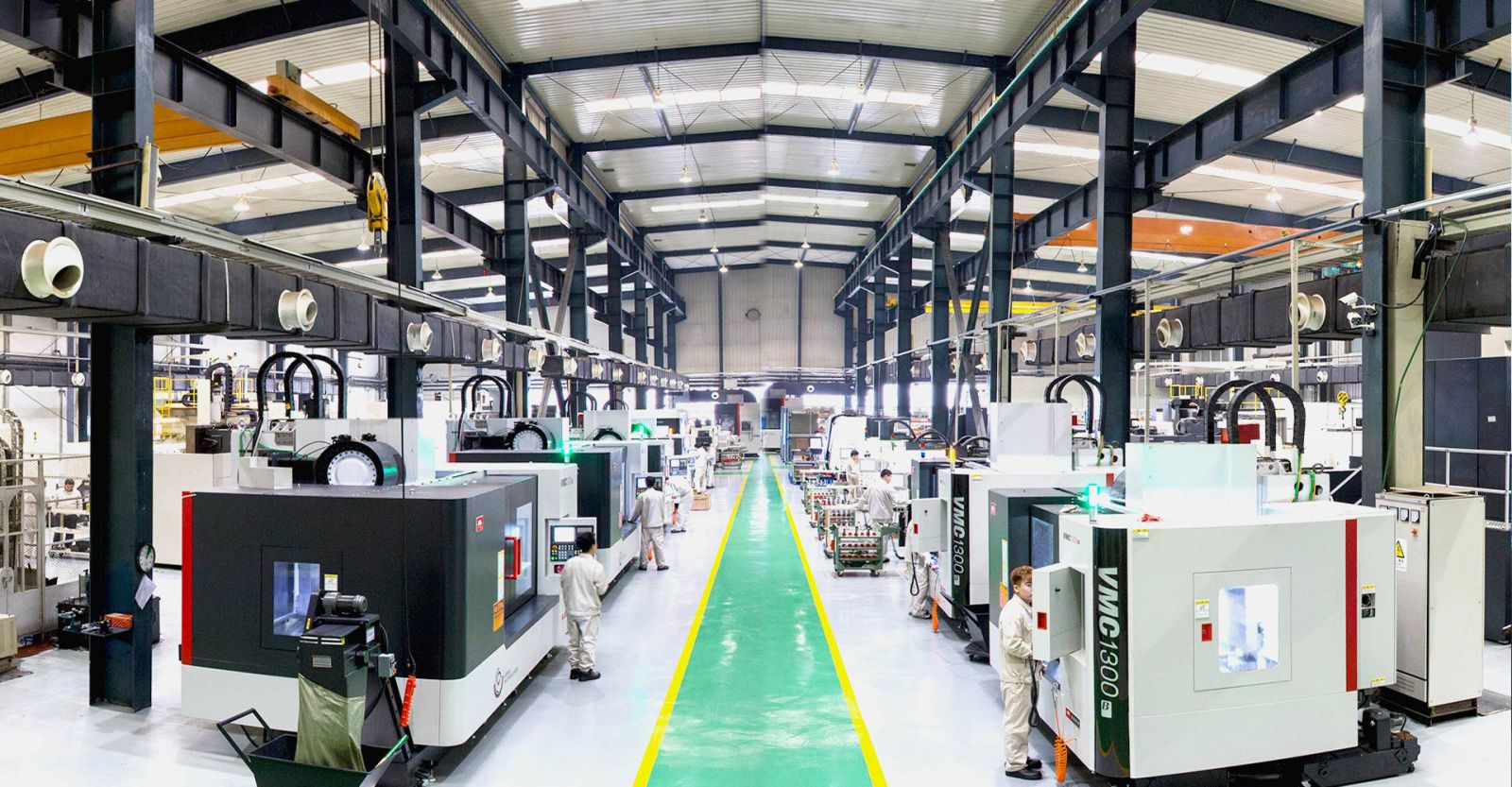
Looking for a manufacturing partner for turboprop components? YICHOU (www.nbyichou.com) provides five-axis CNC machining for impellers and blisks, vacuum investment casting for superalloy turbine hardware, and precision fabrication of carburized gears, splines, shafts, and structural housings. Upload your 3D STEP files and 2D drawings for a DFM review and quotation.
Get in Touch with Yichou
- Email us: jack@nbyichou.com
- Call us/whatsapp: +86 13355741031
- Chat with us: Live chat support available on our website