Meta Description: Compare turbojet, turbofan, turboprop, and turboshaft engines from a sourcing perspective. Learn how to qualify suppliers for Inconel impellers, turbine wheels, and blisks—and where YICHOU fits as a precision manufacturing partner for aerospace, UAV, and industrial gas turbine programs.
Why Engine Architecture Matters to Procurement Teams
Every gas turbine engine shares the same thermodynamic core: a compressor squeezes air, a combustor burns fuel, and a turbine extracts energy to drive the compressor and produce either jet thrust or shaft power . The Brayton cycle does not change. What changes is how engineers apportion that energy—and that decision cascades directly into what you buy, how it is made, and who can make it reliably.-1-2
For sourcing and engineering teams evaluating propulsion systems or placing orders for rotating turbomachinery, the four architectures below represent four distinct supply chains with different material specifications, tolerance regimes, and qualification burdens. Understanding these differences is the first step toward asking the right questions of any potential manufacturing partner.
Quick Reference: Four Architectures, Four Sourcing Profiles
| Engine Type | Primary Output | Optimal Regime | Key Sourced Components | Manufacturing Priority |
|---|---|---|---|---|
| Turbojet | High-velocity exhaust thrust | High subsonic to supersonic | Compressor impellers, turbine wheels, nozzle guide vanes | Compact diameter, high RPM balance, thermal fatigue resistance |
| Turbofan (High-Bypass) | Fan + core thrust | High subsonic cruise | Wide-chord fan blades, blisks, compressor cases | Aerodynamic profile accuracy, weight optimization, fuel efficiency |
| Turbofan (Low-Bypass) | Core jet + bypass thrust | High subsonic to supersonic | Blisks, afterburner components, turbine modules | Thrust density, cooling effectiveness, high-temperature capability |
| Turboprop | Propeller thrust via gearbox | Low to medium subsonic (<400 kt) | Reduction gearbox parts, compressor/turbine rotors | Gear tooth accuracy, shaft concentricity, efficiency at moderate speeds |
| Turboshaft | Shaft torque via gearbox | Hover to medium forward speed | Free power turbine, output shaft, main gearbox | Torque transmission, bearing journal tolerances, continuous-duty reliability |
The turbojet remains the simplest architecture: all intake air passes through the core, and thrust comes entirely from exhaust velocity . This gives it a small frontal cross-section and strong supersonic performance, but higher specific fuel consumption at subsonic speeds compared to turbofans or turboprops. For high-speed UAVs and target drones, the trade-off is often acceptable—what matters more is compact envelope and thrust-to-weight.-2
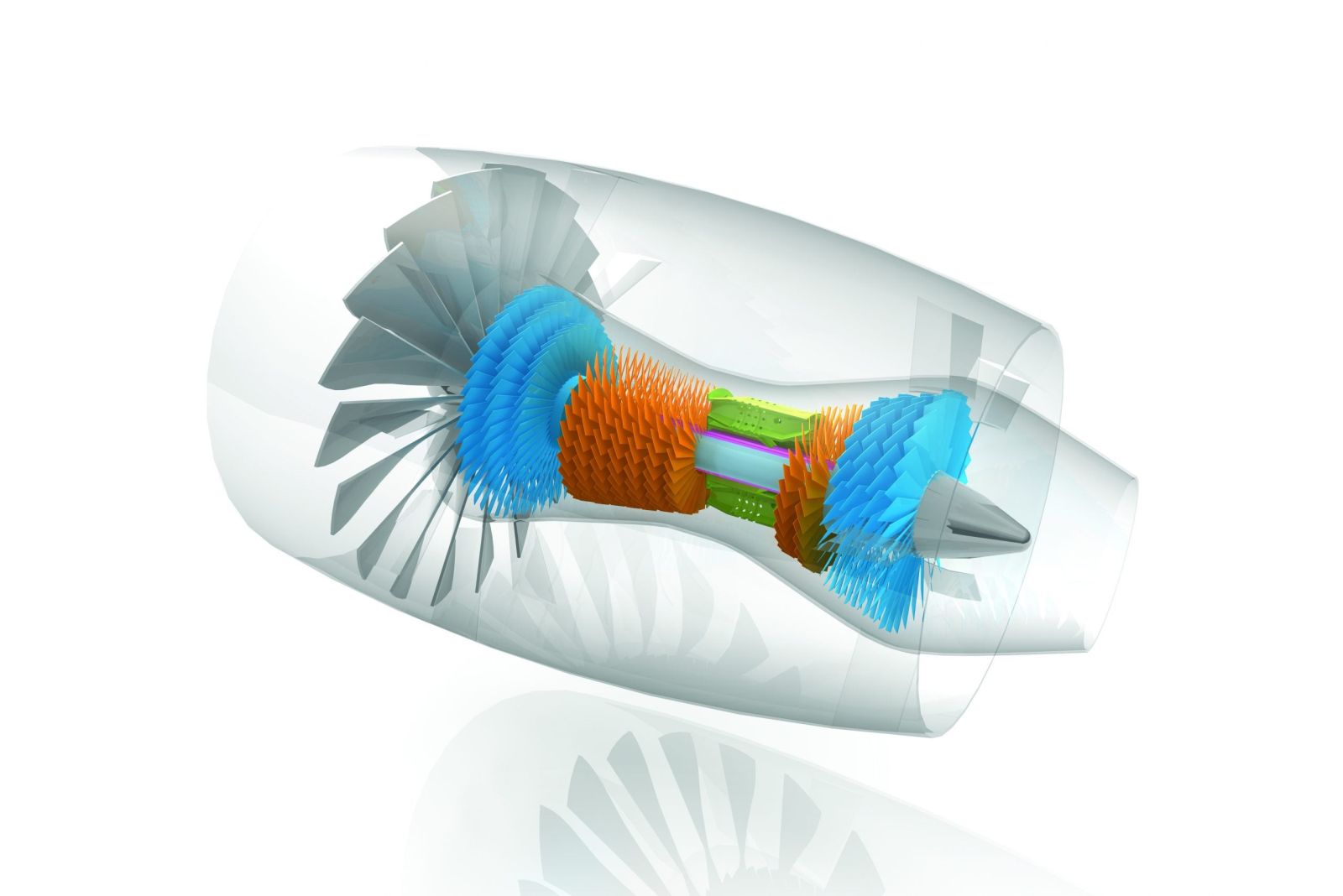
The turbofan adds a ducted fan ahead of the core. High-bypass variants move large volumes of cooler air at lower velocity, dramatically improving propulsive efficiency; this is why they power virtually every modern commercial airliner . Low-bypass variants, often with afterburners, retain more energy in the core stream for tactical aircraft requiring thrust density over fuel economy.-2
Turboprops and turboshafts extract nearly all available energy through the turbine to drive a shaft rather than relying on residual jet thrust . The turboprop drives a propeller through a reduction gearbox; the turboshaft delivers torque directly to a rotor system or industrial drive. From a manufacturing standpoint, both place the highest demands on shaft concentricity, gearbox precision, and continuous-duty bearing surfaces.-2
The Components That Actually Get Sourced
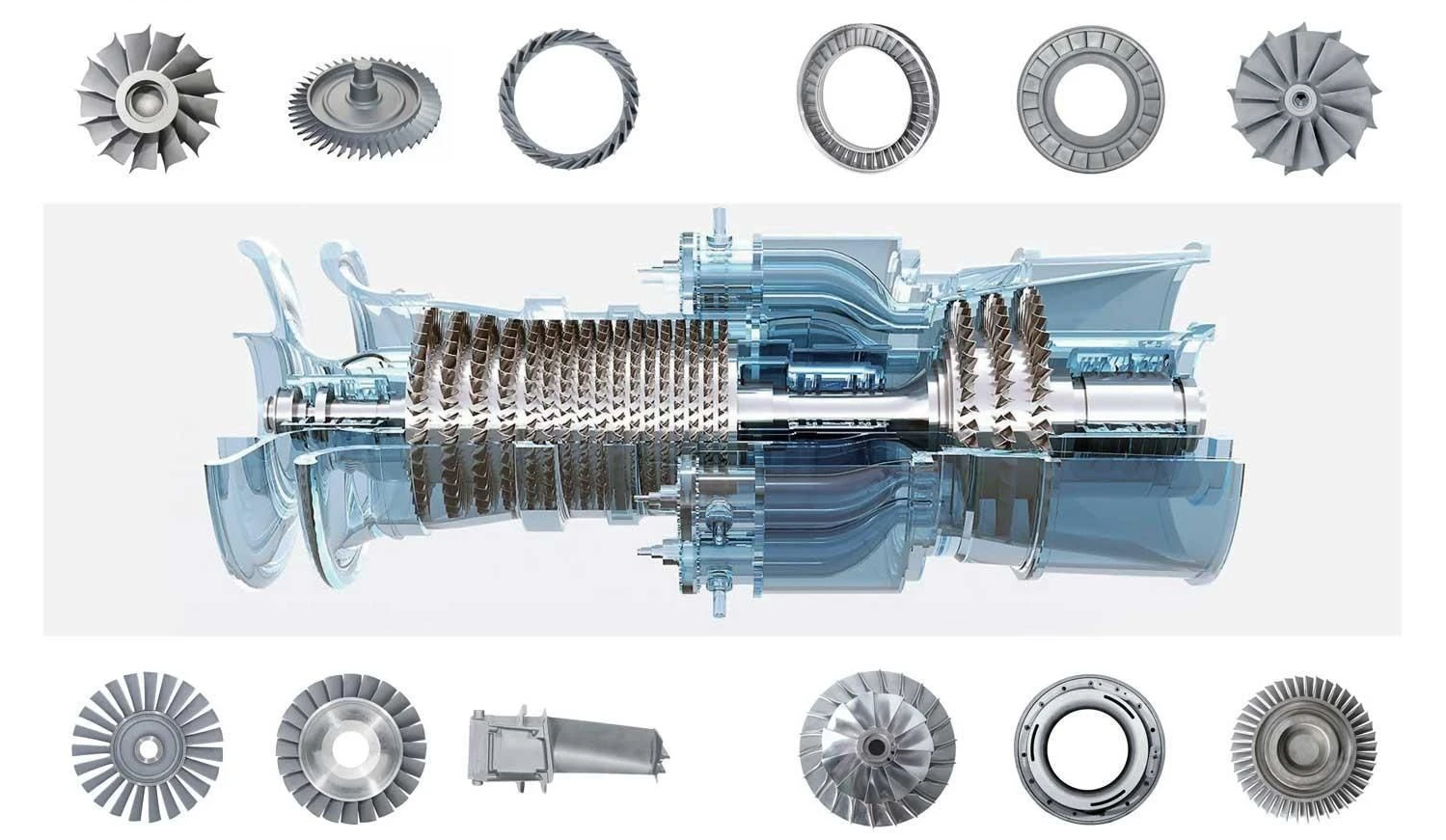
Regardless of architecture, four component families dominate procurement activity in gas turbine supply chains. Each carries distinct manufacturing challenges that separate capable suppliers from order-takers.
Compressor Impellers and Blisks
Centrifugal impellers and integrally bladed disks (blisks) require 5-axis simultaneous CNC machining to achieve the complex vane geometry that maintains aerodynamic efficiency and prevents stall. Inconel 718 and titanium 6Al-4V are common material choices, both of which demand rigid machine tools, optimized coolant strategy, and tooling that can survive abrasive nickel-based alloys without excessive wear.
A supplier that claims 5-axis capability but cannot demonstrate experience with Inconel is a risk. Ask for a first article inspection report from a comparable part, not a catalog page.
Turbine Wheels and Nozzle Guide Vanes
Hot-section components operate under sustained thermal and centrifugal stress. Nickel-based superalloys, often produced through vacuum investment casting, are the baseline material. Controlled solidification and hot isostatic pressing (HIP) are frequently specified to eliminate internal porosity and ensure consistent mechanical properties .-5
The manufacturing route matters here: a casting supplier that also performs finish machining can reduce handoff risk, but only if the casting quality supports the final tolerance. A machinist working from a porous or distorted casting will chase dimensions and still miss.
Combustion Liners and Transition Pieces
Thin-wall geometry, cooling hole patterns, and thermal barrier coating adhesion are the controlling variables. These parts are unforgiving of weld quality and datum coordination—a liner that passes local dimensional inspection can still fail assembly if mounting features do not align with the casing interface.
Rotors, Shafts, and Gearbox Components
Dynamic balance and runout control are non-negotiable. Compact turboshafts and turbojets can spin at tens of thousands of RPM; a rotor with marginal concentricity will vibrate, generate heat, and fail prematurely. Multi-plane balancing, bearing journal tolerance control, and documented runout measurement are minimum expectations from any credible supplier.
YICHOU’s gas turbine parts portfolio covers compressor blades, turbine vanes, combustion liners, nozzles, shrouds, rotors, and casings, with material capabilities spanning Inconel 718/738, Hastelloy, titanium alloys, and cobalt alloys . The manufacturing scope includes multi-axis CNC machining, investment casting, and HIP treatment—the three process pillars that determine whether a hot-section or rotating part will survive its duty cycle.-13
How to Qualify a Supplier (Without Learning the Hard Way)
Most procurement teams default to a predictable sequence: request a quote, check for an ISO certificate, ask for a sample, and proceed if the price is acceptable. This leaves gaps that often surface months later, when a production run fails or a part that passed incoming inspection begins causing field problems .-9
A more defensible qualification process asks harder questions earlier.
Start with capability, not price. A supplier with 3-axis machines quoting on a blisk that requires 5-axis simultaneous machining will either quietly decline or produce a part that misses profile tolerance. Request a machine list and ask specifically which of their machines cut Inconel or titanium in production, not just in theory .-9
Treat certification as a floor. ISO 9001 confirms a documented quality system exists. It does not confirm that the system performs. For aerospace and gas turbine work, AS9100 and Nadcap special process approvals carry substantially more weight. YICHOU operates under ISO 9001 with full quality control including CMM, X-ray, ultrasonic, and penetrant testing —but buyers should verify the specific scope of any supplier’s certification against the processes they are purchasing.-13
Inspect the sample like it matters. Visual inspection of a sample part misses dimensional issues that only appear under CMM verification. Request a First Article Inspection Report alongside the sample. A supplier that produces FAI documentation routinely operates at a different quality consciousness than one unfamiliar with the process .-9
Ask about the non-conforming material process. How does the supplier identify, segregate, and disposition suspect parts? A mature quality system has a clear answer. If the response is vague, the system is likely reactive rather than preventive.
For teams sourcing cast-and-machined assemblies, one additional question is worth asking: does the supplier control both the casting and the finish machining? YICHOU’s combined casting and CNC machining capability allows buyers to place a single order for a turbine wheel blank and finished part, reducing the coordination burden and the risk of tolerance disputes between two suppliers .-13
The Current Supply Chain Reality: Why Lead Times Are Stretched
The gas turbine supply chain is under structural stress that affects every architecture discussed above. Global gas turbine orders reached approximately 38 GW in a single quarter of 2026, while major manufacturers’ annual capacity sits at 55–60 GW. Order backlogs at GE Vernova, Siemens Energy, and Mitsubishi Power extend to 2029–2030, with prices rising roughly 300% over three years .-6
The driver is AI data center power demand. North American data center construction is pushing utilities toward on-site gas turbine generation, but the delivery cycle for new heavy-duty turbines is one to three years—and slots are sold out years ahead . The bottleneck is not assembly capacity alone. Hot-section blades and castings are the tightest constraint, and overseas expansion of blade and forging capacity has been slow .-6-12
What does this mean for buyers of smaller gas turbine components—UAV propulsion units, turboshaft engines for helicopters, aero-derivative industrial packages? Two things.
First, the same hot-section manufacturing capacity that serves heavy turbines also serves smaller engines. Vacuum casting furnaces, HIP vessels, and 5-axis machining centers are shared resources. When heavy turbine demand surges, lead times for smaller castings and precision-machined hot-section parts extend as well.
Second, suppliers with in-house casting and machining control have a scheduling advantage. A shop that can pour its own Inconel blanks and finish-machine them without sending work to an outside foundry is less exposed to the queue dynamics of the casting market. This is not a guarantee of speed, but it is a structural difference worth identifying during supplier evaluation.
What YICHOU Manufactures for Gas Turbine Programs
YICHOU specializes in precision manufacturing of gas turbine components for aerospace, UAV, energy, and industrial applications. The product scope includes:
-
Compressor blades and impellers — 5-axis CNC machined from Inconel, titanium, and stainless alloys
-
Turbine vanes and nozzle guide vanes — investment cast and finish machined
-
Combustion liners and transition pieces — thin-wall fabrication and machining
-
Nozzles and shrouds — cast or machined to flow-path tolerances
-
Rotors, shafts, and casings — turning, milling, and dynamic balance preparation
-
Gearbox and drivetrain components — tight-tolerance machining for turboprop and turboshaft applications
Material capabilities cover Inconel 718 and 738, Hastelloy, Rene alloys, titanium, stainless steels, and cobalt alloys . Manufacturing processes include multi-axis CNC machining, investment casting, HIP treatment, heat treatment, and non-destructive testing (X-ray, ultrasonic, penetrant). Surface treatments and coatings including thermal barrier coatings are available on request.-13
YICHOU operates under ISO 9001 certification with full dimensional inspection via CMM and documented quality records. For buyers requiring DFM feedback before committing to tooling or production, the engineering team accepts STEP files, 2D drawings, and specification packages for review.
UAV and Unmanned Platforms: Matching Propulsion Architecture to Mission Profile
The UAV sector has become the most active growth area for small gas turbine procurement, and the engineering questions buyers bring to suppliers differ meaningfully from those in commercial aviation. Military UAV propulsion requirements explicitly include performance, stealth, reliability, maintainability, and cost—and these factors trade off against each other in ways that depend on the specific mission type, whether unmanned combat aerial vehicle, reconnaissance platform, or tanker . A supplier who understands only “make this part to print” will miss the design-for-manufacturability conversations that determine whether a UAV propulsion program stays on schedule.-1-7
Which architecture fits which UAV class? The mapping is relatively well established. Turbojets suit high-speed target drones and attack UAVs where compact diameter and thrust-to-weight dominate, with takeoff masses ranging from roughly 160 kg to 2,500 kg in typical applications . Turbofans serve high-altitude long-endurance reconnaissance platforms and unmanned combat aircraft—the RQ-4 Global Hawk, at 11.6 tonnes takeoff weight, is the canonical example . Turboprops occupy the medium-altitude long-endurance and attack role, while turboshafts cover vertical takeoff and rotorcraft UAV configurations . The engineering trade-off is not subtle: at Mach 0.6–1.2, turbofans offer the best combination of specific fuel consumption and propulsive efficiency; below Mach 0.4, turboprops and piston engines dominate; turbojets sit at the low end of propulsive efficiency but remain relevant where speed and envelope compactness outweigh fuel burn .-6-12
The manufacturing questions that follow from these choices are specific. For a small turbofan’s high-pressure turbine section, nickel-based superalloy cast rotor blades are the baseline because of their mechanical properties at operating temperature, and vacuum investment casting is the production route that delivers the required microstructure . Compressor blades for small turbofans present a different problem: material selection among sintered titanium, advanced aluminum alloys, and titanium aluminides involves stress-strength analysis across all stages to confirm safety factors under the actual pressure and temperature maps of the engine . A supplier quoting on a UAV compressor blade without asking about stage-by-stage operating conditions is not engaged with the engineering problem.-10
Compact turbojet production for attritable platforms is a distinct manufacturing challenge. The UK’s recent program with startup Alloyed targets a family of turbojet engines from 30 to 2,000 N thrust, with one 1,100 N engine developed in seven months and already in serial production; a 300 N variant, sufficient for a jet-powered drone of roughly 100–150 kg takeoff weight, is also in production . Engines in this class are extremely compact—the MTJ300 produces 300 N while weighing 2.5 kg, at 32.2 cm length and 13.4 cm diameter . Destinus’s T150 turbojet produces 150 kgf at 57,800 RPM, weighs 17.5 kg including accessories, and uses a kerosene-oil blend for both combustion and bearing lubrication, eliminating a conventional oil circuit . These designs push machining tolerances on impellers, turbine wheels, and bearing housings into regimes where standard shop-floor assumptions about rigidity, thermal growth, and balancing fail.-3-9
What this means for supplier qualification in UAV programs. Three questions separate capable suppliers from those who will struggle. First: can you hold blade profile and rotor balance on parts this small at these RPM levels? A 300 N turbojet spinning at tens of thousands of RPM is less forgiving of concentricity error than a larger engine, not more. Second: do you have experience with the material grades these engines actually use—Inconel 718 for hot sections, titanium alloys for compressor stages, and the casting quality required for single-crystal or equiaxed turbine blades? Third: can you support rapid iteration? UAV programs, particularly attritable or combat-emergency variants, compress development timelines in ways commercial aviation does not. The UK’s seven-month turbojet development cycle is not an outlier in this segment; it is the competitive baseline .-3
YICHOU’s manufacturing scope—5-axis CNC machining of Inconel and titanium impellers and blisks, vacuum investment casting of turbine wheels and vanes, and the inspection infrastructure to document conformance—maps directly onto these UAV component families. For engineering teams working through the architecture-to-manufacturing translation, the productive conversation starts with a specific drawing and a material specification, not a general capability brochure.
Frequently Asked Questions for Procurement Teams
Can YICHOU handle both cast and machined turbine components?
Yes. YICHOU provides vacuum investment casting for turbine wheels, vanes, and nozzle guide vanes, followed by in-house 5-axis CNC finish machining, heat treatment, and final inspection. This single-source cast-and-machine model reduces the coordination burden of managing separate foundry and machining suppliers .-13
What is a realistic lead time for a prototype Inconel impeller?
Prototype lead times depend on blank availability and inspection requirements. For a machined-from-solid or pre-cast blank, typical turnaround for a 5-axis machined Inconel impeller with CMM inspection is in the range of several weeks. Buyers should provide the STEP file and drawing package for a specific quote rather than relying on generic lead time figures—material grade, vane complexity, and whether HIP or coating is required all affect scheduling. YICHOU provides DFM feedback and a confirmed schedule after drawing review.
What documentation accompanies a shipment?
Standard documentation includes material certificates (mill certs) traceable to the heat number, dimensional inspection reports from CMM, and non-destructive test reports where applicable. Buyers with AS9100-derived requirements should specify their documentation expectations during the RFQ stage so that FAI reports and traceability records can be scoped correctly.
Why choose a Chinese manufacturer for gas turbine components?
The global hot-section supply chain is constrained, and lead times from established Western and Japanese suppliers extend years into the future for new heavy-turbine orders . Chinese precision manufacturers offer an alternative capacity source, but qualification rigor must match the criticality of the part. YICHOU’s value proposition is not simply lower cost—it is access to 5-axis machining and casting capacity that is not queued behind heavy turbine backlogs, combined with the documentation and inspection discipline that aerospace and industrial buyers require.-6
How do I start a qualification or quote request?
Send a 3D STEP model or 2D drawing with material specification, annual quantity, and any special process requirements (coating, NDT, HIP) to YICHOU’s engineering team. The team will return a DFM review, material and process recommendations, and a factory-direct quotation with a confirmed delivery window. Samples and first article inspection can be arranged before production commitment.
Matching Architecture to Mission—and Supplier to Architecture
The choice between turbojet, turbofan, turboprop, and turboshaft is an engineering decision made long before a purchase order is issued. But the procurement consequence of that decision is immediate: a high-bypass turbofan program needs a supplier who can hold aerodynamic profiles on wide-chord fan blades; a turboshaft program needs a supplier who understands shaft runout and gearbox interface tolerances; a turbojet program for UAVs needs compact, high-RPM rotating parts with documented balance.
YICHOU’s manufacturing scope covers the component families that span all four architectures—impellers, turbine wheels, vanes, liners, rotors, and shafts—in the superalloys and titanium grades these engines require. For procurement teams navigating a supply chain where lead times are stretching and qualification failures are expensive, the most productive first step is a technical conversation grounded in a specific drawing and material specification.
Submit your STEP file or drawing package to YICHOU for a DFM review and factory-direct quotation. Visit www.nbyichou.com to upload files or contact the engineering team directly.
Get in Touch with Yichou
- Email us: jack@nbyichou.com
- Call us/whatsapp: +86 13355741031
- Chat with us: Live chat support available on our website