Defeating Erosion
Maximizing System Efficiency and Reducing Maintenance Costs in High-Temperature, Abrasive Environments
By the Engineering Team at YICHOU
1. Introduction: The Extreme Demands on Industrial Nozzles
In the world of heavy industry, the nozzle is often the weakest link. Whether it is a Flue Gas Desulfurization (FGD) system in a power plant or the combustion chamber of a gas turbine, the component responsible for injecting fuel or slurry operates on the frontline. It faces a relentless assault of high-velocity abrasives, corrosive chemicals, and extreme temperatures.
For decades, engineers have fought a losing battle against "non-planned downtime." When a standard stainless steel or high-alloy nozzle fails—its orifice worn oval by limestone slurry, or its face cracked by thermal shock—the entire system must shut down. The cost is not just the price of a replacement part; it is the loss of megawatts of power or the halting of a chemical process.
This is where Silicon Carbide (SiC) changes the game. As an advanced engineering ceramic, SiC offers a hardness second only to diamond and a thermal resilience that allows it to thrive where metals fail. At YICHOU, we have mastered the art of transforming this rigid material into precision tools for flow control. This article explores why SiC nozzles are the ultimate standard for high-temperature, high-wear environments and how they provide "performance insurance" for your critical systems.
2. The Science of Survival: Material Properties of Reaction-Bonded SiC (RBSiC)
Not all SiC nozzles are created equal. At YICHOU, we specialize in Reaction-Bonded Silicon Carbide (RBSiC) , also known as SiSiC. This material is manufactured by infiltrating a porous compact of SiC and carbon with liquid silicon. The result is a dense, non-porous structure with near-theoretical density.
This microstructure is the secret to the nozzle's longevity. Here are the critical specifications that matter to systems engineers:
-
Hardness & Wear Resistance: With a Vickers hardness exceeding 2,200 HV (far beyond that of hardened steel), YICHOU's RBSiC nozzles provide erosion resistance that is 10 to 20 times greater than high-chrome alloys or stainless steel. In practical terms, while a metal nozzle in a limestone slurry application might show significant bore enlargement after 500 hours, a YICHOU SiC nozzle maintains its precise diameter for over 8,000 hours.
-
Density & Porosity: Our RBSiC achieves a density of 3.02–3.10 g/cm³ with open porosity below <0.1% . This eliminates pathways for corrosive agents to penetrate the material, ensuring chemical stability even in acidic environments.
-
Oxidation Resistance: At high temperatures, SiC forms a thin, protective layer of silica ($SiO_2$). This self-healing film acts as a barrier against further oxidation, preventing the material degradation that plagues metals in high-heat applications.
3. Oxidation Resistance: Thriving at 1300°C and Beyond
In aerospace and power generation, components must endure the impossible. When a jet engine afterburner ignites or a gas turbine ramps up, nozzle face temperatures can skyrocket. For metallic alloys, this leads to "scaling"—the formation of thick, brittle oxide layers that flake off, destroying the precision of the fuel spray.
Silicon carbide, however, thrives in these conditions. Unlike metals that rely on alloying elements to resist oxidation, SiC leverages its chemical stability to form a passive oxide layer that actually protects the underlying material. This self-limiting oxidation mechanism ensures that the dimensional accuracy of the nozzle is preserved over thousands of operational hours.
The YICHOU Advantage:
In burner applications, a YICHOU SiC nozzle maintains its geometric integrity up to 1,450°C in an oxidizing atmosphere. This ensures that the flame pattern remains consistent, combustion is complete, and NOx emissions are minimized—something specialty steels simply cannot guarantee without active cooling.
4. Optimizing Spray Patterns: Precision Geometry for FGD Systems
In FGD systems, the goal is simple: maximize the contact between limestone slurry ($CaCO_3$) and flue gas containing $SO_2$ to create gypsum. However, achieving this is a complex fluid dynamics challenge. The nozzle must produce a specific droplet size distribution and a uniform coverage pattern to ensure 99%+ removal efficiency.
The abrasive nature of the slurry (typically 20-30% solids) makes this incredibly difficult. As a nozzle wears internally, the swirl chambers degrade, the spray pattern collapses from a hollow cone into a solid stream, and absorption efficiency plummets. When the spray pattern degrades, scrubber performance drops, leading to non-compliance with emissions regulations.
Complex Geometry with Hard Materials:
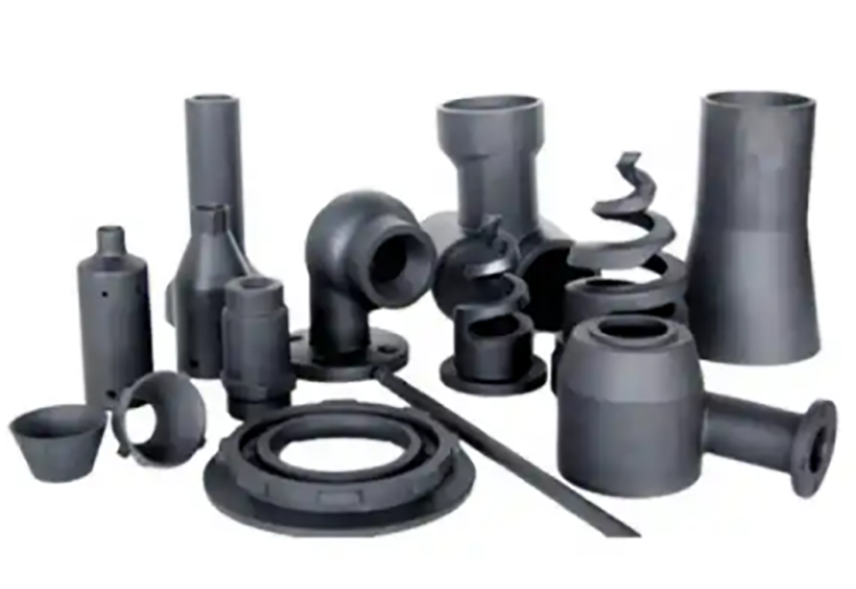
At YICHOU, our RBSiC process allows for near-net-shape casting of complex internal geometries. We produce spiral, vortex, and multi-stage nozzles that would be impossible to machine from hard metals.
-
Spiral Nozzles: These designs use a helical insert to create a full-cone pattern with large free passages. YICHOU's SiC spiral nozzles feature free passage diameters significantly larger than traditional whirlpool nozzles, making them highly resistant to clogging while still producing fine droplets.
-
Angle Stability: We guarantee spray angle deviation of less than <3° over the entire lifespan of the nozzle. This precision ensures that the absorption tower has no "dead zones" where untreated gas can slip through, maintaining compliance with EPA or local emissions standards.
5. Thermal Shock Resilience: Managing Rapid Temperature Spikes
Perhaps the most common failure mode for ceramic components is thermal shock. Imagine a quench tower in a steel mill: the nozzle is at ambient temperature one second, and the next, it is hit by a blast of high-temperature gas followed immediately by a spray of cool water. This rapid expansion and contraction creates immense internal stress that fractures less robust materials.
SiC is uniquely suited to handle this due to two properties:
-
Low Coefficient of Thermal Expansion (CTE): SiC expands and contracts very little with temperature change—approximately one-third that of tungsten carbide and one-fifth that of zirconia. This minimizes the stress generated during thermal transients.
-
High Thermal Conductivity (80–120 W/m·K for pure SiC): This allows the material to dissipate heat quickly, preventing localized hot spots that lead to cracking. In fact, SiC's thermal conductivity approaches that of some metals, making it exceptional among ceramics.
Real-World Performance:
YICHOU's RBSiC nozzles are engineered to tolerate thermal transients of up to 250°C per minute. This makes them the ideal choice for cyclic operations like peak-load power plants or batch processing in the metallurgical industry, where daily start-stop cycles would rapidly destroy metallic alternatives.
.jpg)
6. Lifecycle Cost Analysis: The "Investment" vs. "Expense"
When procurement departments see the initial price tag of a high-quality SiC nozzle, there can be sticker shock. However, sophisticated operations know that price is paid once, but cost is paid forever. The "Cost of Ownership" model proves the superiority of SiC.
A Comparative Analysis (FGD Application):
| Factor | Standard Hardened Alloy Nozzle | YICHOU RBSiC Nozzle |
|---|---|---|
| Initial Cost | Low | Higher |
| Lifespan | 3–6 months | 2–5 years (verified) |
| Failure Mode | Orifice wear → pressure drop → pattern distortion | Minimal wear; erosion is slow and predictable |
| Maintenance Frequency | Quarterly replacement | Biannual inspection only |
| Hidden Costs | Labor, crane time, disposal, lost efficiency | None |
| Downtime Risk | High (unplanned failures) | Zero (predictable performance) |
The Verdict:
While a SiC nozzle may cost more upfront, its operational lifespan often exceeds that of metal nozzles by a factor of 10x or more. Customers report that with YICHOU nozzles, they see virtually no wear and no corrosion during multi-year operation. When you factor in the cost of a single unplanned shutdown—which can run into hundreds of thousands of dollars in lost production—the ROI on SiC becomes undeniable.
7. Customization at YICHOU: Engineering to Your Specs
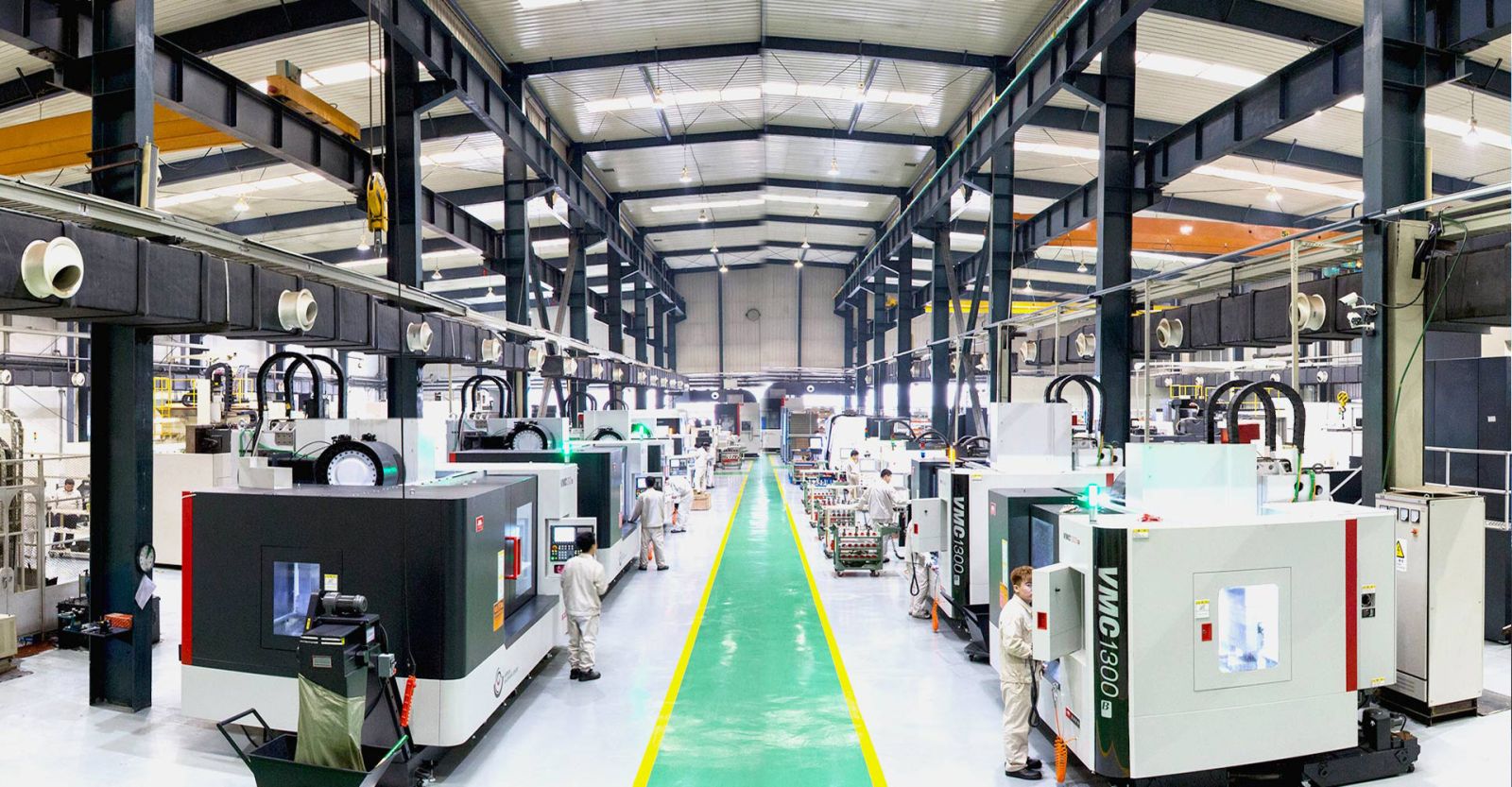
At YICHOU, we understand that every system is unique. We don't just sell nozzles; we engineer flow control solutions. Our factory is equipped to take your project from a CAD concept to a finished ceramic product.
Our Customization Capabilities:
-
Geometries: We can produce custom spiral, hollow cone, full cone, and multichannel nozzles tailored to your specific flow rate and pressure drop requirements. Whether you need 30° narrow-angle or 150° wide-angle distribution, we can deliver.
-
Interfaces: Whether you need NPT, BSPT threads, DIN flanges, or custom mounting sleeves, our precision machining holds tolerances to ±0.03 mm on critical interfaces.
-
Quality Control: Every nozzle batch undergoes rigorous testing. We conduct flow rate verification, pressure tolerance tests up to 1.5x operating pressure, and non-destructive testing (NDT) to detect any micro-cracks or inclusions. Every part that leaves our facility is mission-ready.
Visit our website at www.nbyichou.com to view our standard sizing charts and technical drawings.
8. FAQ: Expert Advice for Systems Engineers
Q: Can SiC nozzles handle hydrofluoric acid (HF) in cleaning cycles?
A: While all ceramics have limitations with HF, YICHOU's RBSiC features a dense microstructure that offers excellent resistance to a wide range of acids, including HCl and $H_2SO_4$ at elevated temperatures. For cycles involving HF, we recommend consulting with our engineers to analyze the specific concentration, temperature, and exposure duration to determine suitability.
Q: What is the maximum pressure rating for YICHOU's reaction-bonded SiC nozzles?
A: Our standard RBSiC nozzles are designed to operate reliably in systems up to 10 bar (145 psi) . For high-pressure applications requiring up to 30 bar, we can engineer sintered SiC (SSiC) variants with enhanced flexural strength exceeding 250 MPa. Contact our engineering team with your specific requirements.
Q: How do I prevent mechanical impact damage during installation?
A: Unlike metals, ceramics do not yield; they are brittle. Installation should be done with care. We recommend:
-
Using torque wrenches set to specified limits (provided with each order)
-
Ensuring the nozzle pocket is clean and free of debris
-
Using anti-seize compounds on threads (where chemically compatible)
-
Avoiding impact tools or hammering
YICHOU provides detailed installation guides with every order to prevent over-torquing, which is the leading cause of mechanical damage.
Q: Can you provide material certifications and test reports?
A: Absolutely. Every YICHOU shipment can be accompanied by material certification, dimensional inspection reports, and hydrostatic test certificates upon request. We maintain full traceability from raw material batch to finished product.
9. Conclusion: Reliable Flow Control in the Toughest Environments
In the battle against erosion, corrosion, and high temperatures, Silicon Carbide stands as the undisputed champion. It transforms the nozzle from a consumable spare part—a necessary evil—into a durable, high-performance component of your engineering system.
By choosing YICHOU's advanced RBSiC nozzles, you are not just buying a piece of ceramic; you are investing in uptime, efficiency, and peace of mind. You are protecting your operation from the crippling costs of unplanned downtime and ensuring that your emissions control or combustion system performs at peak efficiency, year after year.
The choice is simple: Continue replacing failed metal nozzles every quarter, or make the switch to SiC and forget about nozzle maintenance for years.
Stop replacing nozzles every quarter. Make the switch to long-term reliability.
Consult with our engineers for a custom SiC solution or download our technical Nozzle Catalog today.
Contact us today for a competitive quote and technical support!
Let Yichou help you achieve excellence in your next project. Whether you need raw materials, custom alloy solutions, or precision-manufactured components, our team is ready to assist.
- Email us: [email protected]
- Call us/whatsapp: +86 13355741031
- Chat with us: Live chat support available on our website