.jpg)
Meta Description:
Explore the definitive guide to Clad Pipes. Understand their purpose, the explosion welding process, key differences from lined pipe, and why yichou Clad Piping offers a superior, cost-effective solution for corrosive and high-pressure applications in Oil & Gas, Chemical, and Power industries.
Clad Pipes: The Ultimate Guide to Metallurgical Bonding, Performance, and Industrial Application
Introduction: The Engineering Imperative for Advanced Piping Solutions
In the intricate circulatory systems of modern industry—from the depths of offshore oil fields to the heart of chemical processing plants—piping is not merely a conduit; it is the first line of defense against some of the most aggressive environments on earth. Traditional monolithic pipes, whether carbon steel or solid alloy, frequently present a compromise: sacrificing either cost, structural strength, or corrosion resistance. This fundamental challenge is the catalyst for an advanced engineering solution: Clad Pipes (Explosion Welded Clad Pipes).
As a leading manufacturer at the forefront of yichou composite pipe technology, we recognize that specifying the correct piping system is a critical decision with long-term implications for project integrity, operational expenditure, and safety. This definitive guide delves deep into the world of clad piping, exploring its core purpose, sophisticated manufacturing processes, and decisive advantages over alternatives, establishing why yichou Clad Pipes represent the pinnacle of performance for demanding industrial applications.
1. What is a Clad Pipe? Deconstructing the Composite Architecture
At its core, a Clad Pipe is a composite material system engineered by metallurgically bonding a Corrosion-Resistant Alloy (CRA) layer (the cladding) to a high-strength, economical backing material (the substrate), typically carbon steel or low-alloy steel.
This is not a mechanical assembly but a molecular-level fusion:
-
The Substrate (e.g., ASTM A516 Gr. 70 Carbon Steel): Serves as the structural "backbone," providing the mechanical integrity to withstand internal pressure, external loads, and structural stresses. It is the cost-effective workhorse of the composite.
-
The Cladding (e.g., 316L Stainless Steel, Duplex 2205, Inconel 625, Hastelloy C276): Acts as the "protective shield," forming the internal bore that directly contacts the process media. It is specifically selected for its exceptional resistance to corrosion, erosion, and high-temperature oxidation.
Crucial Terminology: Cladding vs. Lining vs. Coating
The term "cladding" refers explicitly to a metallurgical bond. This permanent, atomic-level union, achieved through processes like explosion welding, creates a single, integral material. This stands in stark contrast to a "liner" (a physically separate tube inserted into a host pipe) or a "coating" (a thin, superficially applied layer). The yichou Clad Pipe is defined by this robust, metallurgical bond, ensuring performance under the most severe conditions.
2. The Fundamental Purpose of Cladding: Beyond Basic Corrosion Protection
The implementation of cladding is a strategic engineering decision driven by multiple, interconnected imperatives that extend far beyond simple corrosion control.
-
Unmatched Corrosion and Erosion Resistance: This remains the primary driver. In Oil & Gas production, fluids containing H₂S (sour service), CO₂, chlorides, and free water can decimate standard carbon steel in a matter of years. The CRA cladding in a yichou composite pipe acts as an impervious barrier, extending asset life from years to decades and preventing catastrophic failures.
-
Dramatic Life-Cycle Cost Reduction (40-70% Savings): While the initial cost of a clad pipe is higher than carbon steel, it is drastically lower—often 5 to 10 times less—than a pipe made entirely from solid CRA. This optimal use of expensive alloy material makes advanced corrosion protection economically viable for large-scale projects.
-
Superior Structural and Mechanical Performance: Carbon steel substrates offer superior tensile strength, toughness, and pressure-bearing capacity compared to many softer, solid CRAs. This makes clad piping indispensable for high-pressure flow lines, subsea risers, and thick-walled reactor vessels where mechanical integrity is non-negotiable.
-
Enhanced Safety and Asset Integrity: By virtually eliminating internal corrosion as a failure mode, clad pipes significantly reduce the risk of leaks, spills, and unplanned shutdowns. This proactive approach to asset integrity management safeguards personnel, the environment, and operational continuity.
3. Clad Pipe vs. Lined Pipe: A Critical Performance-Based Distinction
The confusion between "clad" and "lined" pipe is common, but the performance implications are profound. Understanding this distinction is critical for correct material selection.
| Feature | Clad Pipe (Metallurgically Bonded) | Lined Pipe (Mechanically Assembled) |
|---|---|---|
| Bonding Mechanism | Metallurgical Bond. Atomic diffusion creates a permanent, wavy interface with high shear strength. | Mechanical Fit/Adhesive. Relies on interference fit, swaging, or adhesives. No atomic-level bonding. |
| Thermal Performance | Excellent resistance to thermal cycling and high temperatures. The bond expands and contracts as one. | High risk of liner collapse (buckling) under vacuum or external pressure. |
| Mechanical Integrity | Behaves as a homogeneous material. Excellent resistance to external pressure, bending, and vibration. | Prone to liner wrinkling, "guitar-stringing," and detachment under vibration or thermal cycling. |
| Fabrication & Welding | Can be bent, forged, and welded using qualified procedures that maintain corrosion resistance at joints. | Subsequent fabrication is highly restricted and risks damaging the loose liner. |
| Lifecycle Cost | Higher initial cost, but lower total cost of ownership due to reliability and longevity. | Lower initial cost, but high risk of premature failure, downtime, and maintenance. |
| Ideal Applications | Critical, high-P/T, dynamic loading: Subsea pipelines, process piping, pressure vessels, reactors. | Non-critical, low-P/T, stable services: Water lines, temporary bypasses, mild chemical transport. |
The Verdict is Clear: For any critical, high-integrity application where failure is not an option, Clad Pipe is the unequivocal superior choice. yichou specializes in providing this high-reliability solution.
4. The Manufacturing Process: How is Pipe Cladding Achieved?
The creation of a high-integrity clad pipe is a sophisticated multi-stage process. yichou employs and masters two primary world-class techniques:
4.1 Explosion Cladding (Explosion Welded Clad Pipe)
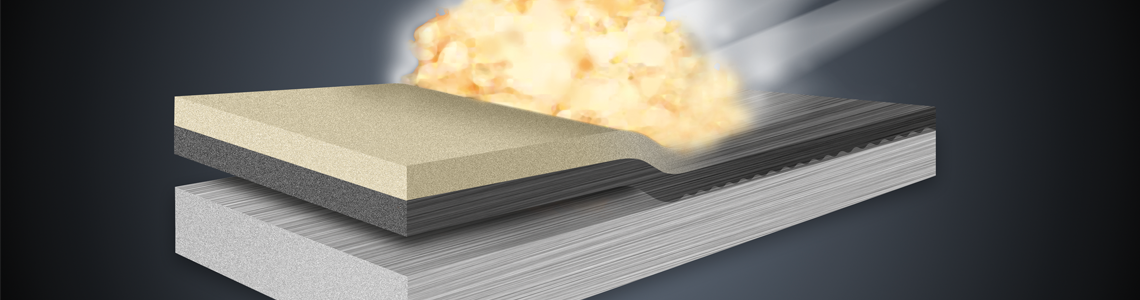
This is a highly specialized and powerful solid-state welding process.
-
Preparation: The CRA cladding plate is positioned parallel to the carbon steel substrate plate with a precise stand-off distance.
-
Detonation: A carefully calculated layer of explosive is laid on top of the cladding. Upon detonation, the controlled explosion drives the cladding plate across the gap at an extreme velocity (hundreds of m/s).
-
Bond Formation: The high-velocity collision generates immense pressure at the interface, ejecting surface impurities (jetting effect) and causing localized plastic deformation. This creates a strong, metallurgical bond, typically characterized by a wavy interface morphology that mechanically locks the materials together.
Advantages of yichou Explosion Cladding: Ability to bond virtually any dissimilar metal combination, exceptionally high bond strength, and excellent resistance to thermal shock.
4.2 Roll Bonding Cladding
This process involves thermomechanical bonding.
-
Heating: The stacked substrate and cladding plates are heated in a furnace to a specific temperature.
-
Rolling: The heated pack is passed through a heavy-duty rolling mill, where immense pressure (thousands of tons) is applied.
-
Diffusion Bonding: The combination of heat and pressure plastically deforms the metals and promotes atomic diffusion across the interface, creating a solid-state weld.
Advantages of yichou Roll Bonding: Highly efficient for large-volume production, produces a flatter interface suitable for thinner claddings, and offers excellent dimensional control.
Post-Cladding Fabrication:
After the plate is clad, it is then formed into a pipe seam (e.g., JCOE or UOE forming) and the longitudinal seam is welded. This weld is performed using specialized cladding in welding techniques, such as the use of strip cladding or specific CRA weld wires, to ensure the corrosion-resistant properties are continuous across the weld seam.
5. Key Applications: Where Clad Pipes are Indispensable
-
Oil & Gas Industry: Subsea flowlines & risers, topside process piping, separator internals, wellhead components handling sour hydrocarbons.
-
Chemical & Petrochemical Processing: Reactors, distillation columns, heat exchangers, and catalyst feed lines exposed to acids, caustics, and other aggressive chemicals.
-
Power Generation: Flue Gas Desulfurization (FGD) systems, scrubber vessels, and boiler components combating acidic condensates.
-
Marine & Offshore: Seawater injection pipes, ballast systems, and hull structural components requiring resistance to saltwater corrosion.
6. The yichou Advantage: Engineering Excellence in Composite Pipes
Our commitment at yichou is to deliver more than just a product; we deliver a guaranteed performance solution.
-
Material Science Expertise: We provide expert guidance on selecting the optimal cladding/substrate combination (e.g., Duplex Steel for chloride environments, Nickel Alloys for high temperatures) for your specific service conditions.
-
Advanced NDE & Quality Assurance: Every yichou Clad Pipe undergoes rigorous Non-Destructive Examination, including 100% UT (Ultrasonic Testing) of the bond interface to ensure zero disbonding, in compliance with ASTM B898 and other international standards.
-
Integrated Welding Solutions: We supply qualified welding consumables and detailed Welding Procedure Specifications (WPS) to ensure field fabrication and installation maintain the integrity of our pipes.
-
Global Project Support: From technical consultation to logistics, our team supports projects of any scale, anywhere in the world.
7. Frequently Asked Questions (FAQ)
Q: Is cladding a fire risk?
A: This question often arises from building facade incidents (e.g., Grenfell Tower). For industrial metallic pipe cladding, this is not a concern. The materials used (steels, nickel alloys) are inherently non-combustible. Our focus is on internal corrosion protection.
Q: What is the difference between PVC and cladding?
A: This is a confusion of terms. PVC is a thermoplastic polymer used for low-pressure water and drainage systems. Cladding, in our context, is a metallurgical process for creating high-performance bimetallic composites for severe service. They are entirely different technologies.
Q: What is the purpose of cladding in welding?
A: In the context of "cladding" as a welding process (e.g., Weld Overlay), it refers to depositing a CRA layer onto a base metal surface to create a corrosion-resistant surface. This is similar in purpose to roll-or explosion-bonded clad plate but achieved through a different, additive manufacturing technique. yichou specializes in the bonded product form.
Q: What is clad thickness and how is it determined?
A: Clad thickness is the nominal thickness of the corrosion-resistant alloy layer. It is determined based on the corrosion rate of the service environment, the design life of the asset, and a mandatory corrosion allowance. Standard thicknesses range from 3mm to 12+ mm.
Q: Why is clad pipe important as opposed to other types of pipe?
A: It is important because it uniquely solves the "corrosion-strength-cost" trilemma. Solid alloy pipe is prohibitively expensive, carbon steel corrodes too quickly, and lined pipe lacks mechanical reliability. Clad pipe is the only solution that delivers high performance in all three areas simultaneously.
Conclusion: Specifying for Success with yichou Clad Pipes
In an era of increasingly challenging industrial environments and heightened focus on asset integrity, the choice of piping material has never been more critical. Clad pipes, with their robust metallurgical bond, offer an engineered solution that transcends the limitations of traditional materials.
By choosing yichou Clad Pipes, you are not just purchasing a pipe; you are investing in decades of safe, reliable, and cost-effective operation. Our expertise in explosion and roll bonding, combined with an unwavering commitment to quality, ensures that we deliver a product that stands up to the most rigorous demands.
Contact the yichou experts today to discuss your project requirements and discover how our clad pipe solutions can optimize your design, enhance your safety, and protect your bottom line.
Get in Touch with Yichou
Let Yichou help you achieve excellence in your next project. Whether you need raw materials, custom alloy solutions, or precision-manufactured components, our team is ready to assist.
- Email us: [email protected]
- Call us/whatsapp: +86 13355741031
- Chat with us: Live chat support available on our website