Meta Description: Discover the science & benefits of explosive welding/cladding. As a leading manufacturer, we provide high-performance, corrosion-resistant clad metal plates for petrochemical, power, and marine industries. Request a quote today!
.jpg)
Introduction: Confronting the Ultimate Material Challenge
In the relentless pursuit of industrial progress, engineers and designers constantly face a fundamental dilemma: how to harness the distinct, often contradictory, properties of different metals in a single, reliable component. How do you combine the formidable strength and structural economy of carbon steel with the exceptional corrosion resistance of titanium or zirconium? How do you merge the superior electrical conductivity of copper with the lightweight durability of aluminum for critical electrical transitions? Conventional methods like overlay welding or mechanical lining often fall short, introducing weaknesses, imperfections, or prohibitive costs.
This is where a revolutionary, physics-driven process steps in to shatter the compromise: Explosive Welding (also known as Explosive Cladding).
Far from being a mere niche technique, explosive cladding is the cornerstone of manufacturing high-integrity clad metal plates—bimetallic materials that are indispensable in the most demanding environments on earth and sea. At [Your Company Name], we are not just manufacturers; we are pioneers and masters of this advanced technology. We partner with industries where failure is not an option to deliver clad plate solutions that offer unparalleled safety, performance, and lifecycle cost savings.
This definitive guide will delve into the science, advantages, applications, and critical selection criteria for explosively welded clad plates, demonstrating why this process is the gold standard for joining dissimilar metals.
Part 1: Demystifying the Process - What is Explosive Welding/Cladding?
At its core, explosive welding is a solid-state welding process. This is its first crucial distinction: the metals join without melting their bulk volumes. Instead, they unite through a controlled, high-velocity collision orchestrated by precisely engineered explosives.
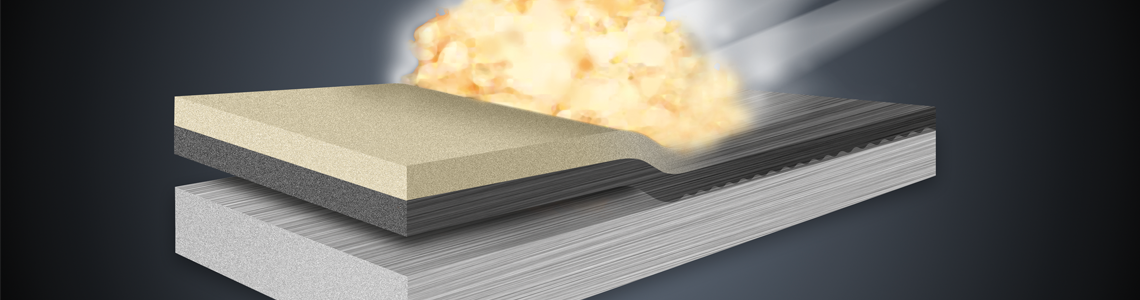
Imagine two metal plates: the base plate (or backing metal, typically a robust, economical alloy like carbon or stainless steel) is positioned horizontally on a heavy anvil. The cladder plate (the corrosion-resistant or functionally specialized metal like titanium, nickel alloy, or copper) is suspended parallel above it at a precise stand-off distance. A layer of specialized explosive is carefully placed on top of the cladder plate.
Upon detonation, initiated from one edge, a high-pressure detonation wave sweeps across the cladder plate. This accelerates the cladder plate downwards at an extreme velocity—reaching several hundred meters per second—and at a precise angle towards the base plate.
The Magic of the "Jet" and the Metallurgical Bond
As the two plates collide at this extreme angle and velocity, something extraordinary happens. The intense pressure at the collision point causes the surface layers of both metals to behave like a fluid. This high-velocity oblique impact creates a forward-spraying "jet." This jet is the secret to the bond's purity; it strips away the oxidized, contaminated surface layers of both metals, ejecting them ahead of the collision point.
What remains are two perfectly clean, nascent metal surfaces that are brought into intimate atomic contact under enormous pressure. This contact, under these pristine conditions, results in a true metallurgical bond. The interface typically exhibits a characteristic wavy morphology (see diagram below), a hallmark of explosive welding. These waves are not merely aesthetic; they signify a massive increase in bonding surface area and mechanically lock the metals together, creating a bond whose shear strength often exceeds the yield strength of the weaker parent metal.
(Insert a high-quality schematic diagram or cross-sectional micrograph here showing the wavy interface between two metals.)
Key Takeaway: Unlike fusion welding, explosive welding:
-
Avoids a Heat-Affected Zone (HAZ): No thermal degradation of metal properties.
-
Prevents Brittle Intermetallics: For many dissimilar pairs (like Ti/Steel), melting creates brittle compounds. The solid-state process avoids this entirely.
-
Ensures 100% Bond Integrity: No porosity, slag inclusions, or cracks associated with melt processes.
Part 2: The Unbeatable Advantages of Choosing Explosively Clad Plate
Why do leading engineering firms and fabricators specify explosively clad plates over alternatives? The benefits are profound and multifaceted.
-
Unmatched Bond Strength and Integrity: The metallurgical bond is not a glue or a mechanical interlock; it is a new metal continuum. This bond exhibits exceptional performance under cyclic loading, thermal stress, and shear forces, making it ideal for pressure vessels, heat exchangers, and critical structural components.
-
Preservation of Original Metal Properties: Since the parent metals do not melt, they retain their intrinsic qualities. The stainless steel cladding remains fully corrosion-resistant, the copper retains 100% of its IACS conductivity, and the high-strength low-alloy base plate keeps its toughness. You get the perfect synergy of properties without compromise.
-
Limitless Material Compatibility: This is perhaps the most powerful advantage. Explosive welding can join metal combinations that are otherwise considered unweldable. Our capabilities at [Your Company Name] include, but are not limited to:
-
Reactive Metals to Steel: Titanium, Zirconium, Tantalum to Carbon Steel or Stainless Steel.
-
Dissimilar Stainless Alloys: Duplex/Super Duplex to Carbon Steel.
-
Non-Ferrous to Ferrous: Copper, Aluminum, Brass, Nickel Alloys (Inconel, Monel, Hastelloy) to Steel.
-
Transition Joints: Aluminum to Copper, Titanium to Aluminum for specialized electrical and aerospace applications.
-
-
Superior Interface Quality for Fabrication: The clad plate you receive is an ideal feedstock. It can be cut, machined, and—most importantly—fusion welded using standard shop techniques tailored to each layer. The consistent, defect-free interface ensures no delamination during subsequent rolling, forging, or forming into heads, shells, and tubes.
-
Optimal Economic Efficiency: Using a solid 20mm thick titanium plate is astronomically expensive and often over-specified. A titanium clad steel plate with a 3mm titanium layer bonded to 17mm carbon steel provides the exact same corrosion barrier at a fraction of the cost. Explosive cladding places the premium material exactly where it is needed.
-
Design Flexibility and Scalability: We produce clad plates in large formats, minimizing welds in final fabrication. We also create complex geometries like explosively welded tubesheets, pipe-to-tube joints, and transition joints for pre-fabricated assemblies.
Part 3: Critical Applications Across Global Industries
Explosively clad plates are the silent workhorses in facilities where safety, longevity, and reliability are paramount.
-
Chemical & Petrochemical Processing: In reactors, columns, and autoclaves handling aggressive acids (sulfuric, hydrochloric) and caustics at high temperatures. Zirconium or Tantalum clad steel is often the only viable solution.
-
Oil & Gas (Upstream, Midstream, Downstream): For Floating Production Storage and Offloading (FPSO) vessels, subsea components, sour service piping and separators (where H₂S is present), and refinery heat exchangers. Duplex stainless steel or Nickel alloy cladding protects against chloride-induced stress corrosion cracking and sour gas attack.
-
Power Generation:
-
Flue Gas Desulfurization (FGD) Systems: Massive ductwork and scrubbers handling wet, corrosive sulfurous gases rely on high-alloy cladding.
-
Nuclear & Conventional Plants: Components in condensers, feedwater heaters, and spent fuel pools.
-
-
Marine & Shipbuilding: Seawater-cooled heat exchangers, hull components for specialized vessels, and ballast systems where corrosion resistance is critical.
-
Pulp & Paper Industry: Digesters and bleaching vessels exposed to corrosive chloride and acidic environments.
-
Specialized Engineering: Transition joints in cryogenic plant construction, vacuum chamber construction, and specialized electromagnets.
Part 4: Beyond the Plate: The [Your Company Name] Advantage
Choosing a clad plate supplier is a critical decision. It's a partnership that hinges on technical expertise, consistent quality, and a deep understanding of end-use application. Here’s what sets [Your Company Name] apart as your ideal partner.
-
Deep Technical Mastery & Consultation: Our metallurgists and process engineers don't just take orders; they consult. We help you select the optimal material pair, clad ratio, and plate dimensions for your specific service conditions, ensuring performance and cost optimization.
-
Rigorous, Multi-Stage Quality Assurance:
-
Material Certification: All incoming base and cladding metals are certified to ASTM/ASME/EN standards.
-
Process Precision: Every explosive parameter—charge type, geometry, stand-off distance—is meticulously calculated for each job.
-
Non-Destructive Examination (NDE): 100% of the bond interface is inspected using Ultrasonic Testing (UT) to ASTM B898 standards. We provide detailed UT scan maps, guaranteeing bond integrity over every square centimeter.
-
Destructive Testing: Witness coupons undergo tensile shear testing and macro/microstructural analysis to validate bond strength and interface quality.
-
-
Full-Service Capability: We are a one-stop solution. From initial consultation and explosive cladding to post-cladding heat treatment, precision machining, rolling, and even fabrication of sub-assemblies, we provide an integrated service that reduces your supply chain risk.
-
Commitment to Global Standards: Our production and quality systems are designed to meet the most stringent international pressure vessel and construction codes, including ASME Section VIII, PED 2014/68/EU (CE Marking), ISO 15620, and major class society approvals (DNV, ABS, etc.).
-
Proven Track Record: We have successfully delivered clad plate solutions for offshore platforms in the North Sea, chemical plants in Asia, and power facilities across the Americas. Our project portfolio speaks to our global reliability.
Part 5: Frequently Asked Questions (FAQ)
Q: What is the typical bond strength of an explosively clad plate?
A: The shear strength of the bond interface typically exceeds the minimum specified yield strength of the weaker of the two parent metals. Standard requirements are often 140 MPa or 200 MPa minimum, but our results are frequently significantly higher.
Q: Can explosive clad plates be formed?
A: Yes, excellently. They can be cold or hot formed, rolled into cylinders, and pressed into dish or hemispherical heads. The superior bond integrity prevents delamination during these processes.
Q: How do I weld a clad plate?
A: Standard fusion welding techniques are used, but with a specific procedure. The base metal is welded first, followed by a buffer or transition layer, and finally the cladding metal is welded using its appropriate filler material. We provide detailed Welding Procedure Specifications (WPS) for every clad plate we deliver.
Q: What are the size limitations?
A: We can produce very large plates (e.g., widths over 4m, lengths over 15m) and also handle very thick sections. The minimum cladding thickness can be as low as 1.5mm, and base plates from 10mm upwards.
Q: How does cost compare to weld overlay?
A: For thinner cladding layers (typically <10mm), explosive cladding is almost always more economical than weld overlay when you factor in material efficiency (no dilution), speed of production, and superior, inspection-ready bond quality. For thicker overlays, weld overlay may compete, but with potential compromises in material properties and inspection certainty.
Conclusion: Partner with the Experts in Metallurgical Innovation
Explosive welding is not just a manufacturing process; it is an enabling technology that allows for daring engineering in hostile environments. It solves the fundamental material conflicts that constrain design and ensures the longevity and safety of critical industrial assets.
Choosing the right partner for your clad plate needs is a decision that impacts the integrity of your project for decades. At [Your Company Name], we combine decades of explosive welding expertise with a relentless focus on quality, customer collaboration, and technical support.
Don't compromise on material performance or project safety.
Ready to Engineer with Confidence?
Contact our technical sales team today
Request a formal quotation for your next project.
Download our detailed Clad Plate Property and Specification Guide to inform your design.
Let us demonstrate how our explosively clad solutions can provide the ultimate performance for your most demanding applications.
Get in Touch with Yichou
Let Yichou help you achieve excellence in your next project. Whether you need raw materials, custom alloy solutions, or precision-manufactured components, our team is ready to assist.
- Email us: [email protected]
- Call us/whatsapp: +86 13355741031
- Chat with us: Live chat support available on our website