Meta Description: Dive deep into titanium forging. Learn why it's the top choice for aerospace, medical, and jewelry like titanium rings, understand the complex process, costs, and why partnering with an expert manufacturer is crucial. Your ultimate resource from industry leaders.
Introduction: The Alloy of the Future, Forged Today
Titanium. The very name evokes images of cutting-edge technology, from sleek jet fighters piercing the clouds to life-changing medical implants and elegant, indestructible rings. This remarkable metal, symbolized as Ti on the periodic table, possesses a legendary combination of properties: it boasts the strength of many steels at nearly half the weight, exceptional corrosion resistance that puts stainless steel to shame, and complete biocompatibility. But how do we transform this exceptional material into the critical components that modern industry relies on? The answer, for the most demanding applications, is forging.
At [Your Company Name], we don't just work with titanium; we master it through the precise art and science of titanium forging. This process is not merely shaping metal; it's fundamentally refining its internal structure to unlock performance levels unattainable by any other means. Whether it's a landing gear component for an aircraft, a prosthetic joint for a patient, or a beautifully durable forged titanium ring, forging is the key. This comprehensive guide will explore every facet of titanium forging, answering your most pressing questions and illuminating why it remains the gold standard for high-integrity parts.
Section 1: Understanding Titanium Forging – More Than Just Shaping Metal
Forging is a manufacturing process where metal is compressed and shaped under immense pressure, often while heated. Unlike casting (pouring molten metal) or machining (cutting material away), forging works the metal, aligning its internal grain structure along the lines of stress. For titanium, this is transformative.
Why Forge Titanium? The Compelling Advantages:
-
Superior Strength & Fatigue Resistance: Forging eliminates internal voids and porosity common in castings. It creates a continuous grain flow that follows the part's contour, dramatically increasing its strength, toughness, and resistance to fatigue failure—critical for parts undergoing repeated stress.
-
Enhanced Structural Integrity: The hot-working process refines the coarse microstructure of the original titanium billet, resulting in a finer, more uniform grain. This leads to more predictable and isotropic mechanical properties (similar strength in all directions).
-
Improved Reliability: Forged parts have a proven track record of reliability. This is non-negotiable in aerospace, where component failure is catastrophic, and in medical implants, where patient safety is paramount.
-
Material Efficiency: While near-net-shape forging can minimize waste, even standard forging is often more material-efficient for high-strength parts than starting with a large block and machining away most of it.
Common Applications of Forged Titanium:
-
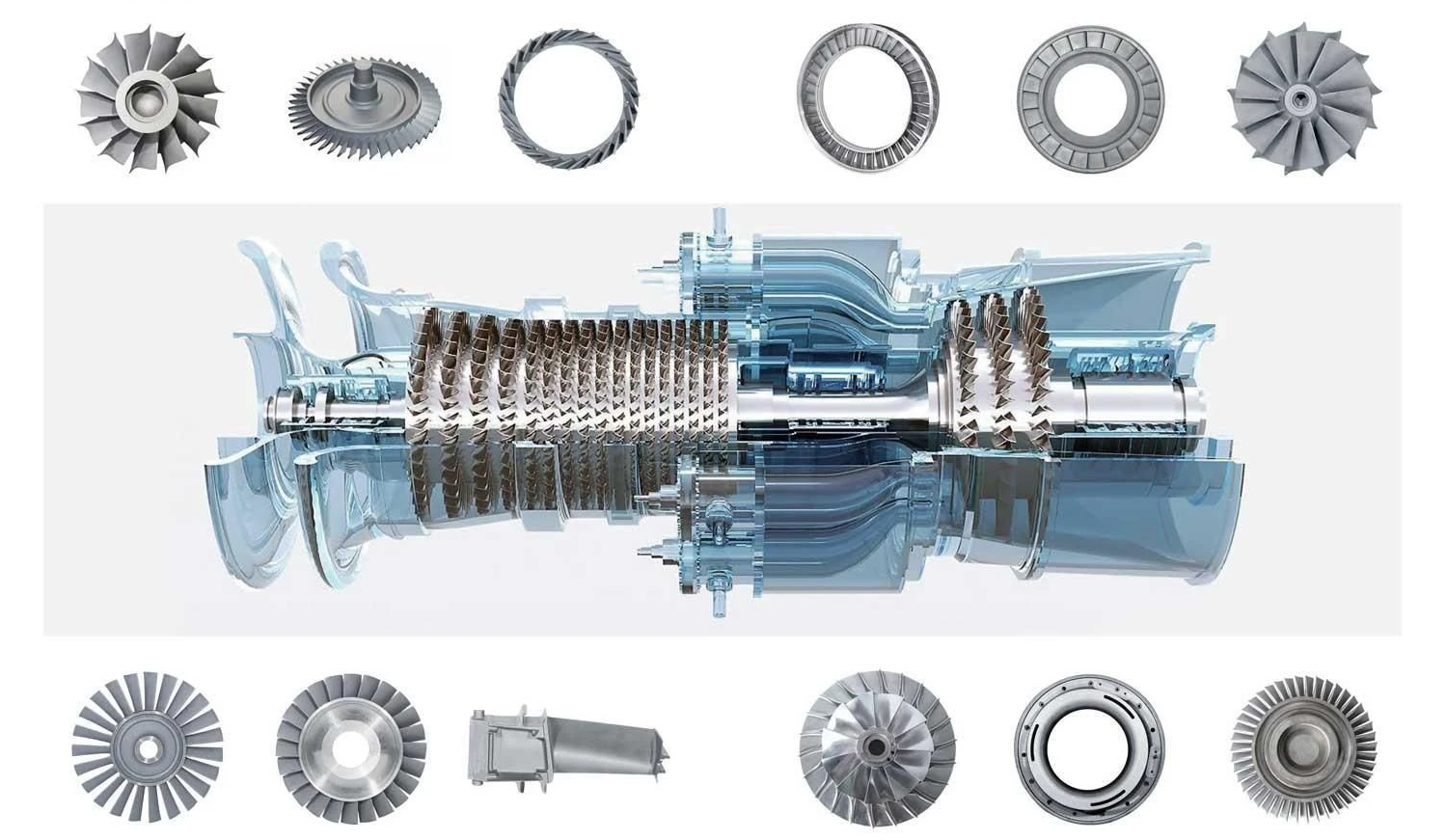
Aerospace: Engine components (fan discs, blades), airframe structures, landing gear parts, and fasteners.
-
Medical: Hip and knee joint replacements, spinal implants, bone plates, and surgical instruments.
-
Industrial: Critical components for chemical processing, marine, and oil & gas applications due to corrosion resistance.
-
Consumer & Specialty: High-performance bicycle frames, golf club heads, and increasingly, premium jewelry—most notably, titanium rings known for their strength and lightweight comfort.
Section 2: The Titanium Forging Process – A Dance with Heat and Force
Forging titanium is a precise operation that demands respect for the material's unique characteristics.
1. The Crucial Forging Temperature
Titanium is typically forged at temperatures between 1500°F and 1800°F (815°C and 982°C). This "hot-working" range is high enough to make the metal malleable without causing excessive grain growth or phase changes that could degrade its properties. Precise temperature control is vital; too low, and the titanium will crack; too high, and it becomes brittle.
2. The Forging Environment: Shielding from the "Enemy"
Titanium's greatest strength is also a forging challenge: its high reactivity. At forging temperatures, titanium readily combines with oxygen and nitrogen in the air, forming a brittle, surface layer called "alpha case." This contaminated layer must be prevented or removed, as it can cause cracking.
-
Solution: Forging is often performed in controlled environments. This can range from using protective coatings on the billet to forging inside vacuum chambers or under an inert argon gas shield—a standard practice for premium manufacturers like us.
3. Forging Methods
-
Open-Die Forging: The workpiece is compressed between flat or simple-shaped dies. It's used for larger, simpler parts or as a preparatory step to refine the ingot structure before closed-die forging.
-
Closed-Die (Impression) Forging: The titanium billet is pressed into matching die cavities that impart the final, complex shape. This is used for high-volume production of parts like connecting rods or turbine blades, offering excellent dimensional accuracy.
Can Titanium Be Cold Forged?
While possible for some simple, small shapes, cold forging of titanium is extremely limited due to its high strength and low ductility at room temperature. It requires enormous forces and risks cracking. Hot forging is the standard and reliable method.
Section 3: The Art of the Forged Titanium Ring
The forge titanium ring is a perfect case study in applying industrial excellence to consumer goods. Here’s why forging is the preferred method for creating heirloom-quality titanium jewelry:
-
Unrivaled Durability: A forged ring has a worked grain structure, making it significantly more resistant to impact and deformation compared to a cast ring.
-
Superior Finish: The forging process allows for intricate designs and a superior metal finish that polishes to a deep, lasting luster.
-
Material Purity: Forging avoids the micro-porosity that can occur in casting, resulting in a denser, more homogeneous band.
-
The "Feel": Forging enables the creation of rings with substantial visual presence that remain incredibly light on the finger, a unique characteristic of titanium.
When you choose a forged titanium ring, you are choosing a piece of wearable engineering, where form and supreme function unite.
Section 4: Titanium Forging FAQ – Answering Your Top Questions
Let's tackle the most common queries head-on, drawing from the industry's most searched topics.
Q1: Is titanium good for forging?
A: Absolutely. While challenging, forging is the best way to produce the highest-strength, most reliable titanium components. Its benefits far outweigh the processing difficulties for critical applications.
Q2: How hard is it to forge titanium?
A: It is considerably more difficult than forging steel or aluminum. The challenges include its high reactivity (requiring shielding), narrow forging temperature window, and high strength at elevated temperatures, which demands more powerful forging equipment.
Q3: What is the cost of titanium?
A: Titanium is a premium material. The cost of 1 kg of titanium (as a raw mill product like billet) can vary widely based on grade, form, and market conditions, but it often ranges from $30 to $100+ per kg. Therefore, 1 lb of titanium can be worth roughly $15 to $45. Finished forged titanium parts cost significantly more due to the complex processing, expertise, and material loss involved.
Q4: Why don’t we make knives out of titanium?
A: While titanium knives exist for niche uses (corrosion-resistant dive knives), they are poor for everyday cutting. Titanium cannot be hardened to the level of high-carbon steel, meaning it won't hold a sharp edge as long. Its excellence lies in strength-to-weight and corrosion resistance, not edge retention.
Q5: Will a magnet stick to titanium?
A: No. Titanium is a paramagnetic metal. It exhibits a very weak attraction to extremely strong magnetic fields but is effectively non-magnetic. This is a key identifying feature and a benefit in many applications.
Q6: What metals cannot be forged?
A: Brittle metals with low ductility are poor candidates for forging. Prime examples include cast iron and certain high-carbon tool steels in their hardened state. They would crack under the forging pressure.
Q7: What is the "enemy" of titanium during forging?
A: Oxygen and nitrogen. As mentioned, exposure to air at high temperatures causes contamination and embrittlement. Hydrogen is another concern, as it can cause hydrogen embrittlement.
Q8: Do you weld titanium on AC or DC?
A: DC (Direct Current) is used almost exclusively for welding titanium. The process must be performed with an inert gas shield (like argon) covering both the front and back of the weld to prevent contamination—a technique known as Gas Tungsten Arc Welding (GTAW/TIG) with trailing shields.
Section 5: Titanium vs. Other Forged Metals: A Comparative Analysis
-
vs. Steel: Titanium is about 45% lighter than steel with comparable strength. It is far more corrosion-resistant but more expensive and harder to forge and machine.
-
vs. Aluminum: Titanium is significantly stronger and more heat-resistant than aluminum alloys, but it is heavier and far more costly. Aluminum is much easier and cheaper to forge.
-
vs. Superalloys (Inconel, etc.): Titanium offers a better strength-to-weight ratio at lower to medium temperatures. Superalloys excel in extreme heat environments (e.g., jet engine hot sections) but are denser and often even more difficult to process.
Verdict: Titanium is the optimal choice when the design mandate is maximum strength with minimum weight, coupled with outstanding corrosion resistance.
Section 6: The Critical Role of an Expert Titanium Forging Manufacturer
Given the complexities, not every machine shop can forge titanium successfully. Partnering with a specialist is essential. At [Your Company Name], we provide:
-
Advanced Metallurgical Expertise: Deep understanding of titanium alloys (Grades 1-5, 23, etc.), their phases, and forgeability.
-
Controlled Environment Forging: Utilizing protective atmospheres and vacuum furnaces to prevent contamination.
-
Full Process Control: From certified raw material sourcing to precise heat treatment (critical for titanium) and final NDT (Non-Destructive Testing like ultrasound).
-
Industry-Specific Compliance: Adherence to stringent standards like AS9100 (aerospace), ISO 13485 (medical), and ITAR.
-
Collaborative Engineering: Working with clients to design for forgeability, optimizing parts for performance and cost-effectiveness.
Section 7: The Future of Titanium Forging
The landscape is evolving:
-
Advanced Alloys: Development of new, more forgeable, and higher-strength titanium alloys.
-
Isothermal Forging: A precision technique forging in a vacuum or inert gas at a constant, super-plastic temperature, allowing for complex, near-net-shape parts with minimal waste.
-
Competition from Additive Manufacturing (3D Printing): While excellent for complex prototypes and low-volume, intricate parts, forging still reigns supreme for the highest-integrity, high-volume structural components due to its superior material properties.
-
Growing Markets: Demand is rising in renewable energy (wind turbine components), automotive (performance and lightweighting), and consumer electronics (like Apple's exploration with titanium watch cases and phone frames).
Conclusion: Forging the Future with Titanium
Titanium forging stands at the intersection of ancient craftsmanship and modern metallurgical science. It is a demanding process, fraught with challenges from heat management to atmospheric control. Yet, the result is unparalleled: components that are stronger, lighter, and more reliable than those made by any other method.
From the struts of spacecraft to the beating heart of a medical implant, and onto the finger as a symbol of enduring strength in a titanium ring, forged titanium is the invisible backbone of innovation. Its value lies not just in the material cost per pound, but in the performance, safety, and longevity it delivers.
we are passionate about transforming this extraordinary metal into the solutions of tomorrow. If your project demands the ultimate in performance and reliability, let's discuss how our titanium forging expertise can bring your vision to life.
Contact us today for a consultation on your next titanium forging project.
Get Quote
- Visit our website: https://www.nbyichou.com/
- Email us: [email protected]
- Call us/whatsapp: +86 13355741031
- Chat with us: Live chat support available on our website